

Incident Report Template

Table of Contents

Introduction

What happens when a forklift operator suddenly brakes to avoid a pedestrian crossing an aisle? If the forklift stops in time, no one gets injured, and operations continue as normal. And of course, many organizations would consider this a non-event.

But the site’s EHS manager must see it differently.

They must immediately initiate an incident report, document the near miss, interview witnesses, review CCTV footage, and discover what had blocked visibility at the intersection. And, of course, corrective actions must be implemented within a week.

So when another forklift could approach the same intersection. This time, a contractor may unexpectedly walk across the aisle. Because of the earlier corrective measures, both individuals saw each other in time and avoided what could have become a serious injury.

This story illustrates why an effective incident report template is one of the most important tools in an organization’s EHS management system. It transforms workplace events into learning opportunities and helps organizations prevent future incidents before they escalate.

Why Incident Reporting Matters

Many organizations still view incident reports as administrative paperwork. But in reality, incident reporting is a leading indicator of safety performance.

  • According to the International Labor Organization (ILO), approximately 395 million workers worldwide suffer non-fatal occupational injuries every year, while nearly 3 million people die annually due to work-related accidents and diseases.

  • Another global study found that around 49% of workplace harm incidents go unreported, limiting organizations’ ability to identify risks and implement preventive measures.
  • The ILO also emphasizes that effective recording, notification, and investigation systems are critical for improving occupational safety and health outcomes.

For Indian industries—whether manufacturing, construction, pharmaceuticals, chemicals, automotive, logistics, power, or infrastructure—timely incident reporting is essential for:
  • Preventing recurrence
  • Identifying root causes
  • Supporting compliance requirements
  • Improving safety culture
  • Protecting employees and contractors
  • Reducing operational disruptions
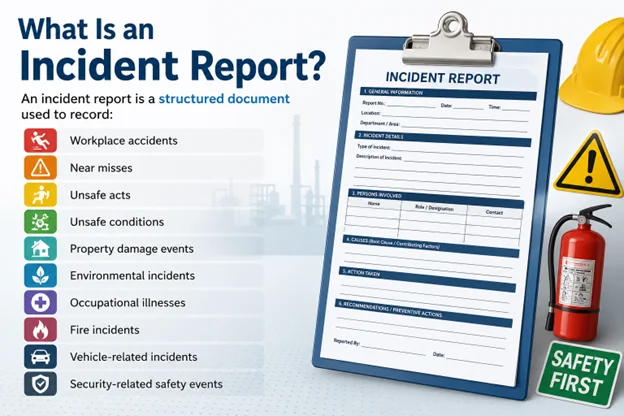
What is an incident report

Step-by-Step Incident Report Template
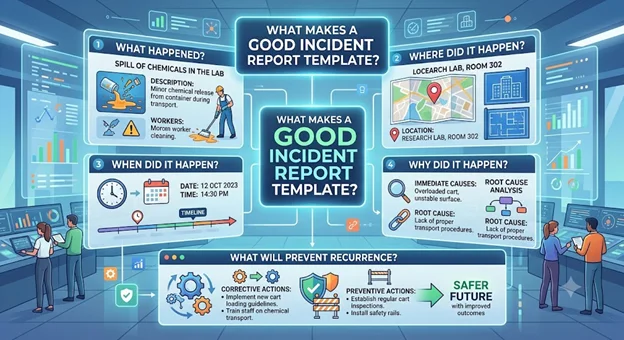
Steps of Incident Report Template

Below is a practical framework for EHS teams.

Section 1: Basic Incident Information

Capture:

  • Incident number
  • Date
  • Time
  • Department
  • Plant/site name
  • Reporting person
  • Incident category

Section 2: Location Details

Include:

  • Building
  • Floor
  • Production line
  • Work area
  • GPS location (for remote sites)

Section 3: Persons Involved

Document:

  • Employee name
  • Contractor details
  • Witnesses
  • Supervisor
  • Injured person (if applicable)

Information to capture:

  • Designation
  • Employee ID
  • Experience level
  • Shift details

Section 4: Incident Description

This section should contain only facts.

For example, it must not be described as “Operator was careless and caused the accident.”

But it must be described in detail, such as: “Operator’s hand came into contact with the rotating shaft while adjusting material alignment during machine operation.”

Because facts support effective investigations.

Section 5: Classification of Incident

Common categories include:

  • Safety Incidents
  • Near Misses
  • Property Damage
  • Environmental Incidents
  • Fire and Emergency Events

Section 6: Immediate Actions Taken

Record emergency response actions.

Examples:

  • Area isolated
  • Equipment shut down
  • Injured employee treated
  • Spill contained
  • Fire extinguished

This information demonstrates a timely response.

Section 7: Root Cause Analysis

This is the heart of the incident report. Methods commonly used include:

  • 5 Why Analysis
  • Fishbone Diagram
  • Fault Tree Analysis

Section 8: Corrective Actions

Corrective actions address the immediate cause.

Examples:

  • Replace the damaged guard
  • Repair defective equipment
  • Update SOP

Section 9: Preventive Actions

Preventive actions eliminate future risk.

Examples:

  • Conduct training
  • Redesign workstations
  • Improve traffic management plans
  • Install engineering controls

Section 10: Approval and Closure

Include:

  • Investigation team
  • Department manager
  • EHS manager
  • Closure date
  • Verification of effectiveness

Incident closure should occur only after actions are verified.

Common Mistakes in Incident Reporting

Many organizations miss valuable learning opportunities because their incident reporting practices are weak. Common mistakes include

  • delayed reporting, which reduces accuracy;
  • blame-focused investigations, which discourage people from reporting;
  • incomplete data, such as missing witness statements;
  • ignoring near misses, even though they often reveal serious hazards,
  • Closing reports too early before corrective actions are properly verified.

For example, if a forklift nearly hits a pedestrian but the near miss goes unreported, the same hazard could cause a serious injury later.

Digital Incident Reporting: The Future of EHS

Organizations are increasingly moving away from paper-based reporting. Digital incident reporting systems offer:

  • Mobile reporting
  • Real-time notifications
  • Photo and video attachments
  • Automated workflows
  • Corrective action tracking
  • Analytics dashboards
  • Regulatory documentation support

For multi-site organizations, digital reporting improves visibility and accelerates response times.

This is where integrated EHS platforms such as TECH EHS help organizations streamline incident management, standardize reporting processes, and ensure corrective actions are tracked to completion across locations.

Building a Strong Reporting Culture

Building a strong reporting culture is essential, because even the best incident-reporting template will fail if employees are afraid to report incidents. High-performing organizations create psychological safety so employees can report without fear of punishment, encourage near-miss reporting to recognize proactive behavior, involve leadership by having managers actively review incidents, and provide timely feedback so employees can see how their reports lead to improvements. When workers see visible action taken on reported incidents, reporting rates improve significantly.

The Business Value of Incident Reporting

An effective incident reporting system provides:

  • Reduced injuries
  • Lower operational disruptions
  • Better compliance performance
  • Improved contractor management
  • Stronger safety culture
  • Better ESG reporting
  • Enhanced operational resilience

More importantly, it helps organizations prevent serious incidents before they occur. Every major incident leaves behind warning signs, and incident reports help organizations identify them early.

Conclusion

An incident report template is far more than a compliance document. It is a learning tool that transforms workplace events into actionable safety improvements.

A well-structured incident report captures facts, identifies root causes, drives corrective actions, and strengthens organizational learning. The organizations that excel in safety are not those with the fewest incidents. They are the organizations that learn the fastest from every incident, near miss, unsafe act, and unsafe condition.

FAQs

An incident report template is a standardized form used to document workplace accidents, near misses, unsafe conditions, environmental events, and property damage incidents.
Incident reporting helps identify hazards, determine root causes, implement corrective actions, and prevent future incidents.
It should include incident details, location, people involved, description, causes, corrective actions, preventive actions, and approval records.
Incidents should be reported immediately or as soon as practicable after occurrence to ensure accurate investigation and response.
Yes. Near misses provide valuable information about hazards and often reveal risks before injuries occur.
Digital reporting enables real-time reporting, faster investigations, action tracking, automated notifications, and centralized safety analytics.

EHS Software

Our web-based and mobile-ready HSE software solutions are a comprehensive platform for small, mid-size, and large enterprises to streamline EHS processes and standardize information management.

Solve your EHS challenges and streamline safety operations with our help.

5.4 min read Views: 196 Categories: Safety Software

About the Author: Purva Mishra

Purva Mishra
Purva Mishra is a seasoned content strategist with years of experience in creating high-impact B2B digital content. She focuses on simplifying complex topics in safety, compliance, and digital transformation. Her work helps organizations translate safety strategy into actionable, scalable solutions.