
Table of Contents
Introduction
‘Unified workforce’ is a myth in modern EPC projects. A typical project may involve an EPC contractor, several major contractors, specialist subcontractors, labor suppliers, and workers from multiple countries, all entering the site at different stages of construction.
That creates a challenge that goes beyond conducting a safety induction.
Every contractor may bring their own training materials, terminology, onboarding process, competency records and interpretation of site requirements. When contractors operate in isolation, one safety standard quickly mutates into multiple, confusing versions.
Research from the Construction Safety Research Alliance has also found that workers identify only about 45% of hazards during pre-job safety meetings. A 2026 industry initiative is now calling for more consistent safety language because the same hazards are not always described or understood in the same way across job sites. (Construction Dive)
For EPC companies, the lesson is clear:
Safety induction should be treated as part of a standardized contractor safety assurance system, not simply as a presentation workers complete before receiving site access.
Why It Matters Especially for GCC’s EPC Projects
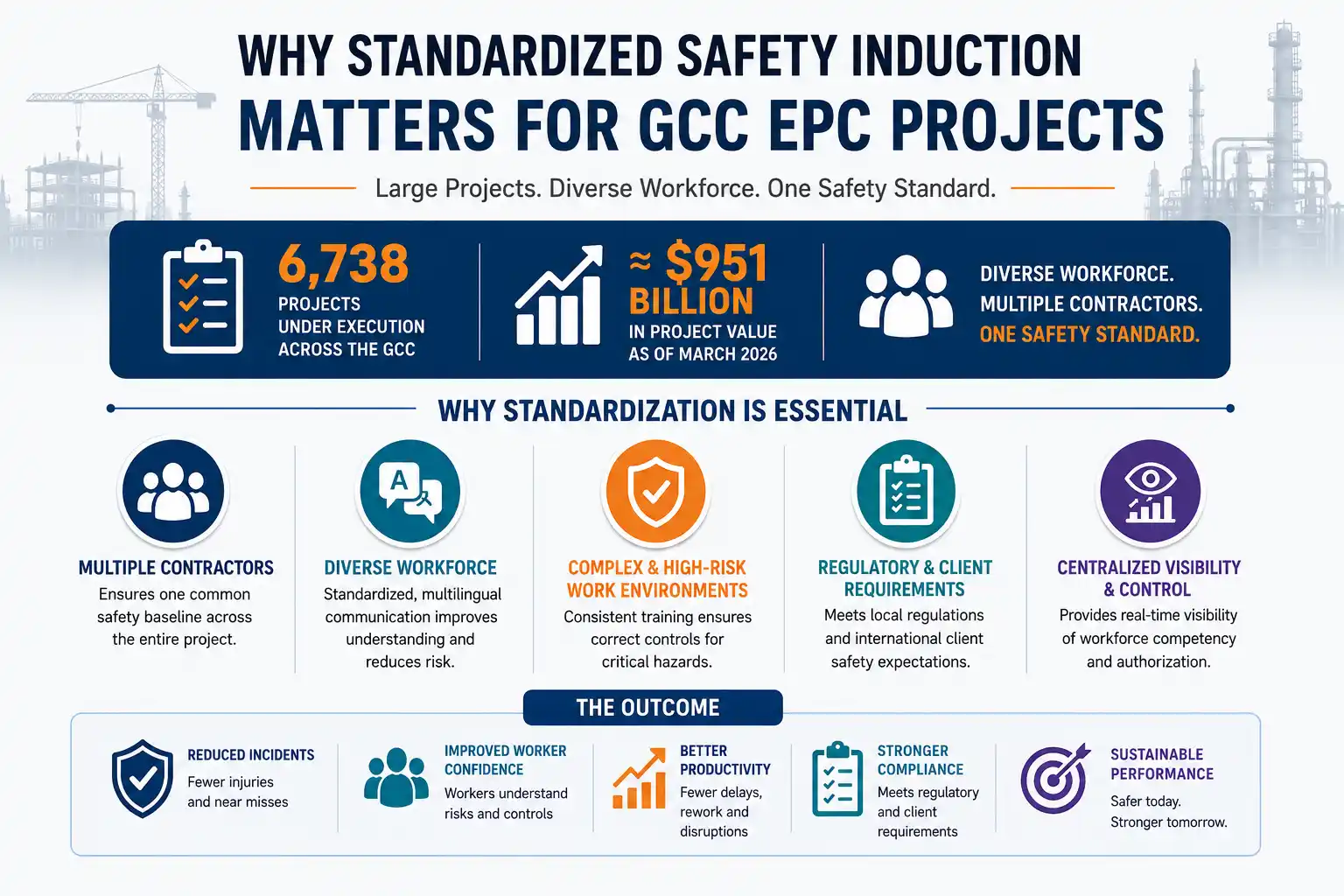
MEED reported 6,738 projects under execution across the GCC with a combined value of approximately $951 billion in March 2026, illustrating the scale of project activity across the region. (MEED): 6,738 Projects Underway in the Gulf States Worth $951 Billion – Maaal
Saudi Arabia and the UAE remain the dominant project markets, alongside Qatar, Oman, Kuwait and Bahrain, who also contribute to significant infrastructure, energy, industrial and development programs. AECOM’s 2026 MENA construction review notes that access to labor remains an important consideration for the region’s construction sector. MENA construction market review | AECOM Insights
Thus, the need for standardized contractor safety induction is particularly pronounced across EPC projects here, where large, multi-contractor developments bring together diverse workforces, specialist contractors and rapidly changing work fronts.
Workforce diversity adds another safety challenge. Research on GCC construction sites has found substantial gaps between the languages used to deliver safety information and those understood by workers, with more than 55% of surveyed respondents reporting such a mismatch. Potential of Virtual Design Construction Technologies to Improve Job-Site Safety in Gulf Corporation Council
For EPC companies operating across the GCC, standardized induction therefore needs to address more than contractor consistency. It must also provide common safety terminology, multilingual communication, consistent competency requirements, and centralized visibility across contractors and projects.
Why Contractor Onboarding and Mobilization Matter
Standardization should begin before workers arrive at the gate.
During project mobilization, the EPC company can establish the common requirements that every contractor must follow. These should cover:
A practical workflow is:
Contractor onboarding → Worker registration → Credential verification → Pre-arrival induction → Competency verification → Authorization → Site access
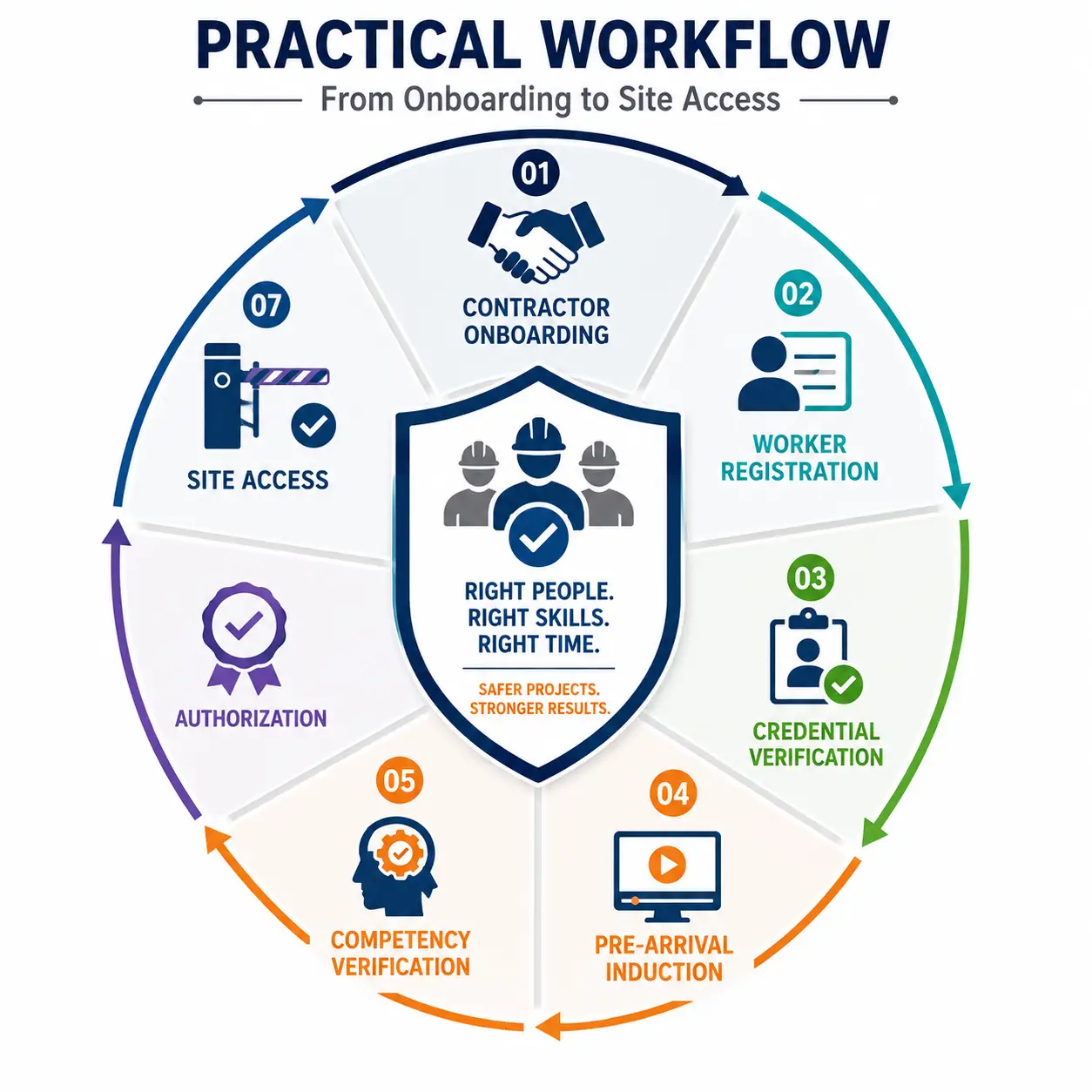
This proactive approach creates a seamless mobilization process, ensuring a smooth transition to the site rather than creating a bottleneck at the gate.
Standardize the Framework, Not Every Training Detail
A common mistake is to interpret standardization as making every worker complete exactly the same induction.
That can create unnecessary training while still failing to address task-specific risks.
A better model is a Layered induction structure:
| Layer | Who needs it? | Typical content |
|---|---|---|
| Core site induction | Everyone | Site rules, emergency response, PPE, reporting, access, stop-work authority and critical risks |
| Contractor/trade induction | Relevant groups | Scope-specific hazards, equipment, interfaces and procedures |
| High-risk/task modules | Authorized workers | Confined space, lifting, electrical, hot work, excavation, work at height, commissioning, etc. |
This creates a common safety baseline while allowing the induction to reflect the worker’s actual exposure.
Standardize Hazard Language Across Contractors
Safety terminologies are often overlooked and inconsistent. If one contractor uses one term for a hazard and another uses a different classification, workers may recognize the condition but fail to connect it with the same control requirements.
EPC companies can create a common terminology framework for critical concepts.
| Safety concept | Standardized project terminology |
|---|---|
| Stored/released energy | Energy hazard |
| Restricted work area | Exclusion zone |
| Simultaneous activities | SIMOPS |
| Work authorization | Permit to work |
| Emergency assembly area | Muster point/Assembly point |
| Authority to stop unsafe work | Stop-work authority |
| Critical controls | Life-saving/critical controls |
The goal is not to control every word contractors use. It is to ensure that critical safety concepts have the same meaning across the project.
Make Multilingual and Visual Communication Part of the Standard
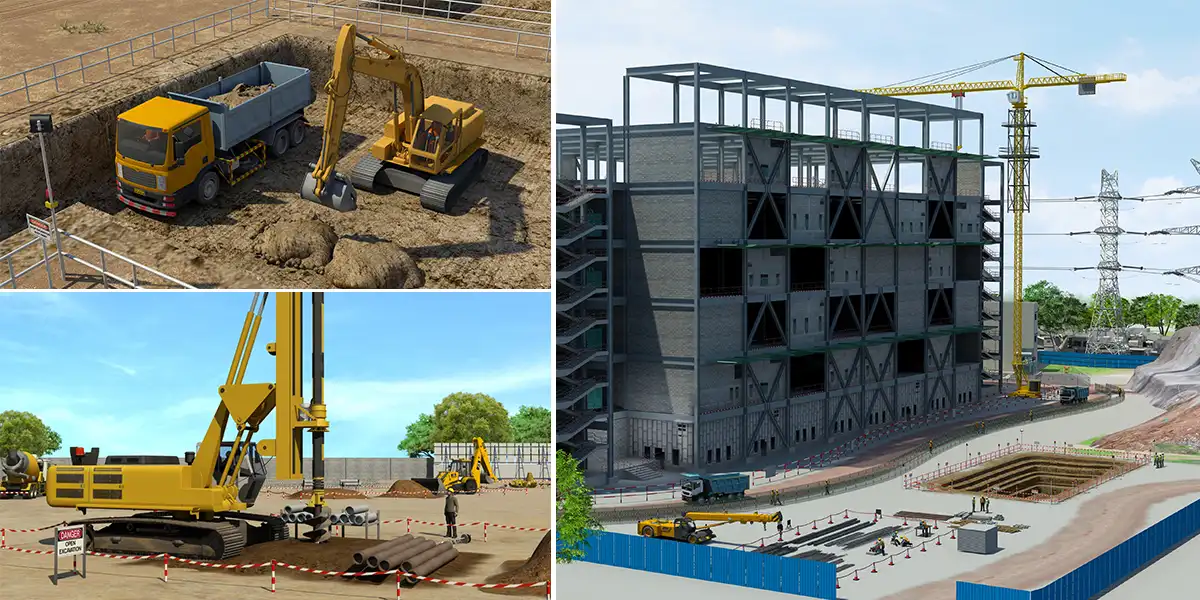
A standardized induction should also be understandable. On multinational EPC projects, translating an English presentation into another language does not automatically guarantee comprehension. Workers may also have different literacy levels and different levels of familiarity with technical safety terminology. Then comes the challenge of dealing with unskilled workers too, who may need video-based induction to understand it better. A video-based animated safety induction will definitely resonate well with skilled workers, too, as information retention is much higher in this format compared to traditional safety inductions.
OSHA guidance also emphasizes that training should be delivered in a language and vocabulary workers can easily understand. Its safety-management guidance also includes contractor, subcontractor, and temporary-agency workers within the training framework. (OBIS)
EPC companies can improve consistency through:
The principle is simple:
Standardize the safety message, not just the words used to deliver it.
Move Beyond Induction Completion to Competency Verification
One of the most important improvements is to separate four concepts:
Training → Understanding → Competency → Authorization
Completing a module does not automatically prove that a worker can safely perform a high-risk activity.
Depending on the task, an EPC system can therefore combine:
Create Digital HSE Records and Multi-Contractor Visibility
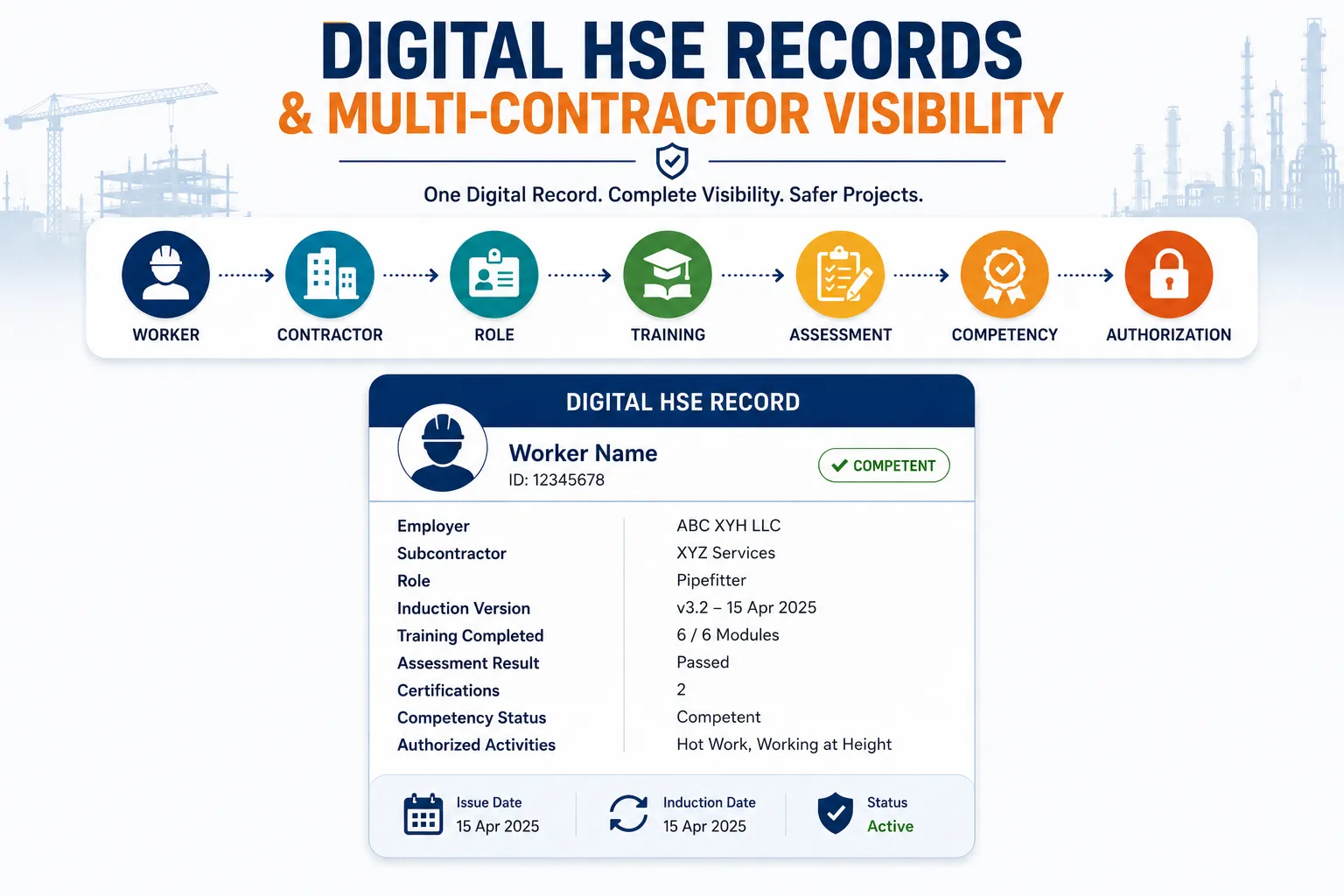
The record should ideally contain:
This allows EHS teams to move from basic completion reporting to project-wide visibility.
For example:
| Contractor | Induction | Competency | Authorization | Expired | Risk flag |
|---|---|---|---|---|---|
| Contractor A | 98% | 95% | 93% | 1% | Low |
| Contractor B | 97% | 82% | 79% | 7% | High |
| Contractor C | 100% | 96% | 95% | 1% | Low |
Illustrative data only.
Instead of asking, “Has everyone been inducted?”, project leadership can ask:
That turns induction data into a leading management signal.
Connect Induction With Permit-to-Work
Permit-to-work should not operate separately from training and competency systems.
For example, a worker who has not completed the required confined-space training should not be eligible for a confined-space permit.
This makes induction an operational control rather than simply an onboarding record.
Make Re-Induction Event-Driven
Safety induction should not depend only on an annual refresher date.
Re-induction may be appropriate when:
| Trigger | Possible response |
|---|---|
| Worker changes role | New role-specific module |
| Worker moves to another project | New site induction |
| Major hazard introduced | Targeted safety module |
| Construction phase changes | Phase-specific induction |
| Serious incident occurs | Lessons-learned module |
| High-potential near miss | Targeted re-induction |
| Procedure changes | Updated induction |
| Certification expires | Competency renewal |
The aim is to keep training aligned with the current risk environment, not simply the calendar.
