

Table of Contents
Introduction
Singapore is known for moving fast. Contractors get pressed for quick turnaround, project timelines get compressed, and every on-site process is expected to move at the pace the schedule demands. Under that kind of pressure, it’s tempting to treat induction time as time borrowed from the job itself. But that’s the incorrect way to look at it. The real issue was never that workers are being trained; it’s that most induction formats take far longer than they need to, without actually improving how much sticks.
Safety training isn’t optional now. Singapore law requires employers to provide workers with adequate instruction, information, training, and supervision to work safely, and specific sectors like construction even require mandatory certified courses. [3][4]
In 2026, MOM (Ministry of Manpower) has stepped up enforcement and is reviewing further measures to strengthen safety ownership and accountability across industry. [2]
The good news is that ‘fast’ and ‘thorough’ aren’t actually opposites. The format of the training matters more than the length of it. Get that right, and you solve a problem that goes well beyond one contractor’s schedule; you solve it across every site, every shift, and every language your workforce speaks.
The Compliance Clock Is Ticking Louder
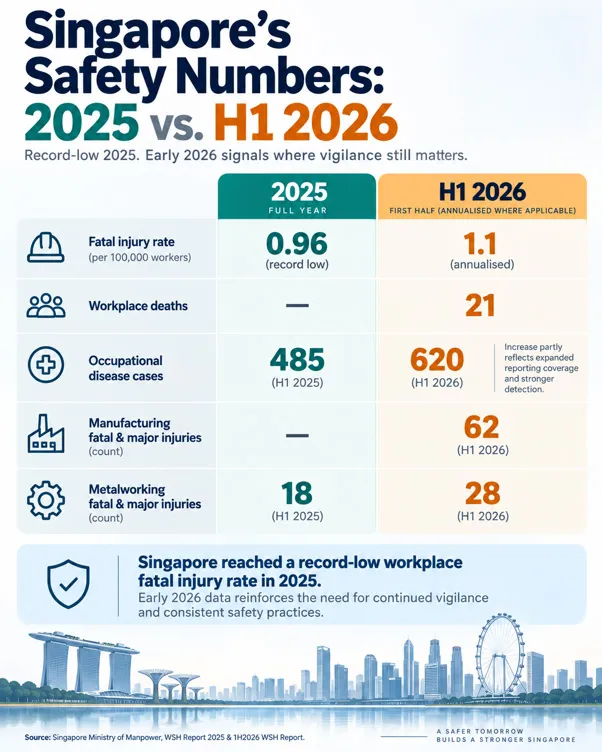
That progress reversed somewhat in 2026. MOM’s first-half report shows the annualized fatal injury rate climbing to 1.1 per 100,000 workers, with 21 deaths recorded and vehicular incidents the leading cause. Occupational disease cases rose to 620, up from 485 in the same period a year earlier. However, MOM attributes part of that increase to expanded reporting coverage under updated legislation rather than a genuine decline in workplace health. [2]
Manufacturing felt this too. The sector logged 62 fatal and major injuries in H1 2026, and metalworking cases specifically climbed from 18 to 28, prompting MOM to maintain higher inspection frequency in that sub-sector. MOM is also reviewing further measures to strengthen WSH ownership and accountability, including tougher enforcement and a review of the bizSAFE program to reflect actual safety performance better. [2]
None of this means Singapore’s workplaces have become dangerous. It reinforces MOM’s broader emphasis on ownership, accountability, and stronger workplace safety practices, rather than treating compliance as a box-ticking exercise.
The Real Cost of a Slow Induction Room
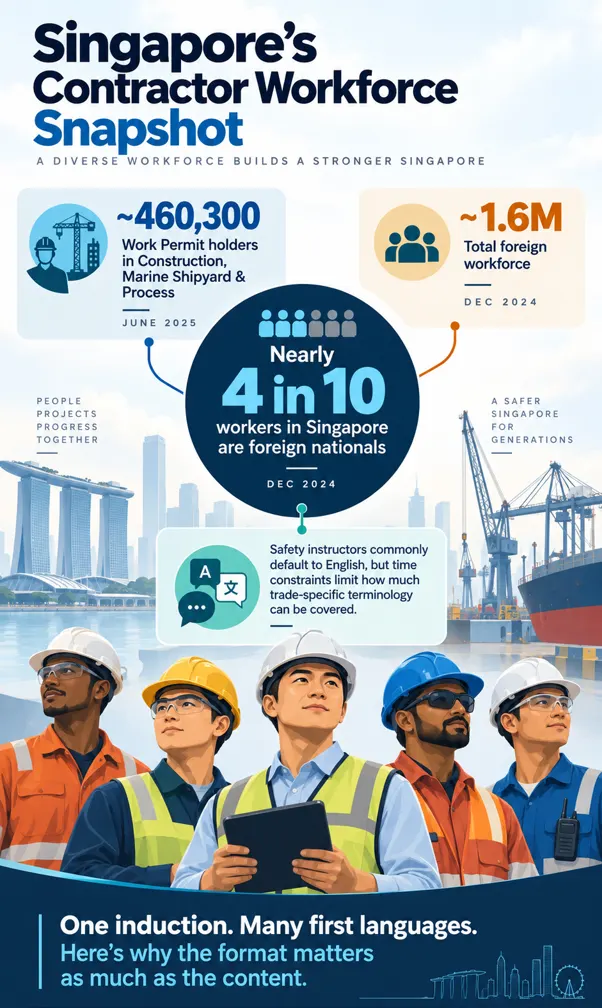
Singapore’s construction, marine, and process sectors run on a large, fast-moving contractor workforce. As of June 2025, MOM recorded roughly 460,300 Work Permit holders across these sectors. [5] Separately, as of December 2024, Singapore’s total foreign workforce stood at close to 1.6 million, making nearly four in ten workers in Singapore foreign nationals. [6] Those two figures come from different reporting dates. Still, together they illustrate the scale of Singapore’s foreign contractor workforce and the potential volume of workers moving through onboarding and safety training.
Workers performing manual labor in construction must complete one of two approved safety courses, the Construction Safety Orientation Course (CSOC) or the Apply Workplace Safety and Health in Construction Sites course, within two weeks of arrival, and pass within three months, or their Work Permit may be revoked. [4]
That’s a lot of people moving through induction rooms, repeatedly, across every site and every subcontractor. The training itself isn’t the problem; delivering the same content live, over and over, is. Every hour a supervisor or EHS officer spends re-running an identical session is an hour they could instead spend on floor walks, hazard checks, or the higher-value parts of the job. Multiply that across a multi-site operation with rotating contractors, and manual re-delivery becomes the real drain, not the training requirement it’s serving.
The Language Wall Nobody Talks About
Here’s the part that rarely makes it into onboarding conversations. Researchers at the National University of Singapore’s Safety and Resilience Research Unit interviewed CSOC instructors. They found that lessons default to English, since it’s the language workers from different countries are most likely to share, but time constraints mean instructors can’t cover the specialized, trade-specific terms a worker will actually encounter on site. [7]
That gap matters. Based on MOM workforce data for December 2024, nearly four in ten workers in Singapore were foreign nationals, drawn from countries with very different first languages. [6] A verbal briefing or a text-heavy slide can only reach as far as the shared vocabulary in the room allows.
The same NUS researchers found that graphics and demonstrations travel across language barriers in a way spoken English can’t, and recommended leaning on speech and visuals rather than text-heavy delivery. [7] Visual sequences don’t eliminate the need for some shared vocabulary, but they reduce how much of the training depends on it.
Why Visual Format Closes the Gap Speed Can’t
This is where the delivery format itself does real work. E-learning has been reported to require less employee time than comparable classroom training. A widely cited Brandon Hall Group benchmark puts the reduction at 40 to 60 percent, though that figure comes from general corporate e-learning research. [9]
The learning-effectiveness side of the story is more nuanced than a single retention percentage can capture. The journal “Safety Science” did a thorough review and analysis examining virtual-reality safety training across industries including construction, fire, aviation, and mining. Their 2024 report found that VR-based safety training outperformed traditional training in knowledge acquisition and information retention. The researchers also flagged how little long-term retention data exists in the field. [8]
It suggests that well-designed technology-assisted safety training can improve learning outcomes compared with traditional approaches, supporting the use of focused animation as part of an HSE induction strategy rather than as a wholesale replacement. Short, focused visual modules paired with knowledge checks and site-specific examples are a more defensible bet than a single long-format lecture trying to cover everything at once.
What Organizational Onboarding ROI Actually Looks Like
Individual speed is one layer. The bigger win sits at the organizational level: standardization and documentation.
When induction content is animated and centrally produced, every worker at every site can see the identical sequence, delivered the same way, regardless of which supervisor is running the session that day or how many times they’ve already repeated it that week. That kind of standardization fits well with MOM’s broader emphasis on ownership and accountability, rather than treating compliance as a box-ticking exercise. [2]
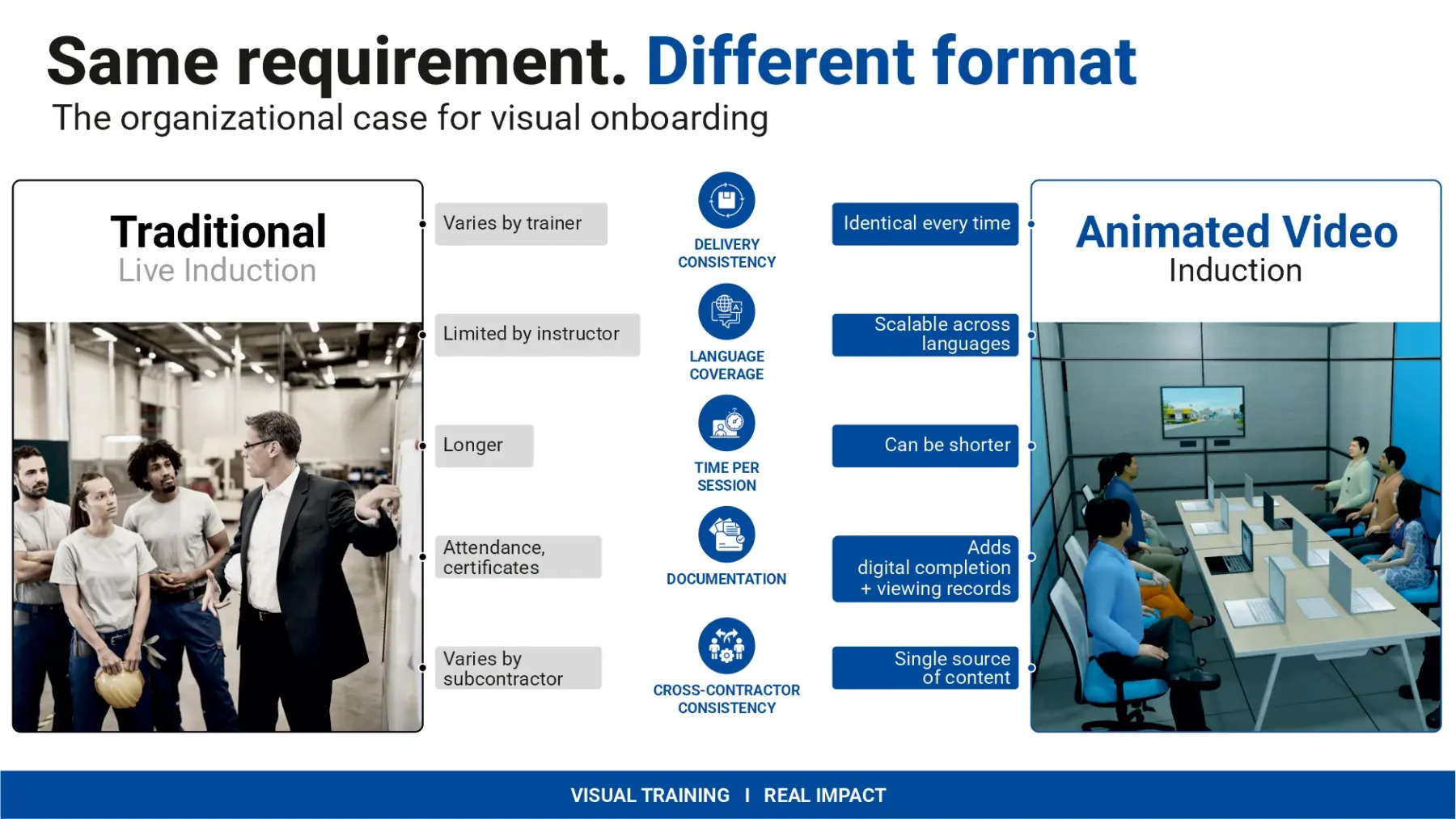
Digital completion and viewing records can support training documentation and follow-up, but it’s worth being precise about what they prove. A recorded viewing timestamp shows that content was assigned and accessed, not that a worker understood it or is competent to perform the task. Pairing video content with a short knowledge check closes that gap and gives you something closer to genuine evidence of training, not just evidence of exposure to it.
References
Singapore-specific sources
1. Ministry of Manpower, Workplace Safety and Health Report 2025 (mom.gov.sg)
2. Ministry of Manpower, Workplace Safety and Health Performance in First Half of 2026 (mom.gov.sg)
3. Workplace Safety and Health Act 2006, Singapore Statutes Online (Attorney-General’s Chambers of Singapore), on employers’ duties to provide adequate instruction, information, training and supervision
4. Ministry of Manpower, Construction sector: Work Permit requirements (mom.gov.sg), on required safety courses for construction migrant workers
5. Dormitory Association of Singapore Limited and Knight Frank, Worker Dormitories in Singapore, H2 2025, citing MOM’s June 2025 foreign workforce data of approximately 460,300 Work Permit holders in the Construction, Marine Shipyard and Process industries
6. DollarsAndSense, Understanding Singapore’s Foreign Workforce Numbers, analysis of MOM foreign workforce data as of December 2024
7. Lim, S.H.M. and Goh, Y.M., National University of Singapore Safety and Resilience Research Unit, Insights from the CSOC: Language Issues in the Communication of Safety Knowledge
Globally sourced research
8. Scorgie, D., Feng, Z., Paes, D., Parisi, F., Yiu, T.W., and Lovreglio, R., Virtual reality for safety training: A systematic literature review and meta-analysis, Safety Science, Vol. 171 (2024)
9. Brandon Hall Group, HCM Outlook Survey findings on e-learning training time, reporting that e-learning typically requires 40% to 60% less employee time than comparable traditional classroom training, as reported by secondary industry sources including Forbes. The figure is used here as a general corporate e-learning benchmark, not as Singapore-specific or safety-specific evidence.
