
Table of Contents
Introduction
Every week, a new AI tool promises to make video and animation production faster. So it’s just natural that clients have a curiosity to ask why we at TECH EHS don’t use it to build HSE animations. The honest answer isn’t that we distrust AI. It’s that HSE animation is not generic content, and the information behind it isn’t ours to risk.
The Legal Warning Nobody’s Talking About
Most conversations about AI and confidential data reach for the same example: Samsung engineers pasting proprietary source code into ChatGPT in 2023, which led the company to restrict generative AI use altogether. It’s a fair example, but it’s also a software story, and HSE animation is not a software problem. It’s an engineering and facilities problem.
A closer parallel comes from construction and engineering law, not tech. A 2026 legal analysis from law firm Bernstein Shur, aimed squarely at the construction industry, makes a point that applies almost word-for-word to HSE animation production: uploading owner-provided geotechnical reports or Building Information Modeling (BIM) files into an AI tool may itself violate confidentiality restrictions, even if the information never becomes public and no breach ever occurs. It’s a whole separate discussion if it does get leaked.
Swap “geotechnical reports and BIM files” for “facility photos, site drawings, and incident reconstruction material,” and you have the exact situation an HSE animation vendor faces.
Here’s what that means in practice for a company that hires a vendor using third-party AI tools:
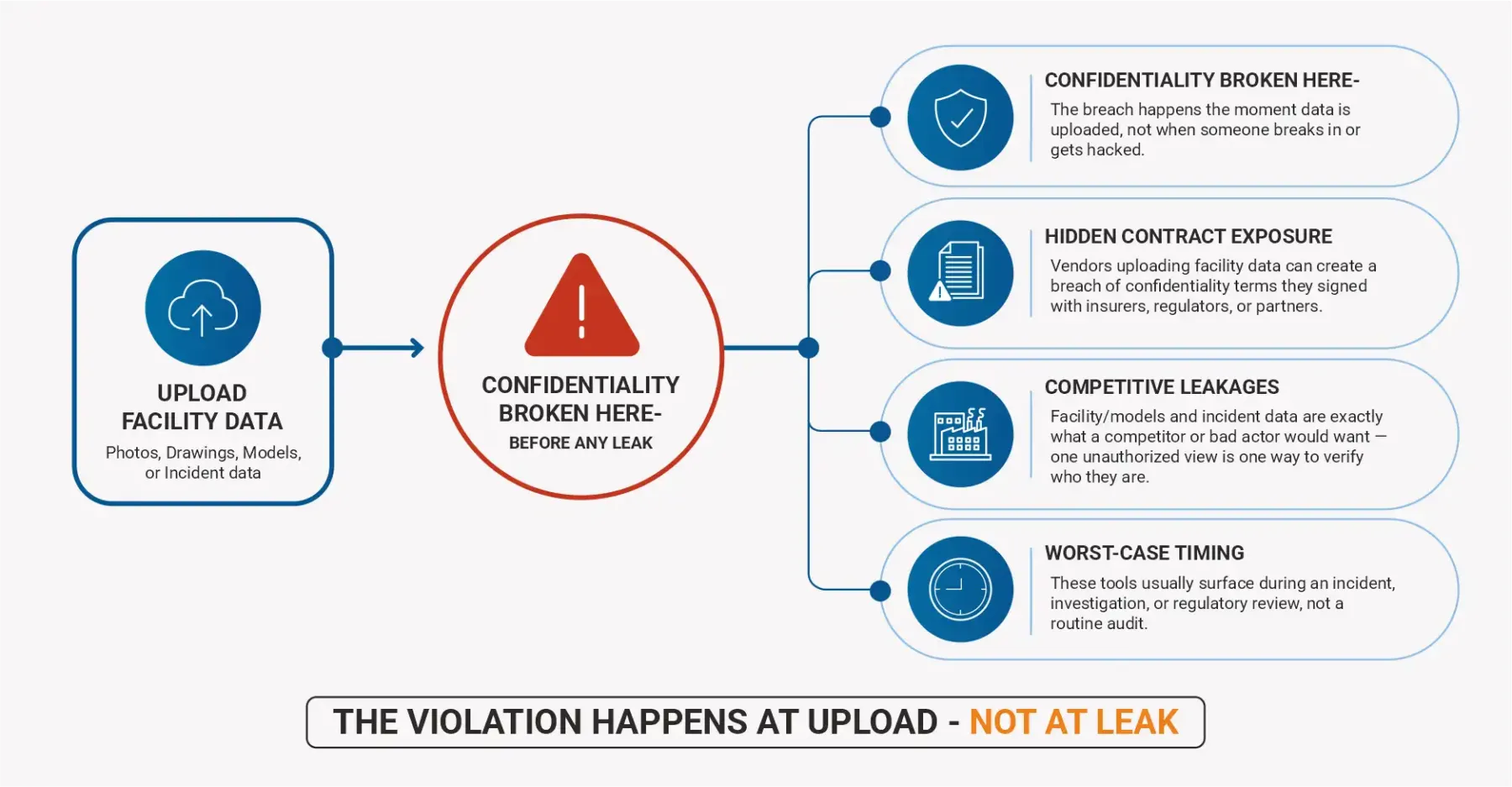
This is a legal grey zone that most companies commissioning HSE content have never thought to ask about, precisely because “we’re just making a training video” doesn’t sound like a data risk conversation. It is one.
To be clear, this isn’t a claim that every AI tool trains on uploads or leaks data to competitors. It’s simpler than that: where your data goes, how long it’s kept, and who can access it depends on each provider’s architecture and contracts, and that varies widely. AI can genuinely speed up image and 3D work. The question is why take on an unverifiable dependency when the risk is avoidable.
Your Facility Isn’t Stock Footage
Stock footage and real facility footage aren’t just different in quality. They’re different in what they reveal:
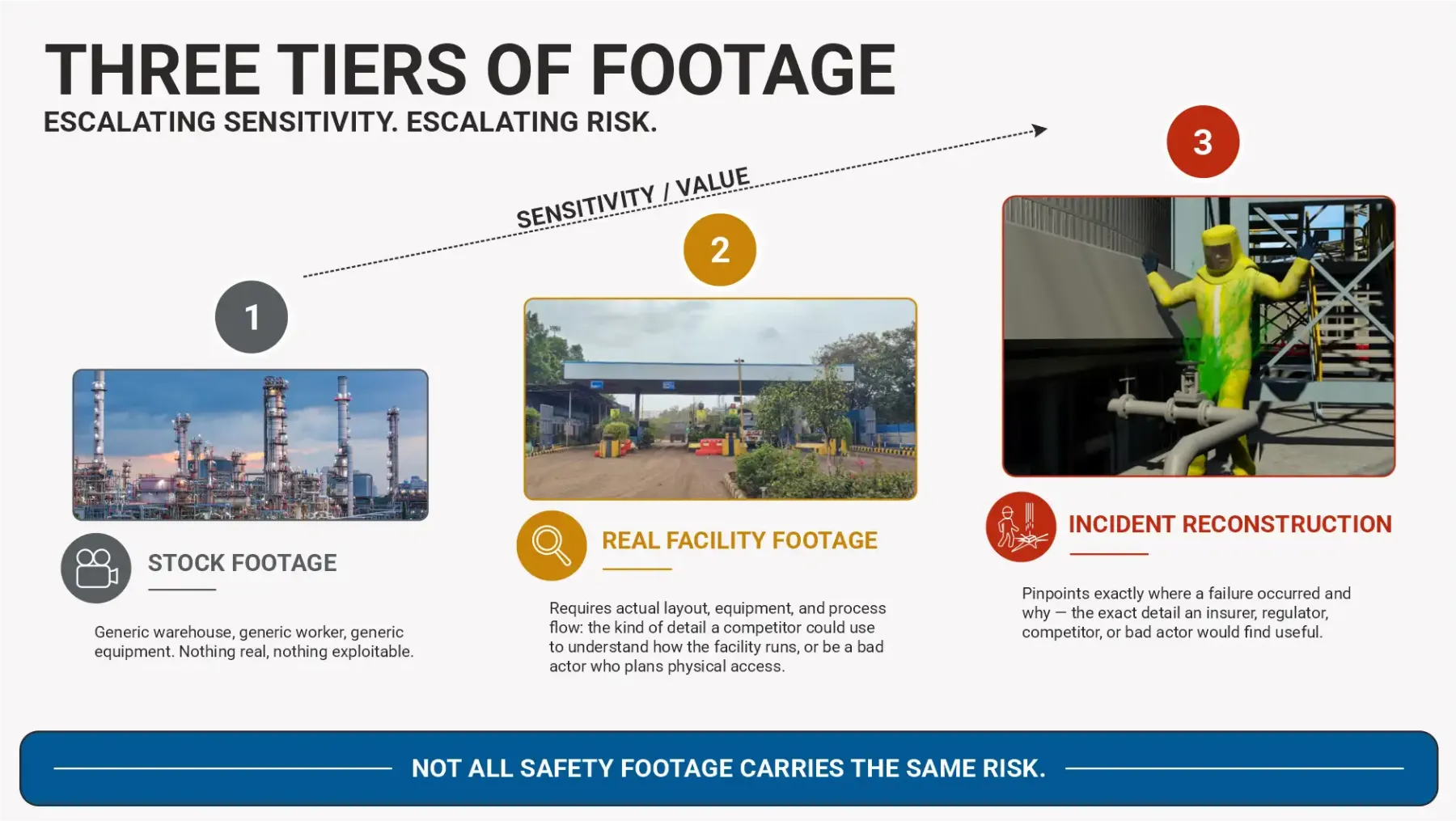
TECH EHS animations fall firmly into the second and third categories. They’re built from a specific client’s real facility: actual photographs, accurate 3D recreations of real buildings and equipment, real site conditions, and often, reconstructions of an actual incident and its root causes.
A highly accurate 3D model of a client’s plant isn’t just “content.” It’s a detailed representation of their physical infrastructure, and in incident cases, a record of exactly where something went wrong. That’s sensitive information in its own right, independent of the video it eventually becomes, and exactly the kind of asset the legal warning above is describing.
How We Actually Build Your Animation
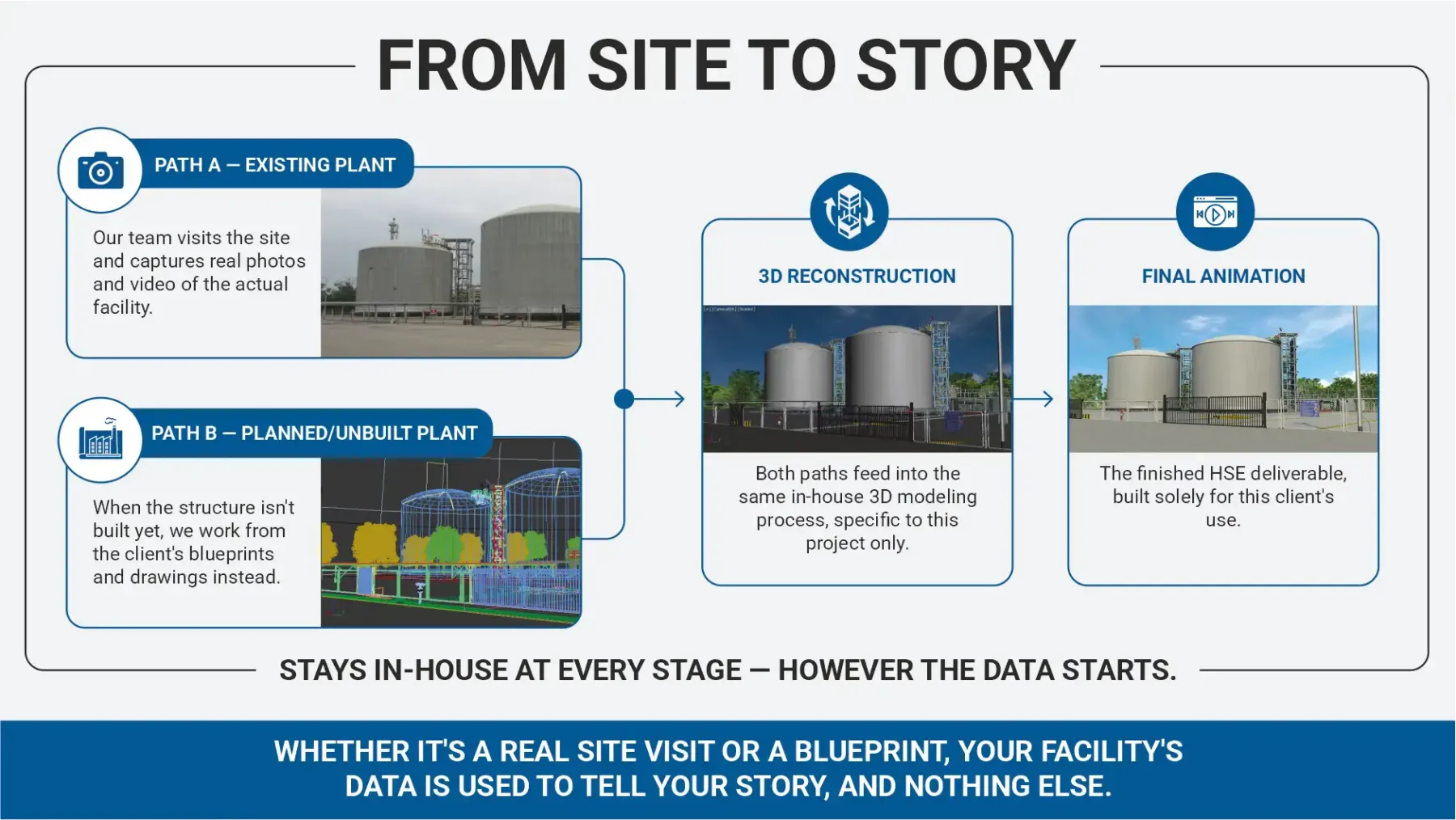
Client-provided information, like photographs, drawings, and investigation material, is shared with us under trust and often formal confidentiality agreements, for one purpose: to recreate that client’s facility and incident accurately, for that client’s specific deliverable. It is not used to train external AI models, build reusable datasets, generate assets for other clients, or be shared with third parties.
Every 3D model and reconstruction we build is created specifically for that project, through an in-house, controlled process, not pulled from or fed into a shared external system. Your facility’s data is used to tell your story, and nothing else.
The Trade-Off We’re Honest About
We won’t pretend this approach is the fastest or cheapest option available. Building models and reconstructions in-house, project by project, takes longer than accelerating the work through third-party AI platforms, and it likely costs more too.
But we think that trade-off is worth it. The value of the underlying information, equipment layouts, infrastructure details, and operational weaknesses revealed by an incident investigation is almost always worth more than the hours saved on production. That’s not a close call for us.
Trust Is Our Actual Product
Animation is what you see. Trust is what we’re actually selling. Our USP isn’t just the quality of the video; it’s the confidence that your facility, your incident data, and your confidential information never leave our hands without your explicit consent.
Data confidentiality isn’t an IT policy bolted onto our service. It’s part of the HSE service itself.
Questions Every Company Should Ask Before Using AI for Confidential HSE Work
If your organization is evaluating any vendor that uses third-party AI tools for confidential facility or incident content, these are the questions worth asking before you sign off:
If a vendor can’t answer these clearly, that’s worth knowing before your facility’s data is already uploaded somewhere.
Your Safety Story. Your Facility. Your Data. Our Responsibility.
That’s the line we hold to on every project. Not because we’re cautious about technology for its own sake, but because the information you trust us with is worth more than the time we’d save by handling it differently.
