Table of Contents
Introduction
Why is it that we can track resource usage down to the penny, but when it comes to Governance, the shop floor is left completely in the dark?
But it’s there, every single day.
One of the most momentous governance systems in any enterprise isn’t sitting in a policy binder somewhere. Whether anyone in the boardroom notices or not, it’s the Permit to Work process running on the Shop floor.
Think about what a permit actually is. A hot work permit, a confined space entry, and an isolation certificate are all corporate governance instruments in disguise. It spells out who has authority to approve high-risk work, what has to be verified first, and who answers for it when things go south.
An organization has no real-time way to prove that its stated risk controls are actually being followed when that process lives on paper, carbon copies, clipboard sign-offs, and permits filed in a cabinet.
The moment a company shifts its PTW ecosystem from paper to digital, it’s not only digitizing a form but rebuilding its entire risk profile, swapping informal trust for something structured, auditable, visible to the board. That shift is also what global management-systems standards such as ISO 45001 are ultimately asking organizations to demonstrate. Not a proof that controls exist on paper somewhere, but a proof that works, gets tracked, and keeps improving.
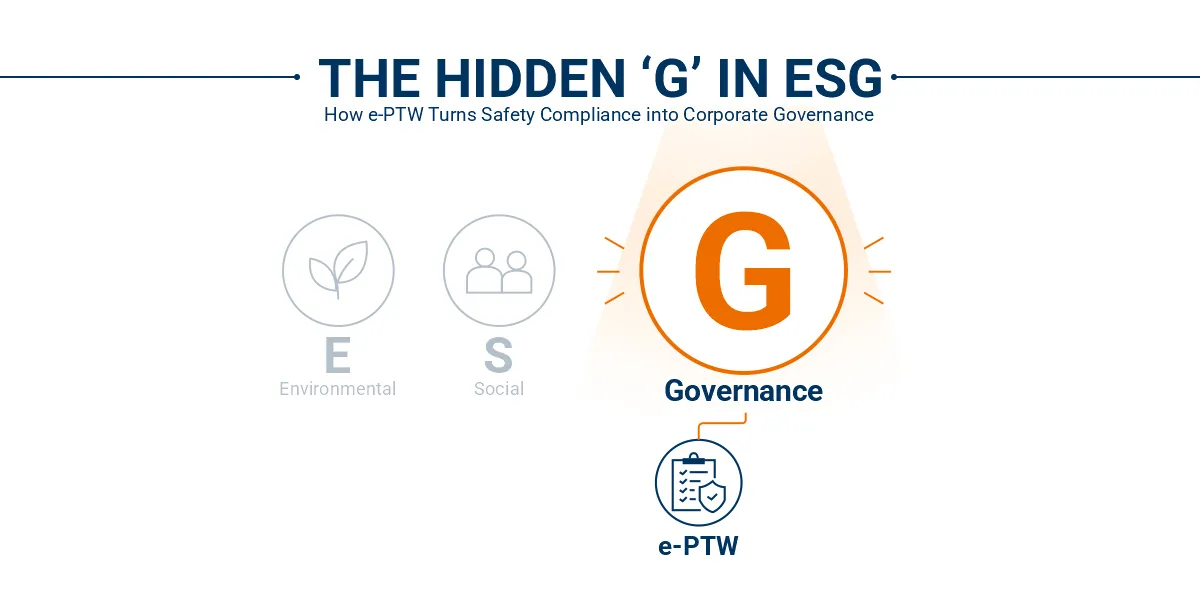
This is the case for treating electronic Permit to Work (e-PTW) not as a safety department line item, but as core governance infrastructure, giving the boardroom the same real-time assurance over operational risk that financial controls already give it over capital risk.
Overview: The e-PTW Governance Framework
Here’s how it breaks down.
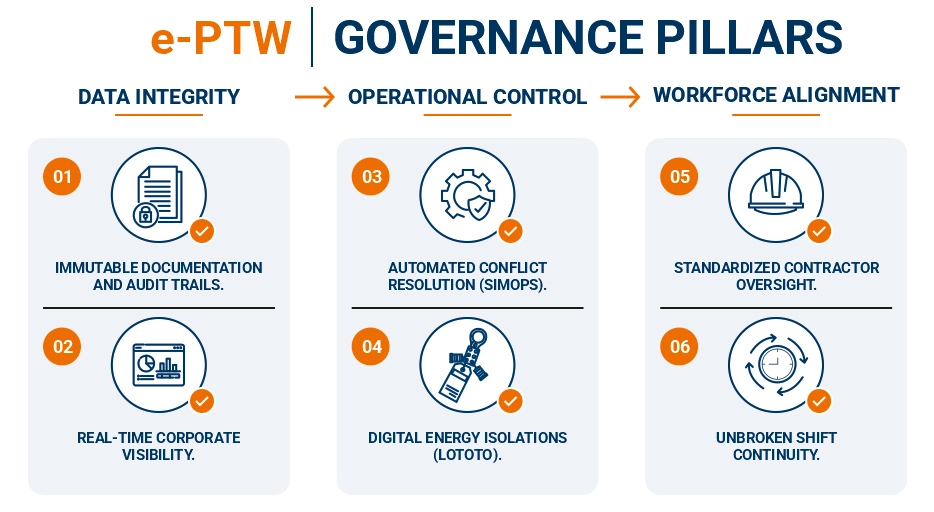
Each category maps to one blunt question a board, auditor, or regulator is entitled to ask for:
A mature e-PTW ecosystem is built to answer all three, continuously, without anyone digging through a filing cabinet to find the right binder.
The 6 Key Pillars of Digital Safety Governance
Data Integrity
1. Immutable Documentation and Audit Trails
Paper permits have a problem baked into their DNA. They can be edited, misplaced, or used for post-incident damage control by anxious staff. A supervisor backdates a signature, or a hazard note quietly disappears between issue and closeout. Even a permit vanishes entirely right before an incident investigation kicks off.
None of this requires anyone acting in bad faith, by the way. It’s just what happens when a corporate governance record depends on someone’s filing habits instead of systematic architecture.
Swap that for an e-PTW platform, and the fragility disappears. Every action against a permit gets a permanent, time-stamped, user-attributed record of who raised it, who reviewed it, what got verified, what changed, and when it closed. Nothing gets altered or amended after the fact. That’s the whole difference between a company that says it manages risk responsibly and one that can instantly prove it to stakeholders who showed up wanting evidence, not a story.
2. Real-Time Corporate Visibility
Here’s an uncomfortable truth about paper systems: the real state of operational risk management across a multi-site enterprise stays invisible above the site level.
Nobody at the top management hears about any of it until an incident forces the conversation.
That’s not governance, that’s hindsight wearing a governance costume.
Digital e-PTW gives corporate risk, HSE, and executive functions a live dashboard of permit activity across every site. How many high-risk permits are open right now, where isolations are pending verification, and which locations are trending toward control fatigue. This converts safety oversight from a quarterly report into a standing governance capability, the same real-time posture the board already expects for financial risk and cybersecurity.
Operational Control
3. Automated Conflict Resolution (SIMOPS)
Picture a maintenance work running alongside production, Contractors working near live process equipment, multiple crews converging on the same asset without either one knowing it. Simultaneous Operations (SIMOPS) is where a disproportionate share of major incidents originate.
On paper, catching a SIMOPS conflict comes down to luck, where somebody happens to remember that another crew is working nearby.
But a digital PTW engine doesn’t rely on luck.
By automatically cross-referencing every active and pending permit across locations, equipment, hazards, and activity types, it identifies and flags conflicts before a permit is ever issued.
That’s governance in its most literal sense: a system-enforced control that doesn’t depend on anyone’s memory in the moment, and one that leaves a record proving the check actually happened.
4. Digital Energy Isolations (LOTOTO)
Lockout-Tagout-Try-out, or LOTOTO, is the last line of defence against release of hazardous energy. It’s also one of the easiest steps to shortcut when a crew is under time pressure.
Digital isolation management doesn’t leave that to chance. It sequences each lock point, demands photographic or sensor-based verification, and refuses to release a permit until every isolation point is confirmed and logged against a named individual.
Workforce Alignment
5. Standardized Contractor Oversight
Contractor and third-party labor is where governance frameworks most often fracture. Because competency verification, induction records, and site-specific rules historically live in separate systems, or worse, in a folder at the gate nobody’s updated in months. An e-PTW platform pulls all of it into one place and centralizes contractor credentials, certifications, and site inductions. No permit gets issued to anyone whose competency assessments have lapsed or were never checked in the first place.
This closes a critical gap in contractor safety. Following an incident, many organizations cannot prove they performed due diligence when authorizing third parties for high-risk work.
6. Unbroken Shift Continuity
Shift handover is where risk information quietly disappears. It’s a recurring root cause across incident investigations, a hazard identified on one shift that mostly never reaches the next. Paper logs rely on a verbal handover and a legible note. A digital PTW system doesn’t forget any open permit; every outstanding hazard, every pending isolation carries forward automatically, visible to the incoming shift before a single task even begins.
This turns continuity of care from a cultural aspiration into a system property, which is precisely the kind of demonstrable control that governance frameworks are designed for.
Why Digitalizing PTW Transforms Enterprise Governance
So, who wins the actual ESG governance conversation in the years ahead?
Probably not the companies with the most polished policy documents. It’ll be the ones who can open a dashboard, right now, and show exactly how every permit issued today was controlled, verified, and closed, turning the whole game. frontline permit discipline into hard evidence of enterprise-wide governance.