
Personalized & Predictive EHS eLearning: AI, Data Analytics & Mobile

Table of Contents

Introduction

“Training cannot afford to be static or one-size-fits-all.”

Traditional training models have often proven to be limited in engagement, retention, and applicability. Even schools are upgrading to new learning/teaching methods, so why are workplaces stuck in the old era? And this “not upgrading” is not just costing the organizations their brand value, but also workers’ lives!!

The solution?

Personalized and Predictive EHS eLearning powered by AI, data analytics, and mobile platforms. This new approach is transforming compliance-focused training into proactive, engaging, and highly effective safety programs.

Let us know how?

AI-Powered Personalization: From Generic to Individualized Learning

Historically, EHS training programs were designed with broad strokes. A single module on “fire safety” or “hazardous chemical handling” was delivered to everyone regardless of role, risk exposure, or prior knowledge. While this approach checks compliance boxes, it doesn’t necessarily change behavior or prepare individuals for real-world risks.

Enter “AI-powered personalization”. By leveraging algorithms and machine learning, organizations can now deliver training that adapts to each learner:
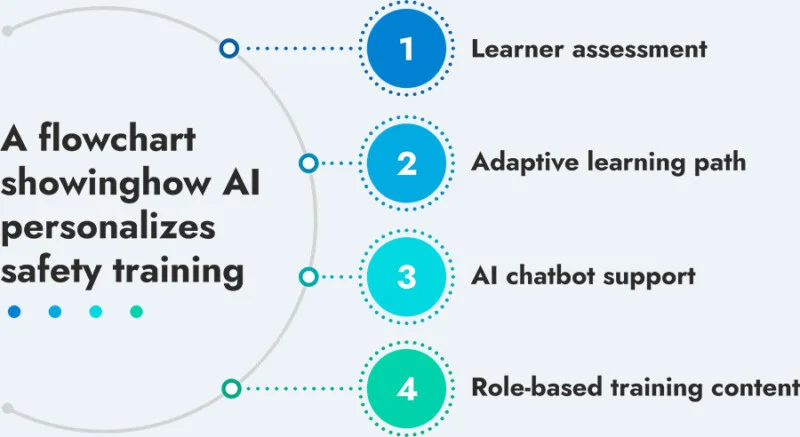
Adaptive Learning Paths: If a frontline worker scores high on electrical safety but struggles with confined space awareness, the AI-driven LMS automatically adjusts the course sequence, allocating more resources, simulations, or assessments for the weaker area.

AI Chatbots and Assistants: Imagine a worker preparing to operate a new piece of machinery. Instead of flipping through manuals, they can ask an AI assistant for “steps to safely lockout-tagout this system” and receive real-time, contextual guidance. This bridges the gap between training and on-the-job support.

Tailored Content by Role and Risk: Supervisors might need in-depth training on incident investigation, while contractors only need short hazard-awareness micro-modules. AI ensures each learner gets the content relevant to their work environment.

A flowchart showing how AI personalizes safety training
Real-World Example

A U.S.-based chemical manufacturer deployed AI-driven adaptive safety learning. Workers who repeatedly underperformed in hazard recognition simulations were automatically assigned more VR-based practice modules.

The outcome: Incident rates fell significantly within a year, while compliance audit scores improved drastically.

Supporting Stats

According to Brandon Hall Group, personalized learning can improve engagement by 80% compared to traditional eLearning.

PwC’s study on VR and AI in training revealed learners were 4x faster to train and 3.75x more emotionally connected to the content compared to classroom methods.

Predictive Analytics & Big Data: Training That Looks Ahead

While personalization focuses on the learner, predictive analytics leverages organizational data to identify and prevent risks before they happen.

So, how does it work?

Incident Data Analysis: Past accident reports, near misses, and hazard observations are analyzed to identify recurring trends. For example, if multiple forklift-related near misses occur in a specific warehouse, predictive analytics flags it as a training priority.

Learner Behavior Tracking: If employees consistently fail specific modules, this indicates gaps not just at an individual level but potentially in organizational processes or hazard awareness.

Forecasting Hazards: Combining environmental monitoring data (like air quality sensors) with training analytics can predict days of higher risk. Training reminders or refresher modules can then be pushed to staff in advance.

Real-World Example

A European logistics company integrated predictive analytics with its EHS training program. By analyzing historical injury data and pairing it with worker training records, the system predicted high-risk operations in loading docks during seasonal peaks. Targeted microlearning refreshers were rolled out before peak season. The result? A significant reduction in musculoskeletal injuries during peak operations.

Supporting Stats
  • According to Deloitte, predictive analytics can reduce workplace incidents by up to 40% when combined with proactive training.
  • A CIT Institute study (2024) highlighted that 62% of organizations that adopted predictive EHS training strategies saw measurable improvements in safety performance within the first year.

Scalable and Mobile Learning: Training Anytime, Anywhere

Safety training is only effective if it’s accessible at the right time and place. For field-based staff, contractors, or remote workers, desktop-based LMS platforms are impractical. This is where mobile-optimized eLearning and microlearning step in.

Key Features:

  • Microlearning Modules: Short, 5–10 minute lessons focused on specific risks (e.g., “How to use PPE for chemical spills”) that can be accessed on smartphones between shifts.
  • Offline Access: Workers in remote locations (like offshore rigs or mines) can download training modules and complete them without internet connectivity.
  • Push Notifications: Automated reminders for refresher courses or safety drills, ensuring continuous reinforcement of learning.
  • Infographic Suggestion: A visual of a worker using a smartphone for training, with callouts for microlearning videos, offline mode, and push notifications.
Real-World Example

An Indian pharmaceutical company with over 5,000 employees rolled out a mobile-first EHS training system. Workers received bite-sized microlearning videos on GMP (Good Manufacturing Practices) and chemical handling. The program significantly reduced non-compliance deviations in the first six months.

Supporting Stats
  • Envesca (2024) reports that mobile learning increases course completion rates by 72%, compared to desktop-only platforms.
  • SHRM data shows employees are 45% more likely to apply knowledge learned through mobile and microlearning compared to traditional training.

Why This Matters

Personalized, predictive, and mobile-first EHS training represents more than just an upgrade in technology. In fact, it’s a strategic shift in safety culture.

  • Employees receive training directly applicable to their tasks and risks.
  • Organizations can prevent incidents rather than react to them.
  • Mobile and on-demand formats adapt to dynamic work environments, ensuring learning never stops.

Industry Applications

  • Oil & Gas: Predictive hazard training for high-risk operations like machine guarding and operator safety training.

  • Pharmaceuticals: Mobile microlearning for GMP and cleanroom safety.
  • Logistics: Adaptive forklift and warehouse safety refreshers during peak seasons.
  • Manufacturing: AI-driven assessments for safety and ergonomics.

Roadmap for EHS Leaders

If your organization is considering transitioning into personalized and predictive EHS eLearning, here’s a step-by-step roadmap:

  • Identify gaps, incident trends, and learner behaviors.
  • Opt for platforms that support adaptive paths and predictive analytics.
  • Use immersive simulations where risks are high.
  • Prioritize accessibility through smartphones and tablets.
  • Track KPIs like incident reduction, compliance scores, and learner retention.
  • Talk to the experts.

Final Thoughts

The EHS training of tomorrow is personalized, predictive, and mobile-first. By embracing AI, data analytics, and flexible delivery, organizations can move beyond compliance checklists to truly embed safety into workplace culture. The shift isn’t just technological; it’s actually cultural, strategic, and essential for industries where every decision can mean the difference between safety and disaster.

Predictive and personalized eLearning is a key step for organizations that prioritize resilience and safety.

FAQs

AI personalizes learning by adapting content to individual learner needs, providing role-specific modules, and offering real-time assistance through chatbots.

Predictive analytics identifies trends from incident data, audits, and learner performance, helping organizations anticipate risks and deliver targeted training before issues arise.

Yes. Mobile learning enables on-the-go access, offline modules, and push notifications. This ensures frontline staff receive just-in-time training relevant to their tasks.

EHS Elearning

EHS E-Learning solutions are essential for every industry to understand a workplace’s dos and don’ts.

Our experts have curated specialized courses for industry-specific training programs and provide accredited courses for individuals seeking career advancement in EH&S.

5.8 min read Views: 550 Categories: E-Learning