
Table of Contents

Introduction

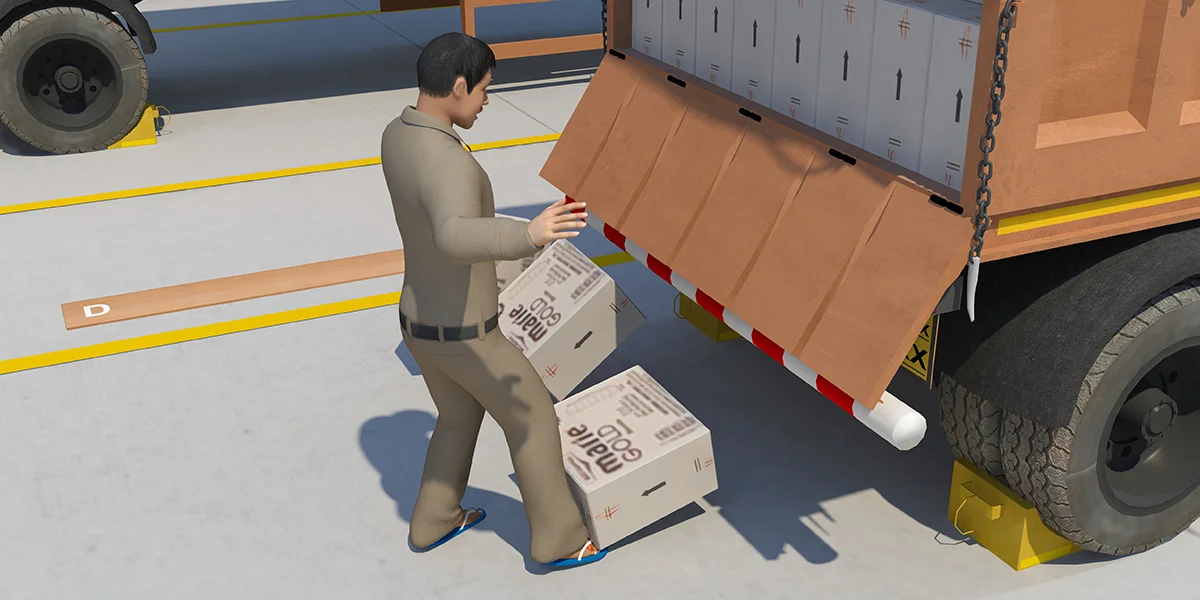
In a factory, an otherwise routine façade job turned catastrophic. A shortcut costs a person their life. Watch the video on how a small mistake turned into a brutal ending.

The traditional method of incident investigation involves producing pages of written reports, photographs, and a timeline — all technically accurate, but challenging for site crews, supervisors, and decision-makers to assimilate quickly. This can increase the likelihood of near-identical recurrences because the frontline crew may not recognize the connection between a procedural note in a PDF and the hazard at hand.

This problem — the need for accurate yet inert incident documentation — is why EHS teams are turning to animated accident recreations. When a scaffold collapse, machinery entanglement, or chemical release is animated, the sequence, forces, SOP deviations, and control failures become immediately visible. Animated visuals turn passive reading into active comprehension and, crucially, into faster, more precise corrective action, just like the above video.

Why plain reports often fail frontline learning

Traditional incident reports (photos + narrative + corrective actions) are indispensable for recordkeeping and compliance. But cognitive science and learning research show limits when complex spatiotemporal failure sequences are condensed into paragraphs:

Humans are visual processors. Studies show learners recall visual/video information far better than text alone — some industry summaries report up to 80–83% better recall for video/visuals versus text.

Well-designed instructional video reduces extraneous cognitive load and supports active learning—principles validated in peer-reviewed educational literature.

For EHS managers, the takeaway is simple: facts in a report are necessary; a visual recreation makes those facts actionable.

The power of visual recreation: what animation adds technically

Animated incident reconstructions are not “cartoons” for the sake of engagement !! They are engineered illustrations of failure modes. A robust recreation includes:

3D spatial reconstruction — to show exact geometry:

Scaffold configuration, anchor points, element sizes, clearances and fall paths. This is critical where spatial tolerances determine failure (e.g., overhanging planks or missing guardrails). OSHA investigations emphasize how small geometric errors (plank overhang, missing ties) precipitate collapses.

Timeline overlays & event markers:

Synced clocks, worker positions, load changes, and equipment state (e.g., hydraulic vs crane placement) so reviewers can see not just what failed, but when and why.

Annotated SOP comparisons — scene toggles show “as-built” vs “per procedure.”

A gate-toggle highlights where SOP steps were skipped (e.g., competent person inspection not performed; scaffold not secured to structure).

Forensic data integration:

Load calculations, wind speed, sensor logs, photographic overlays and CCTV synced into the animation so engineers can test hypotheses visually and numerically.

Human factors and decision nodes:

Animated vignettes can pause for “decision points” showing options workers had, helping trace cognitive and organizational contributors (shift pressure, inadequate supervision, ambiguous procedures).

These technical layers convert “what happened” into “why it happened” and map directly to corrective measures that are measurable.

Replacing PDFs with motion: why animated alerts outperform static documents

Retention & behavior: Industry summaries and provider research consistently demonstrate that video-based learning achieves significantly higher retention rates than text-based learning alone.

Speed to comprehension: When supervisors see an animated rescue of the event, they can immediately identify which SOP step failed and assign corrective actions with screenshot evidence, reducing ambiguity and rework.

Standardized messaging: An animation sent to multiple sites guarantees consistent delivery of the incident story and corrective expectation (unlike variable oral briefings).

In practice, organizations that convert one high-risk incident into an animated alert report faster corrective-action close times and higher site acknowledgement rates because the animation reduces interpretation overhead — everyone literally sees the gap.

Impact on training & awareness – measurable technical KPIs you should track

  • If you produce animation for incident lessons, we recommend that you pair it with a measurement plan:
  • View & acknowledgement rate (LMS + email opens) — did supervisors watch the animation within 48 hours?
  • Time-to-assignment of corrective actions — was an action assigned within 24–72 hours after viewing?

  • Corrective action close time — median days from assignment to verification.
  • Repeat incident rate for the same hazard classification — are we reducing recurrence?
  • Knowledge check scores — short post-view quizzes to measure comprehension and retention.

TECH EHS implementations show that when animations are used as incident alerts + micro-learning modules, organizations see faster corrective action assignment and higher retention in refresher tests versus text-only campaigns.
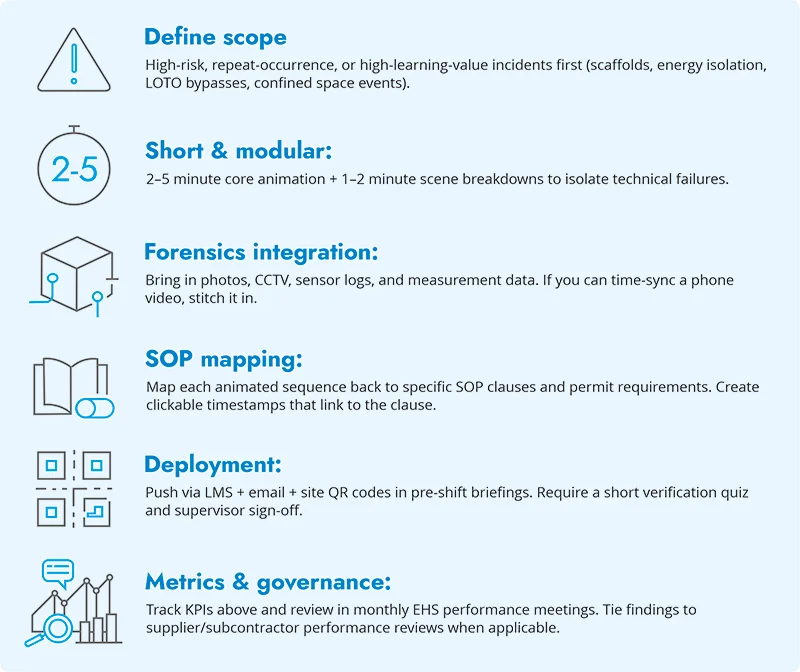
How to build an effective incident animation program — technical checklist

Why Proper Animation Matters?

Accuracy risk

Poorly produced animation can create false confidence. Mitigate by anchoring animations to verified data and by peer review with the incident investigation team.

Over-simplification

Don’t replace technical reports! Animations should augment transcripts, engineering analyses, and legal records.

Privacy & legal

Always anonymize PII and consult legal before distributing animations externally.

Conclusion

For EHS leaders, animated incident recreations bridge the gap between investigative detail and operational behavior change. They make root causes visible, reduce ambiguity in corrective actions, and amplify retention, converting a static file on a shelf into an active prevention tool across sites.

As video and animation literacy grow in the industry, the organizations that treat incidents as visual learning assets will close the loop faster and prevent the “almost identical” replays of yesterday’s failures.

FAQs

Animations can be used as demonstrative aids, but should never replace original evidence. Keep a strict chain of custody for source data and label animations as reconstructions based on available evidence.

Keep core recreations to 2–5 minutes with optional deeper technical breakdown segments.

Photographs, timestamps, CCTV footage, sensor logs, equipment manuals (including load tables), witness statements, and manufacturer procedures. OSHA reports show manufacturer procedure mismatches often explain scaffold failures.

Yes. TECH EHS and similar providers specialize in rapid turnarounds (days to weeks) for frontline alert animations. Ensure the investigation team reviews the initial animation to avoid inaccuracies.

Safety Animation videos

Educating employees about safety-critical activities, hazardous conditions, and company safety policies and procedures is crucial to safety training.

TECH EHS animation services ensure employees have the knowledge and skills to maintain a safe work environment.

4.9 min read Views: 103 Categories: Safety Animation

Subscribe to Our Blog

Want some more? Get updates from TECH EHS, know about latest happenings, Technology news and updates.