

Table of Contents
- Introduction
- Why Safety Induction Matters in Industrial Workplaces
- Industry Challenges in Safety Induction Training
- Modern Approaches to Safety Induction Training
- Key Components of an Effective Safety Induction Program
- Benefits of Effective Safety Induction
- Why Digital and Animation-Based Safety Induction Is Growing
- The Role of LMS in HSE Induction Training
- Example Use Case: Digital Safety Induction in Manufacturing
- Best Practices for Implementing Safety Induction Training
- Conclusion
- FAQs
Introduction
In certain industries, the first few hours of onboarding can set the tone for workplace safety by shaping how employees are introduced to hazards. Before employees move machinery, enter process areas, do maintenance, etc., they need to be introduced to some of the site’s biggest hazards, safety expectations, and/or emergency plans. This is where a well-designed safety induction procedure is important.
A safety induction procedure does much more than provide a pathway for employees to complete a required safety compliance task. It provides an opportunity for an organization to develop and maintain operational awareness, reduce risks, foster a positive shift in operating culture, establish a safety communication baseline, and improve the company’s overall safety culture.
Industries such as manufacturing, construction, oil & gas, logistics, pharmaceuticals, and heavy engineering often manage large workforces that include contractors and third-party personnel. In these environments, consistent health and safety induction training is critical to ensuring that personnel understand potential risks and the operational dynamics of a site.
Increased engagement, easier compliance tasks, and better retention of safety information are incentives prompting many organizations to modernize their safety induction training. These modern methods include digital learning platforms, animated modules, and LMS-based compliance tracking systems.
In accordance with the International Labour Organization (ILO), work-related incidents and workplace illnesses cause close to 3 million deaths worldwide each year. Investing in workforce safety engineering mechanisms is admirable, and still needs to be supplemented with operational safety. Well-designed safety induction training procedures are the most reasonable and viable preventive methods.
Why Safety Induction Matters in Industrial Workplaces
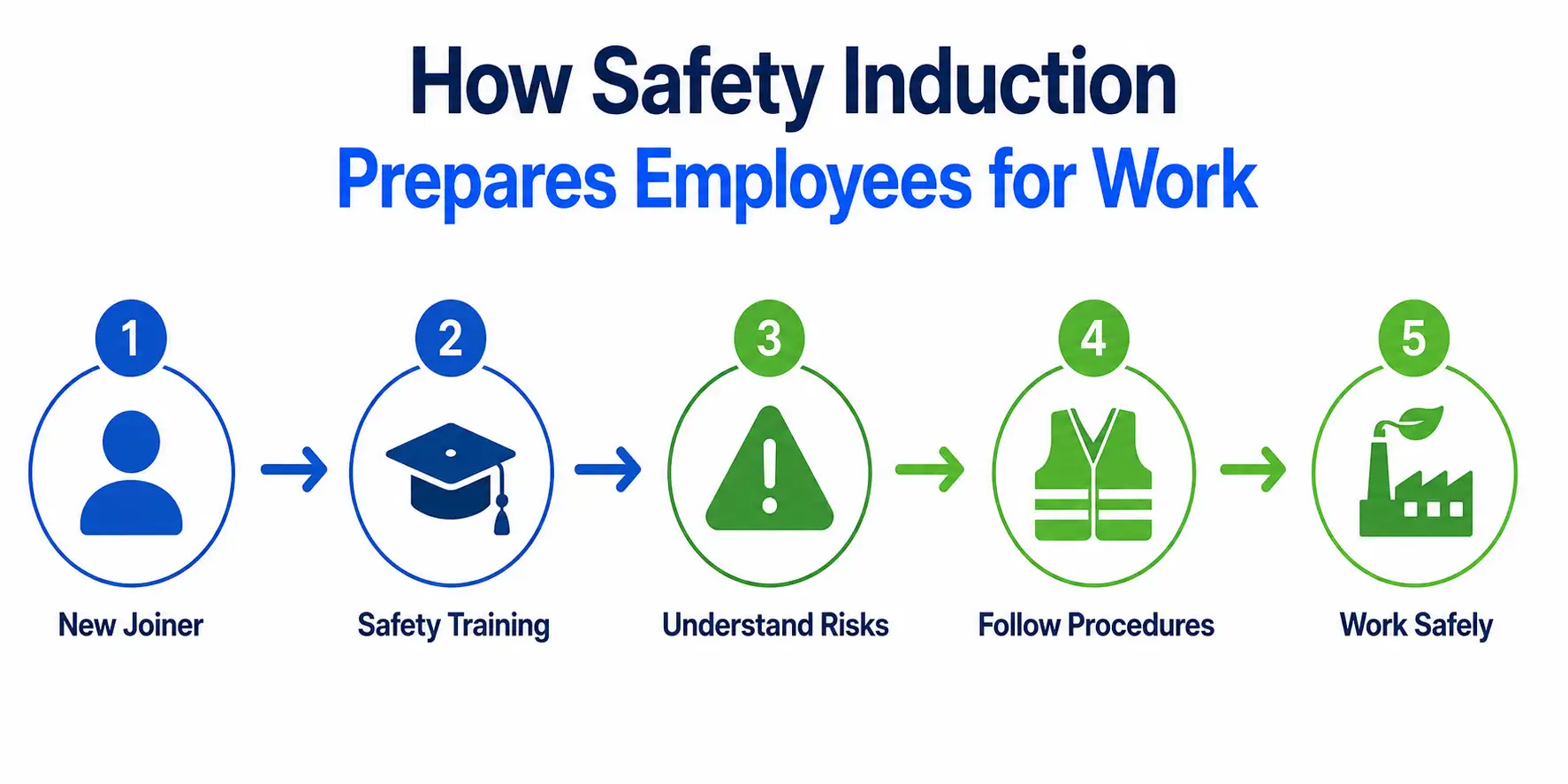
Every industry works differently. A factory might have machine guarding and lockout/tagout. A construction site might have scaffolding and work permit systems. Without a proper health & safety induction, employees might not understand:
An effective safety induction program helps establish a clear understanding of workplace expectations before operational work begins.
Key Objectives of Safety Induction
| Objective | Purpose |
|---|---|
| Hazard Awareness | Helps workers identify and avoid risks |
| Compliance Support | Meets regulatory and organizational requirements |
| Emergency Preparedness | Ensures faster and safer response during emergencies |
| Workforce Readiness | Prepares employees for operational environments |
| Safety Culture Development | Reinforces safe behaviors from day one |
For many organizations, health and safety induction for new employees serves as the foundation for long-term workforce safety performance.
Industry Challenges in Safety Induction Training
Despite its importance, many organizations still struggle to deliver effective HSE induction training programs.
Information Overload During Onboarding
Long presentations during initial induction that encompass various aspects of safety briefing over a short duration is a common practice. The workforce struggles to remember key safety information about:
The National Training Laboratories conducted a research study that found that visual and interactive learning tend to significantly improve retention compared to lectures and traditional teaching methods.
Diverse and Multilingual Workforce’s
Industrial operations involve workers from diverse languages and educational backgrounds. Induction materials that rely heavily on text may fail to communicate essential instructions to all employees. These issues arise most often in:
Health and safety induction training programs have begun using visual learning techniques to help carry out the training to the different groups in the workforce..
The variation in Contractor and Site Induction Processes
Contractors move from one site to another and carry out their work there. Different site practices make the induction system easy to access, which may lead to a lack of safety awareness and compliance. Companies that work with contractors must implement inductive practices to ensure:
Low Engagement in Traditional Methods of Training
Static presentation methods and lengthy lectures lead to a lack of attention. For this reason, the industry is embracing animation to convey safety messages.
Challenges in Tracking Compliance
The use of an induction system that is not digital poses a challenge to EHS and HR in most companies. They may face the following situations:
The use of digital HSE induction systems gives a solution to the challenges highlighted.
Modern Approaches to Safety Induction Training
Safety induction training has changed a lot in the last few years. And honestly, it needed to. Sitting employees in a room for hours with a slide deck and a checklist just doesn’t work the way it used to. Now, companies are leaning into training methods people actually pay attention to, which include:
The result? Training becomes easier to manage and much more effective for those taking it. Research from the Brandon Hall Group has shown that companies using digital learning technologies often see stronger learner engagement and more consistent training outcomes across distributed workforces.
Key Components of an Effective Safety Induction Program
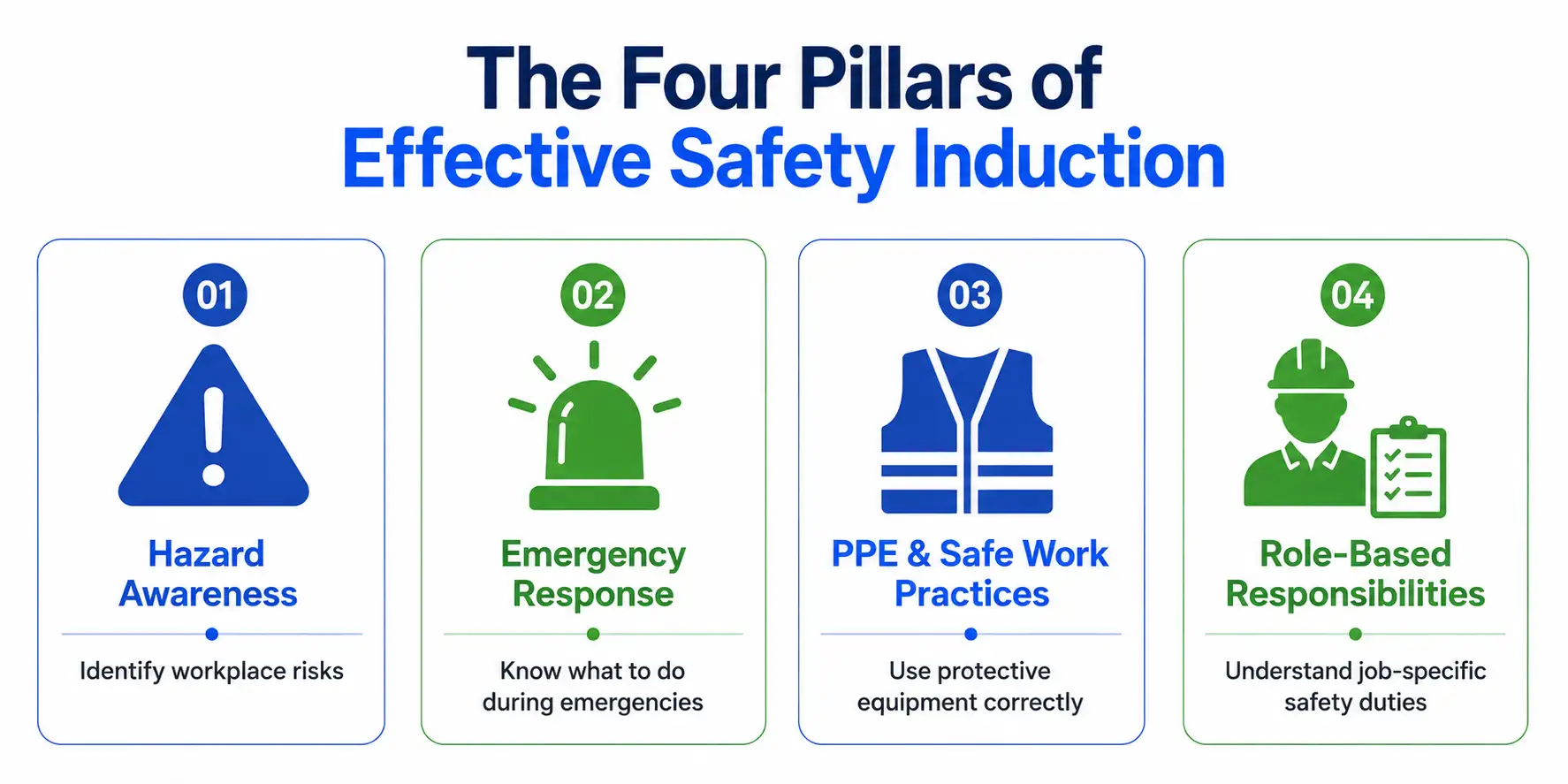
Workplace Hazard Awareness
One of the biggest reasons safety induction training exists is to help workers recognize danger before they are exposed to it. That sounds simple enough, but in fast-moving industrial environments, people can overlook risks once they become familiar with the workplace. On an industrial site, there can be many hazards such as:
When workers understand risks and their causes, they naturally become more aware on the job.
Emergency Response Procedures
During an emergency, people don’t usually stop to calmly analyze the situation step by step. They react based on what they remember from training. That’s why emergency response procedures should never feel rushed during induction sessions. An effective HSE induction training program should explain:
PPE and Safe Work Practices
Employees should know not only what protective equipment is required, but also how to use it correctly and where its limitations begin. Good induction training usually covers:
Role-Specific Safety Responsibilities
Different responsibilities have different safety concerns. For example:
Generic induction sessions usually lose people pretty quickly. So, role-based learning simply makes the training more useful and more believable.
Benefits of Effective Safety Induction
If we take into account all the key components required to make a Safety Induction Program effective, it can have a positive impact on employees.
Why Digital and Animation-Based Safety Induction Is Growing
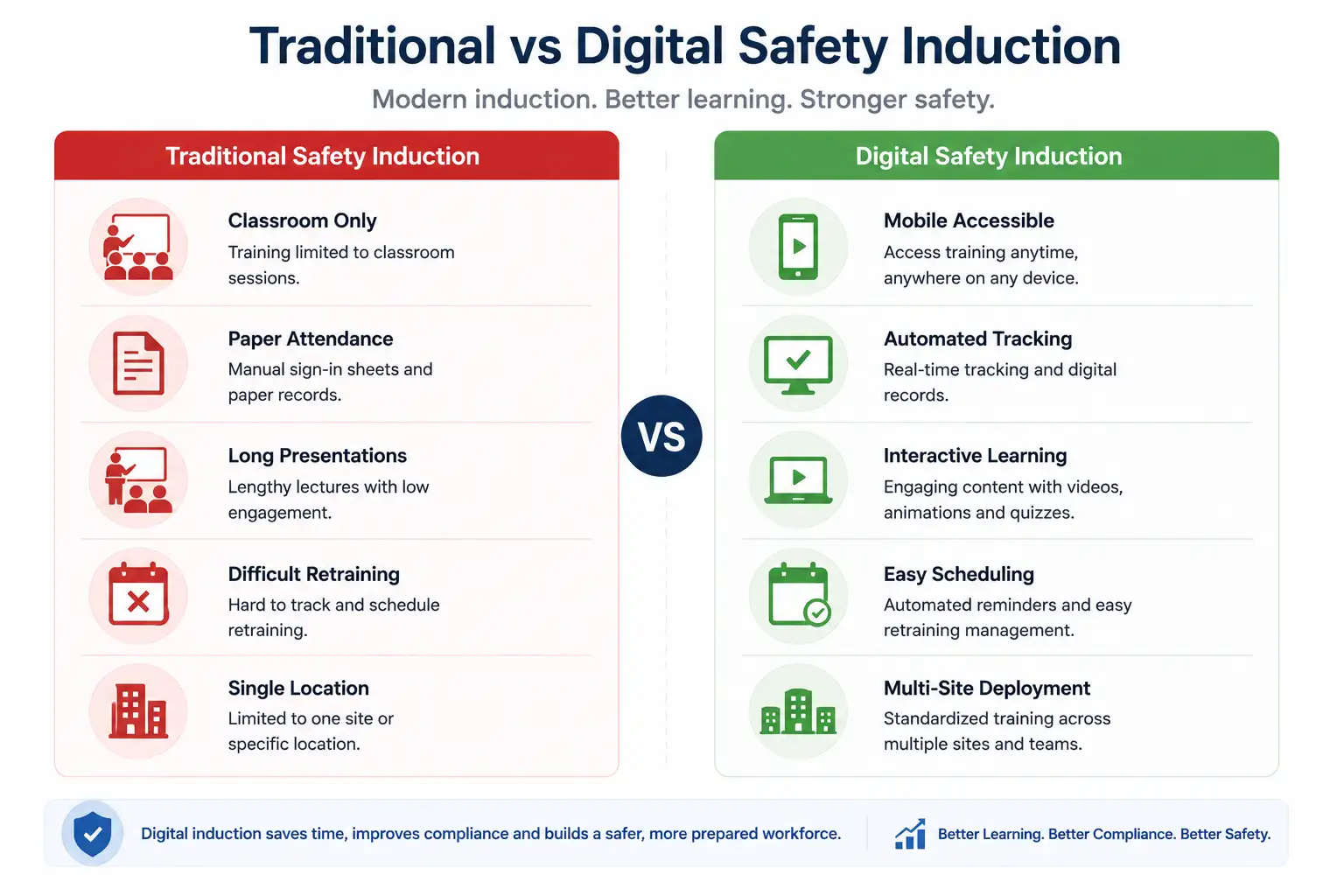
Digital safety induction has started replacing older methods because it’s easier to manage and scale, and is usually far more engaging for employees. Animation-based training, in particular, works well when companies need to explain procedures that are difficult, technical, or high-risk, such as:
Visual storytelling aids workers, especially the multilingual teams, to actually see how a procedure works instead of trying to imagine it from text-heavy instructions alone.
Comparison: Traditional vs Digital Safety Induction
| Traditional Induction | Digital Safety Induction |
|---|---|
| Classroom-only delivery | Accessible across multiple devices |
| Manual attendance tracking | Automated record management |
| Static presentations | Interactive visual learning |
| Difficult retraining management | Easy refresher scheduling |
| Limited scalability | Easier deployment across multiple sites |
The Role of LMS in HSE Induction Training
Learning Management Systems (LMS) are helping organizations streamline workforce training and compliance management. An LMS-enabled HSE induction system allows organizations to:
For organizations operating across multiple facilities, LMS-based induction systems improve consistency and operational efficiency.
Example Use Case: Digital Safety Induction in Manufacturing
A manufacturing company with several production facilities was struggling to maintain consistency in its safety induction process across sites. Each location handled training a little differently, which started creating operational gaps like:
The organization implemented a digital health and safety induction training solution integrated with an LMS.
The updated system included:
As a result, over time, the company saw noticeable improvements in training consistency across facilities, Compliance tracking became easier to manage and onboarding delays were reduced.
Best Practices for Implementing Safety Induction Training
1. Keep Training Practical
Use real operational examples instead of overly theoretical explanations. Workers engage better with practical workplace scenarios.
2. Use Visual Learning Methods
Animations, videos, and interactive scenarios improve understanding and retention.
3. Customize Training by Role
Different workforce groups require different levels of safety instruction. Role-specific induction improves training relevance.
4. Update Induction Content Regularly
Review induction materials periodically to align with:
5. Measure Training Effectiveness
Use:
to evaluate training effectiveness continuously.
