
Table of Contents
Introduction
It is not new to know that safety failure rarely comes from missing documentation. It comes from the inability to translate procedures into instinctive action under pressure.
Employees attend compliance training, sign the SOP acknowledgment and even complete the mandatory induction. But still in the critical moment, why does hesitation takes over?
Not because they lacked information but because they lacked visualization!
This is why visual learning is rapidly becoming one of the most strategic investments in modern EHS programs. Organizations are moving beyond static compliance formats toward immersive and scenario-based learning experiences powered by safety animation videos and digital safety communication.
The shift is not about making training “more creative.” It is about improving cognition, retention, workforce behavior, and operational resilience.
The Problem With Traditional Safety Training
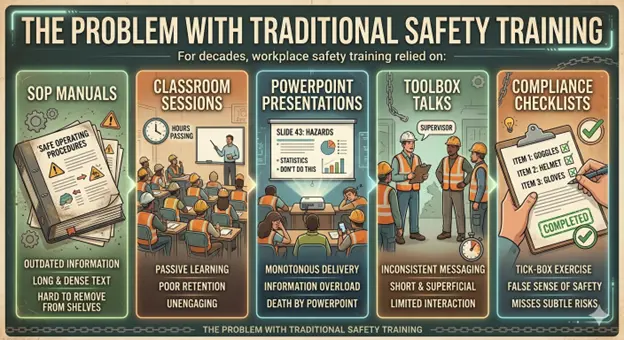
Passing training assessments does not always translate into safe behavior on-site.
This challenge becomes even more significant in industries with:
When training depends heavily on text, attention drops quickly. Workers may understand procedures theoretically but fail to mentally simulate hazards in real environments.
Visual learning addresses this gap directly.
The Rise of Safety Animation Videos in High-Risk Industries
Humans process visuals significantly faster than text. In operational environments where decisions must happen in seconds, visualization improves both comprehension and recall.
This is where animated safety training videos create measurable operational value.
Rather than describing risk, they demonstrate it, meaning that workers do not just read about confined space hazards or chemical exposure scenarios; they visually experience procedural consequences, environmental conditions, and appropriate response actions.
That cognitive shift changes behavior. Visual storytelling improves attention, emotional connection, and memory retention.
Animated environments can also simulate dangerous conditions safely without exposing workers to real operational risks.
For example:
Traditional classroom methods struggle to achieve the same level of cognitive immersion.
From Compliance to Cognitive Safety
A major transformation is happening inside EHS programs globally. Organizations are shifting from compliance-driven training to cognition-driven safety systems. This means the objective is no longer merely;
“Did employees complete the training?”
The new question is:
“Can workers recognize and react to hazards instinctively?”
This is why many enterprises are integrating Animated Workplace Safety Training Videos into broader digital transformation initiatives.
According to recent EHS industry discussions, animation-based safety learning helps organizations simplify complex procedures through:
The outcome is improved workforce comprehension across varying literacy and experience levels.
The ROI of Safety Animation Videos for Training & Compliance
Leadership teams often ask a practical question: What is the measurable ROI?
And trust us, as the answer extends far beyond training completion rates.
| Reduced Incident Costs | Visual learning improves hazard awareness before incidents occur. |
| Higher Retention and Recall | Visual training creates mental reference points that workers can recall during operational decision-making. |
| Consistency Across Global Operations | Animated Safety Videos help standardize safety messaging. |
| Faster Onboarding | Visual modules accelerate understanding by simplifying procedures and protocols. |
| Long-Term Cost Efficiency | Digital safety content creates a scalable learning infrastructure. |
Safety performance is no longer seen only as an operational metric; it is now a critical indicator of broader organizational health.
Today, it is closely tied to ESG disclosures, investor confidence, governance maturity, workforce well‑being, and sustainability reporting. Modern ESG frameworks increasingly evaluate organizations on how effectively they reduce incidents, build workforce competency, maintain consistent training standards, and foster a preventive safety culture.
Visual learning plays a powerful role in strengthening these indicators by boosting workforce engagement and enabling proactive hazard recognition. For example, animated safety videos can show a realistic chemical spill scenario, guiding workers step by step through the correct response, or simulate a forklift collision to highlight both unsafe acts and proper corrective actions. These visual, scenario‑based experiences help employees internalize safe behaviors rather than simply memorize procedures. As a result, digitally enabled EHS ecosystems that leverage visual training are gaining greater executive attention worldwide as strategic drivers of ESG performance and long‑term organizational resilience.
The most effective safety programs do not simply distribute information. They influence behavior. Storytelling is powerful because workers remember narratives better than instructions alone.
Consider the difference between:
Traditional Training:
“Always wear fall protection while working at height.”
Visual Narrative:
A worker skips harness anchoring for a “quick task,” slips during repositioning, and triggers a cascading incident affecting nearby teams.
One is a rule, while the other creates emotional memory.
This is why the benefits of Animations extend beyond engagement metrics; in fact, they reinforce behavior.
Industry Applications of Safety Animation Solutions
| Industry | Applications of Safety Animation Solutions |
|---|---|
| Manufacturing | Machine guarding Lockout/tagout procedures Conveyor hazards Robotic movement zones Chemical transfer procedures |
| Pharmaceuticals | Contamination control Cleanroom movement protocols Hazardous material handling Emergency response workflows GMP-linked safety procedures |
| Oil & Gas | Confined-space entry Hydrocarbon leak response Flare system hazards Permit-to-work coordination Shutdown/startup safety |
| Construction & Infrastructure | Work-at-height risks Crane operations Excavation hazards Scaffolding procedures Heavy equipment movement |
| Logistics & Warehousing | Forklift safety Pedestrian segregation Traffic flow management Loading dock procedures Manual handling practices |
The Future of Safety Learning
The next generation of EHS training will likely combine:
However, remember that people learn faster when they can see risk rather than just read about it.
FAQs
