
Table of Contents
Introduction
Learning is only for new joinees or employees who make mistakes? Think again…
But first, let’s read a story together.
It was 02:30 when the EHS manager’s phone buzzed. A permit-to-work had been signed off, a valve left open, and a near-miss turned into an equipment damage incident. On paper, the company had “strong” policies. On the shop floor, the rules looked optional. The CEO asked a blunt question in the morning meeting: “Why didn’t anyone stop it?” No one had answers!
These issues arise when senior leadership is not adequately trained, retrained, and held accountable. It’s not rocket science to train senior leadership; all it requires is a modern, measurable eLearning program that rewires how leaders see safety.
Therefore, read the blog to know more. This blog guides EHS managers and senior management through the design and deployment of a program that is technical, measurable, and story-driven, positioning leadership as the first line of prevention rather than just the signatory at the end of paperwork.
The storytelling approach: learning that sticks
Adults remember stories where consequences are real and choices are visible. Therefore, we suggest designing your senior management HSE eLearning like a short case saga.
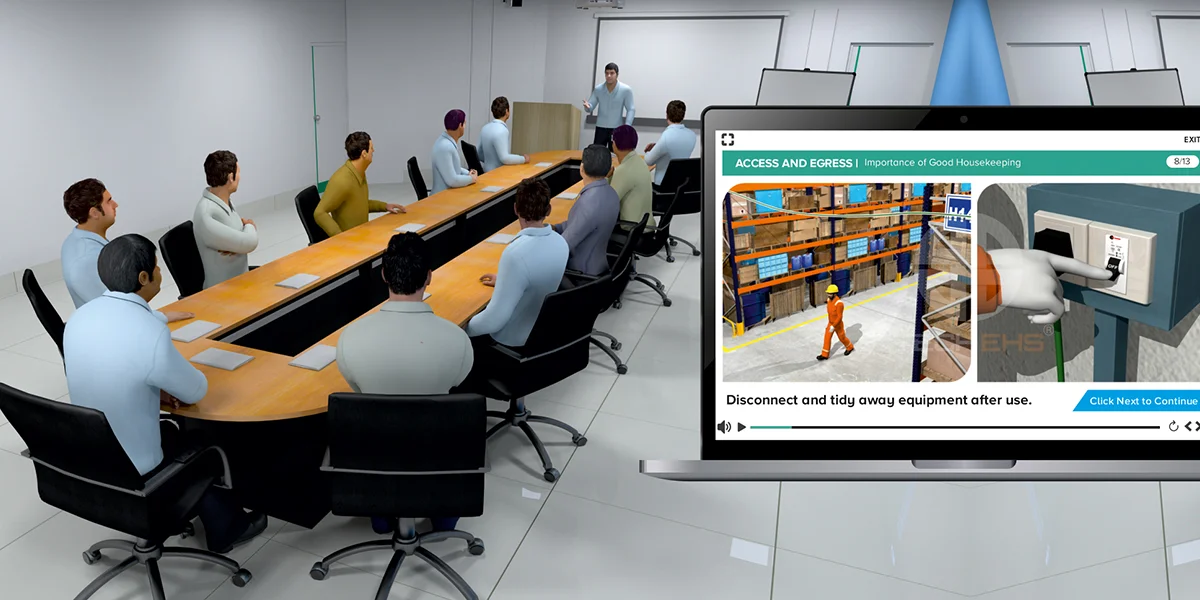
Hook. The Incident Snapshot. Start with a 2–3 minute animated reenactment (technical animation) showing the incident sequence from permit, signoff, to near-miss. TECH EHS’s animation work shows how complex processes can be simplified visually to make latent failures obvious.
Leadership Moment. Present the scene from two leadership perspectives: the Plant Head who delegated, and the Shift Manager who assumed “someone else” had checked. Show the cognitive biases and systemic pressures (KPIs, production targets) that influence choices.
Root Cause Trail. Utilize an interactive timeline that enables learners to access permit documents, risk assessments, and the latest audit findings. Make learning practical rather than philosophical.
Decision Points. Interactive Scenarios. At five decision nodes, ask the leader: “What would you do?” Each choice unfolds a short consequence simulation, reinforcing that leadership choices cascade to operational outcomes.
Technical Drill-down Module. After the story, offer a 10–15 minute technical module: refresher on permit-to-work, hot works, handover checklists, and safety critical element (SCE) tagging. Include engineering diagrams, failure modes, and typical human factors traps.
Commitment Contract. End with a short, digital leadership pledge linked to measurable commitments (e.g., “I will attend two site walkarounds monthly and sign the quarterly safety leadership review”).
This narrative + technical combo avoids passive slide decks and ensures leaders confront the consequences of their decisions in a safe environment.
Make Accountability Visible
Accountability hinges on measurement! Therefore, a practical KPI stack must be implemented and tracked. Some of them are;
Learning Metrics (LMS/xAPI): completion rates, assessment scores, decision-node choices, time spent on walkaround simulations.
Leadership Behaviour KPIs: number of documented site walkarounds/month, quality score of walkarounds (audit checklist pass rate), number of open safety observations closed within SLA.
Safety Performance KPIs: leading indicators (near-miss reports, pre-task risk assessments completed) and lagging indicators (TRIR/LTIR, incident severity). Tie executive bonus or leadership scorecards to improvements in leading indicators to avoid perverse incentives.
Certification & Re-certification: ranked certification (bronze/silver/gold) based on assessment and follow-up actions. Re-certify annually or after a safety event.
Use dashboards that blend course completion with behavioural evidence — e.g., “Senior VP: 100% course complete; 1 walkaround/month logged; 3 overdue observations” — and present these in quarterly management reviews.
Conclusion
When leaders view safety as measurable work, rather than a mere checkbox, the organization shifts from a reactive to a proactive approach. A well-designed, story-led eLearning program, reinforced with technical modules, xAPI tracking, KPI linkage, and digital follow-through, assigns true accountability. Utilize animation to foster empathy and clarity, link measurable commitments to leader scorecards, and observe improvements in leading indicators before lagging metrics change.
