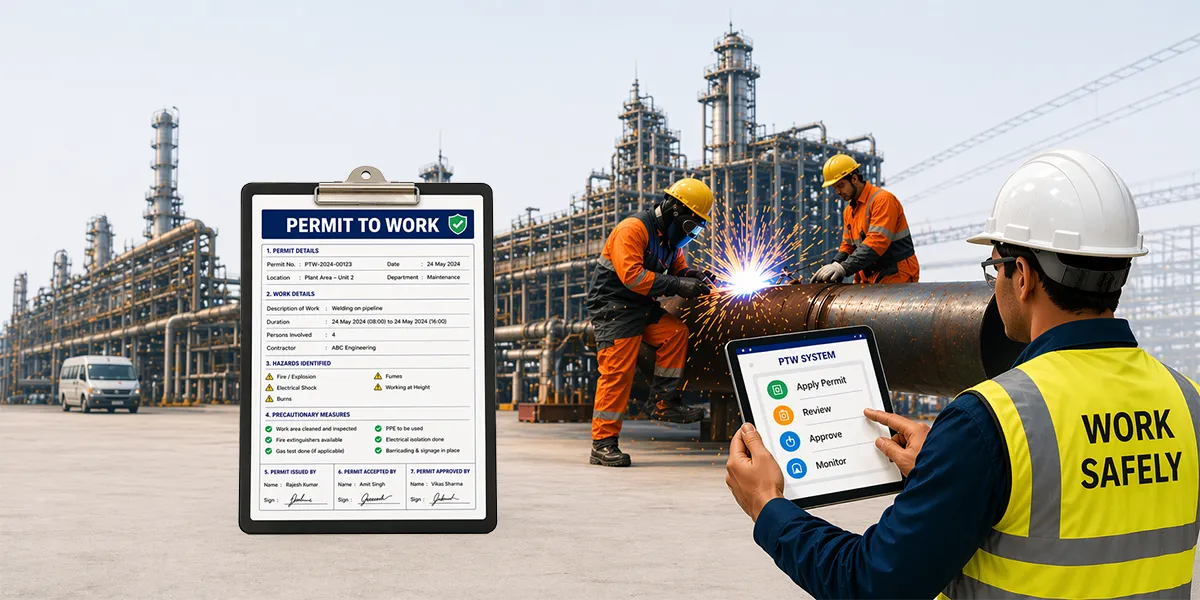
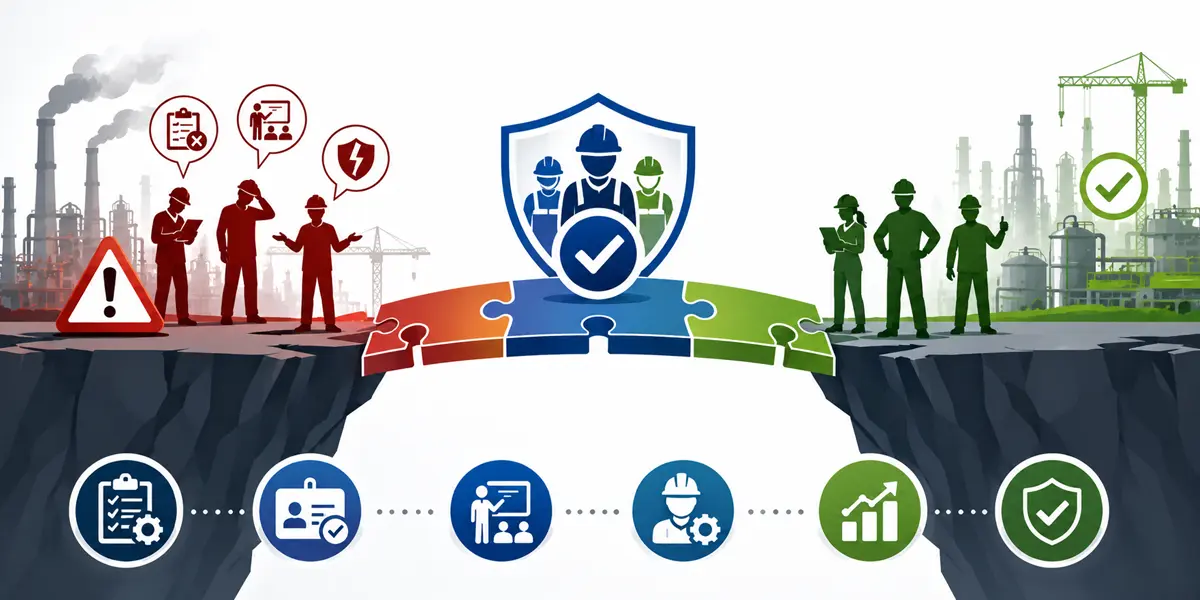
contractor safety management workforce readiness

Table of Contents

Introduction

Let’s read a story that keeps repeating.

At a large-scale petrochemical shutdown, everything was “compliant on paper.” Permits were issued. PPE was distributed. Inductions were completed.

Yet within 72 hours, three near-miss incidents occurred, each involving contract workers.

  • One didn’t fully understand confined space protocols.
  • Another bypassed lockout-tagout due to schedule pressure.
  • A third wasn’t aware of site-specific emergency exits.

Now, if you notice, then none of these failures was due to a lack of policy. They were failures of workforce readiness.

This is the paradox facing modern EHS leaders. Despite robust frameworks, contractor risk remains disproportionately high.

On the contrary, most organizations still measure the number of inductions completed, training hours logged, PPE distributed, and similar tangible, traditional measures. But leadership-level EHS maturity demands a shift towards “Is the workforce actually ready to work safely in this specific environment, at this moment?”

Organizations need a modern contractor safety management approach that evaluates workforce readiness dynamically rather than relying on static compliance metrics.

Dimension What It Means
Capability Skills, certifications, experience
Context Site-specific risks, changing conditions
Behavior Real-time decision-making under pressure

And throw light upon the fact that static checklists cannot capture this!!

The Fragmentation Problem in Contractor Ecosystems

On the org chart, it’s a neat stack of vendors and subcontractors. On the ground, it’s a living network of people, relationships, and information gaps.

You might see:

  • Multiple subcontracting layers
  • Diverse languages and literacy levels
  • Varying safety cultures
  • Inconsistent onboarding practices

Each new layer adds another filter between leadership intent and frontline reality. With every hand-off, a little bit of context is lost, a little nuance gets mistranslated, and responsibility starts to blur.

Slowly, the system fragments.

Information exists, but rarely in one coherent picture. You get:

  • Training records that exist—but are not validated
  • Permits that are issued—but are not context‑aware
  • Risk assessments that are completed—but remain static, not dynamic

Training records that exist—but are not validated

Permits that are issued—but are not context‑aware

Risk assessments that are completed—but remain static, not dynamic

Contractor Management Process in High-Risk Industries

A strong contractor management process ensures that safety is not lost across layers of subcontracting. In high-risk industries, this process must go beyond onboarding and include continuous monitoring.

Key stages include:

  • Pre-qualification and risk assessment
  • Contractor onboarding and training validation
  • Permit-to-work integration
  • Real-time monitoring of contractor activities
  • Performance evaluation and continuous improvement

This structured contractor management process helps organizations bridge the gap between compliance and real workforce readiness.

The Shift Toward Digital EHS Ecosystems

The solution is a connected, intelligent EHS system. A system that is tangible but also ensures that leaders have proper control and real-time visibility to all the EHS happenings and more.

The EHS digital ecosystem is not as a technology upgrade but as a risk governance transformation.

So, what changes in a digitally mature environment?

From static training → dynamic competency validation.

From permit issuance → risk-aware work authorization

From incident reporting → predictive risk signals

From contractor onboarding → continuous readiness monitoring

Embedding Contractor Risk into ESG Strategy

Under the ESG (Environmental, Social, Governance) frameworks, “S” (Social) includes worker safety across the value chain. Thanks to the awareness, investors increasingly assess contractor safety performance in ways possible. Also, for better EHS processes, regulatory scrutiny is expanding beyond direct employees. And this is visible because companies are actually changing policies to adhere to a better EHS environment that is actually safe and not just safe on paper.

For example, organizations in the US and Europe are now:

  • Including contractor TRIR (Total Recordable Incident Rate) in ESG disclosures
  • Auditing contractor safety systems as part of governance
  • Linking executive compensation to safety outcomes

So, will adopting technology solve the EHS problem?

There’s a strange paradox: on paper, everything looks perfect, yet risk quietly builds beneath the surface.

Picture a large petrochemical shutdown where permits are issued, PPE is distributed, and inductions are completed. Within just 72 hours, three near-miss incidents occur — all involving contract workers.

  • One worker steps into a confined space without fully understanding the protocol.
  • Another, under schedule pressure, bypasses lockout-tagout.
  • A third, new to the site, doesn’t know the emergency exits.

None of these failures stemmed from missing policies; they stemmed from a lack of true workforce readiness. Unfortunately, this is the uncomfortable reality many EHS leaders face: while traditional metrics like completed inductions, logged training hours, and PPE counts look impressive, they don’t answer the real question — is this specific worker, at this specific site, actually ready to work safely right now?

In the real world, contractor ecosystems are messy. What looks like a clean vendor stack on an org chart is, on the ground, a tangled web of subcontractors, diverse languages and literacy levels, conflicting safety cultures, and inconsistent onboarding practices. With every handoff, a bit of context is lost — risk assessments remain static rather than adapting to changing conditions, training records exist but aren’t always validated, and permits are issued without being truly risk-aware. Dashboards still show green, but leaders are often operating with partial visibility and a false sense of control. This is where the current technology inflection point becomes crucial.

The convergence of data, mobility, and intelligent systems is reshaping EHS — but only if it’s used to orchestrate workflows, not just digitize old checklists. In a digitally mature EHS ecosystem,

  • Real-time contractor onboarding validation
  • Geo-tagged permit-to-work systems
  • Behavior-based safety tracking via mobile
  • Digital competency matrices
  • Integrated near-miss reporting software systems

In this way, contractor risk doesn’t just sit in an EHS silo; it becomes a core part of ESG strategy, where investor expectations, regulatory scrutiny, and internal governance all converge around one central idea.
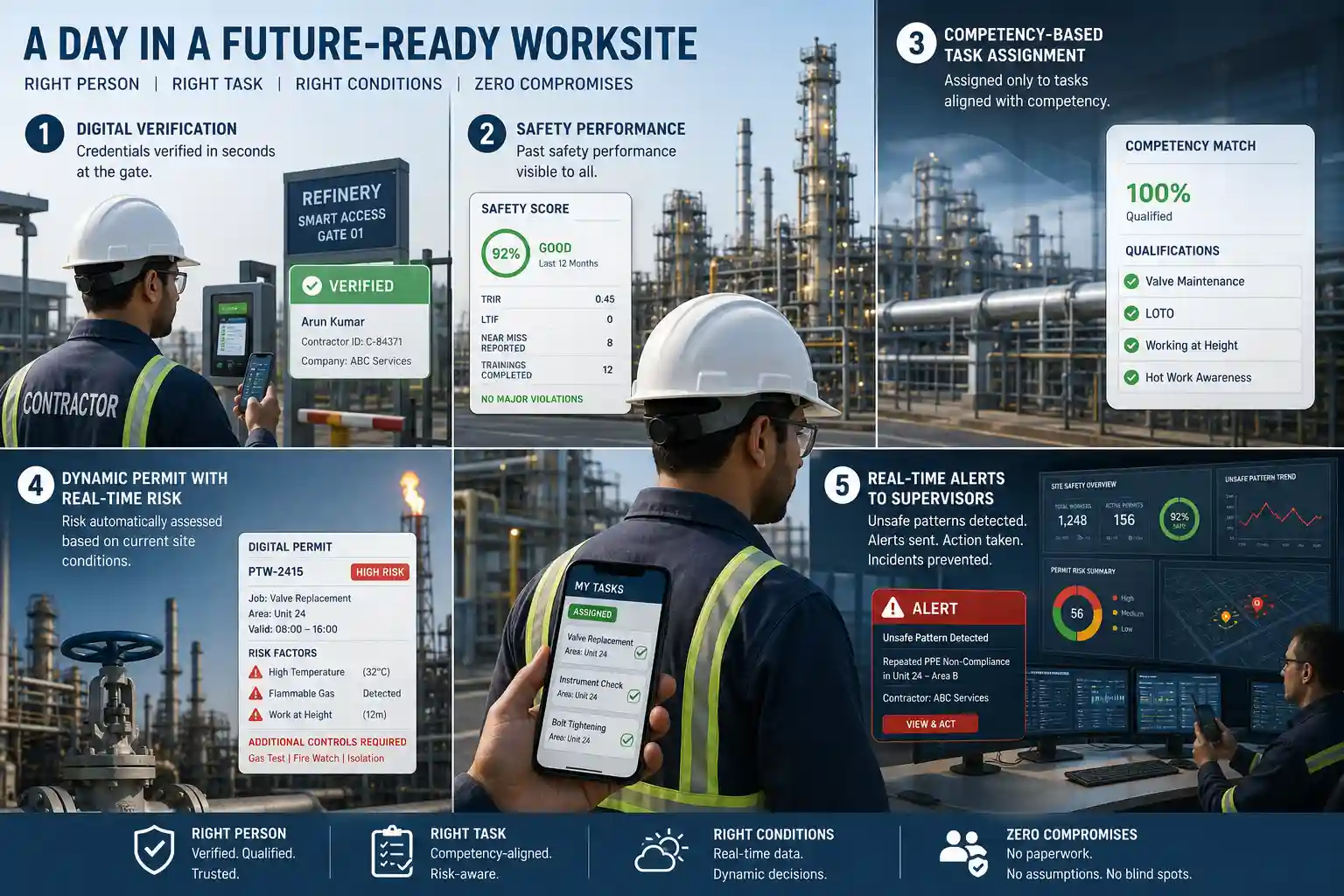
A day in future ready worksite

The Hidden Cost of Ignoring Contractor Readiness

Beyond incidents, the impact includes:

  • Project delays due to safety stoppages
  • Regulatory penalties
  • Insurance premium escalation
  • Reputation risk in ESG disclosures

More critically:
Loss of trust—from the workforce, investors, and stakeholders.

Conclusion

Contractor risk is no longer just a compliance requirement—it is a critical pillar of operational resilience and ESG performance. As industries grow more complex and contractor ecosystems expand, organizations must evolve their contractor safety management program to focus on real-time workforce readiness rather than static metrics.

A well-defined contractor management process, supported by a robust contractor safety management system, enables organizations to move beyond fragmented visibility and gain full control over contractor risk.

By leveraging advanced contractor safety management software like Tech EHS Solution, businesses can build a connected, intelligent EHS ecosystem that ensures safer operations, stronger compliance, and long-term stakeholder trust.

FAQs

Contractor risk management involves identifying, assessing, and mitigating risks associated with third-party workers in high-risk environments, ensuring safety compliance and operational continuity.

Workforce readiness focuses on real-time capability and situational awareness, while compliance is typically checklist-driven and static.

  • Real-time validation
  • Integrated permit-to-work
  • Behavior tracking
  • Data analytics
  • Adopt integrated EHS platforms
  • Shift to predictive safety models
  • Enhance workforce readiness tracking

EHS Software

Our web-based and mobile-ready HSE software solutions are a comprehensive platform for small, mid-size, and large enterprises to streamline EHS processes and standardize information management.

Solve your EHS challenges and streamline safety operations with our help.

About the Author: Purva Mishra

Purva Mishra
Purva Mishra is a seasoned content strategist with years of experience in creating high-impact B2B digital content. She focuses on simplifying complex topics in safety, compliance, and digital transformation. Her work helps organizations translate safety strategy into actionable, scalable solutions.
6 min read Views: 140 Categories: Safety Software

Leave A Comment