
Table of Contents
Introduction
The worry is that organizations are facing a growing disconnect between safety expectations and workforce readiness. The result is a widening safety talent gap, now emerging as a strategic risk at the board level.
Leading organizations do not have capital constraints or regulatory hurdles, but they do not onboard qualified EHS professionals. That is why, despite having world-class SOPs, digital systems, and compliance frameworks in place, they lack competent safety talent for safety operations.
At the same time:
This creates a paradox: More safety systems, fewer people to run them effectively!
Why Traditional Hiring Models Are Failing
Most organizations still rely on conventional hiring approaches such as job portals, referrals, or internal HR pipelines. These models are breaking down for three key reasons:
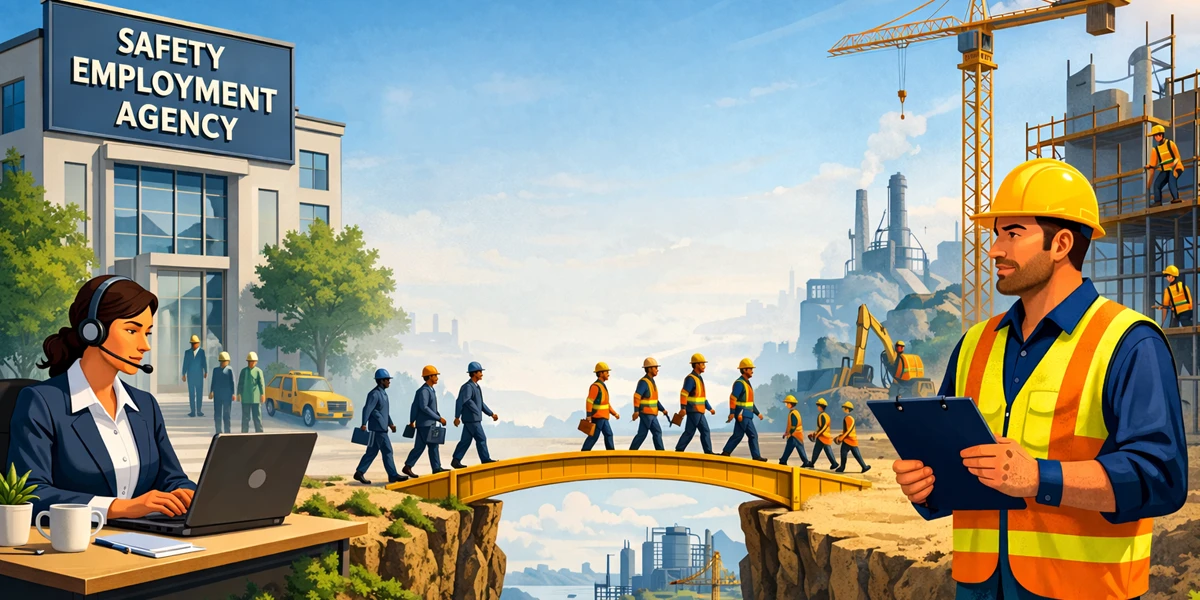
The Rise of Safety Employment Agencies
Safety employment agencies are redefining the talent ecosystem. Unlike generic staffing firms, these agencies operate at the intersection of:
They are not recruitment vendors. They are actually portraying tangible safety performance.
So how do these agencies operate, and how do you separate the sound from the noise? Let us give you a few pointers.

Industry Snapshots: Where the Gap Is Most Visible
Let us dive into the specifics of industries where the EHS manpower gap is most pronounced and how it adversely affects them.
Pharmaceutical manufacturing faces some of the most intense EHS (Environment, Health, and Safety) pressures of any industry because of its strict regulatory and compliance requirements. Audits from regulators, clients, and certification bodies are frequent, meaning any lapse in safety compliance, record-keeping, or training can quickly be exposed and lead to serious penalties, product recalls, or plant shutdowns.
As a result, there is a growing need for EHS professionals who are not just aware of general safety practices but are specifically trained in documentation-heavy roles
For example, consider a pharma plant producing sterile injectables: a minor safety incident, such as a chemical spill or improper PPE usage, must be documented in detail, investigated thoroughly, and linked to corrective and preventive actions (CAPA). An EHS professional in this setting must be able to accurately record the event, reference relevant USFDA and WHO GMP clauses, train operators to prevent recurrence, and be ready to present all of this to auditors at short notice. Without such specialized, documentation-focused EHS talent, even a technically advanced pharmaceutical plant risks non-compliance, reputational damage, and potential disruption of critical medicine supply to the market.
In the oil and gas industry, EHS challenges are amplified because work is carried out in high‑risk environments, involves complex process safety requirements, and often takes place at remote project locations. High‑risk environments include operations like drilling, refining, and handling flammable hydrocarbons under high pressure and temperature, where even a small lapse can lead to fires, explosions, or toxic releases.
Complex process safety requirements mean that EHS professionals must understand advanced systems such as pressure relief devices, emergency shutdown systems, and hazard and operability (HAZOP) studies, and ensure that all procedures are followed precisely.
For example, an offshore drilling platform in the Middle East must manage risks such as gas leaks and blowouts while operating days from the nearest major hospital. Here, a specialized EHS professional is responsible for conducting regular gas detection checks, ensuring blowout preventers are tested, training crew for emergency evacuation drills, and coordinating with onshore emergency response teams.
Data centers are expanding rapidly worldwide, driven by cloud computing, AI workloads, and the growing demand for always‑on digital services. This rapid expansion creates a unique safety challenge because EHS requirements must cover both high‑risk construction phases and highly controlled operations phases. During construction, risks include working at height, heavy lifting, electrical installations, and coordinating multiple contractors on congested sites. Once operational, the focus shifts to equipment reliability, fire safety, risks from batteries and diesel generators, and ensuring uninterrupted power and cooling for critical IT infrastructure. At the same time, data centers are under increasing ESG scrutiny from investors, regulators, and customers, who are closely tracking metrics such as energy usage, water consumption, carbon footprint, and worker safety performance.
For example, consider a new hyperscale data center being built. In the construction phase, the EHS team must manage fall protection for workers installing overhead cable trays and verify contractor certifications for electrical work; once the facility is live, the same organization must ensure safe maintenance of high‑voltage switchgear, implement robust fire detection and suppression systems in server halls, and report safety incidents and LTIFR as part of its ESG disclosures. This dual responsibility, combined with mounting ESG expectations, makes specialized EHS talent critical for data center projects.
In the infrastructure and construction sector, organizations often operate through short‑term, high‑intensity projects that demand rapid mobilization and demobilization of resources. This creates significant workforce variability, as large numbers of workers are brought in for limited durations and then rotated out, often across different locations and project types. Such environments are typically built around multi‑contractor ecosystems, where principal contractors, sub‑contractors, and specialist vendors share the same site but may follow different safety cultures, training standards, and compliance practices.
For example, on a large metro rail construction project, one contractor may be responsible for civil works such as tunneling and elevated viaduct construction, another for electrical installations, and yet another for signaling systems. Each of these contractors may have varying levels of safety awareness and documentation practices. Without qualified EHS professionals to coordinate safety protocols, standardize inductions, verify contractor certifications, and conduct regular site inspections, the risk of incidents such as falls from height, equipment collisions, or unsafe electrical work increases significantly.

