

Table of Contents
Introduction
One safety officer can prevent 10 accidents!!
For CXOs, Plant Heads, and ESG leaders across high-risk industries, the real question is no longer “How many safety officers do we have?”
It is:
Are we enabling each safety officer to function as a strategic risk intelligence node?
Consider an example:
In a large pharmaceutical plant, a single safety officer reviewed a near-miss report about a minor solvent spill. It seemed routine. No injury. No shutdown. No regulatory attention.
But they also noticed something else -> three similar entries over 45 days!!
Different shifts. Same storage rack. Same behavioral lapse and temporary container mislabeling during peak production.
They acted quickly by taking the following actions. They escalated the pattern, initiated a targeted toolbox talk, digitized the chemical handling checklist, and aligned supervisors on verification protocols.
Over the next six months, that facility recorded zero chemical handling incidents in that area.
So, that is how one safety officer can prevent 10 accidents! Its not imposssible made possible. It is just noticing patterns and proactive planning. One safety officer with proper systems and leadership quality can make a huge difference.
The Multiplier Effect in High-Risk Industries
In sectors such as pharmaceuticals, oil & gas, infrastructure, manufacturing and energy, operational complexity grows faster than headcount.
According to the International Labour Organization (ILO), over 2.3 million people die annually due to work-related accidents or diseases. In high-risk environments, even a minor procedural deviation can escalate into catastrophic loss.
Yet research consistently shows:
This means that if one safety officer can detect, interpret, and intervene at the near-miss level, they can disrupt the entire escalation chain. That is preventive risk engineering.
From Compliance Officer to Risk Strategist
Traditionally, safety officers were positioned as compliance custodians. They had to manually handle the jobs of
But today, the role has drastically evolved. A modern safety officer operates at three levels simultaneously:
1. Operational Layer
Ensuring PPE compliance, permit validation, contractor supervision, and task-based risk assessment.
2. Analytical Layer
Identifying recurring unsafe acts, near-miss clusters, seasonal trends, and production-linked risk spikes.
3. Strategic Layer
Recommending process modification, digital workflow upgrades, and leadership engagement interventions.
This layered approach is impossible with manual processes alone.
In board-level discussions—particularly across India, the Middle East, and the US—EHS is now directly linked to:
The Leadership Dimension
The most overlooked multiplier is leadership alignment. Remember, a safety officer prevents accidents when they know when to focus on what. For example;
The Strategic Reality
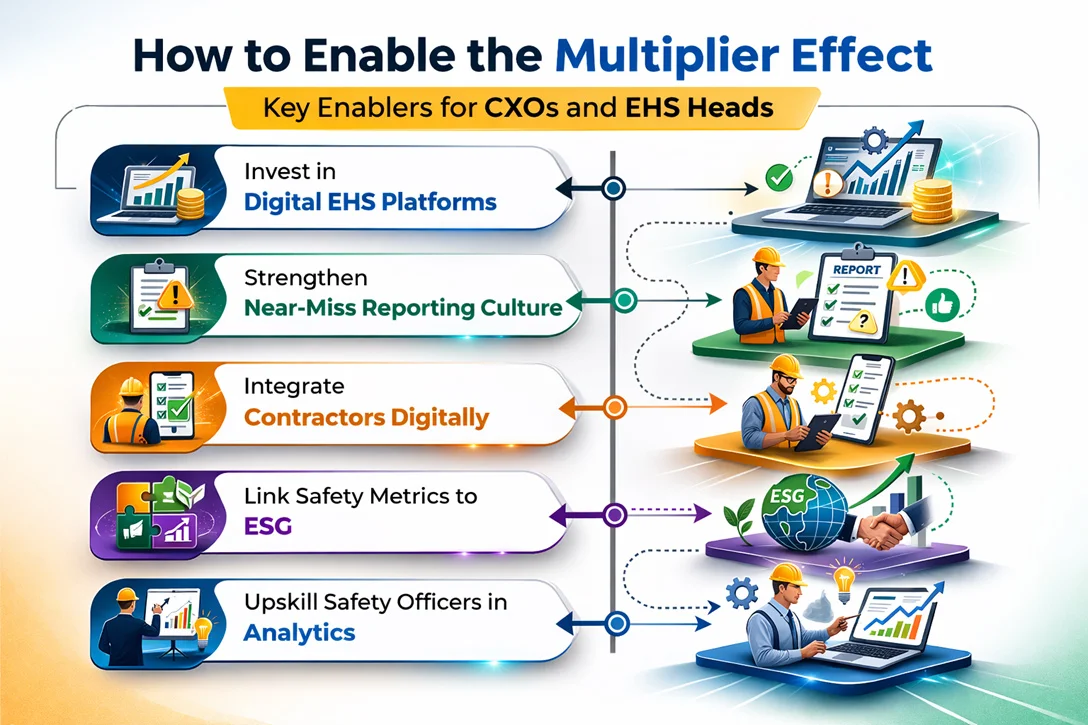
A single safety officer cannot be omnipresent, but by leveraging data visibility, digital systems, leadership access, structured processes, and ESG alignment, their reach and effectiveness are significantly enhanced. This collaborative approach transforms the safety officer into an early-warning system, allowing them to identify and prevent potential hazards before they escalate into serious issues.
In high-risk industries across India, the Middle East, and the US, where production pressures, regulatory oversight, and global reporting expectations intersect, the question is not whether you can afford robust safety leadership.
It is whether you can afford its absence. Because one empowered safety officer does not prevent one accident. They actually prevent ten. And sometimes, far more!!
