
Table of Contents
Introduction
In today’s industrial and corporate environments, basing decisions on “gut feeling” feels kind of old school, and honestly, it doesn’t scale anymore. Modern companies produce huge streams of information almost every day, from operational indicators and field safety reviews to tracking refuse and watching how much resources get used. But here’s the thing: raw data straight from the sites is kind of useless in its early state; it’s just … noise, basically. So to turn that pile of messy workplace records into real business intelligence, organizations usually lean on a structured approach, often referred to as MIS reporting.
If you’re trying to improve cross-site visibility, boost operational efficiency, and keep compliance really tight with international standards, then understanding how to work with management information system reports matters a lot.
In this guide, we’ll sort of unpack what these summaries actually mean, look at the different specialized types, and walk through industrial examples you might recognize, and we’ll also explain how selecting a dedicated management information system software platform can practically reshape your corporate compliance workflow for the better.
What is MIS Reporting?
To grasp the real value behind MIS reporting, it helps to first clarify its core meaning and its purpose inside a modern company.
MIS Report Full Form
First things first, let’s clean up the basic terminology. The MIS report’s full form stands for Management Information System Report.
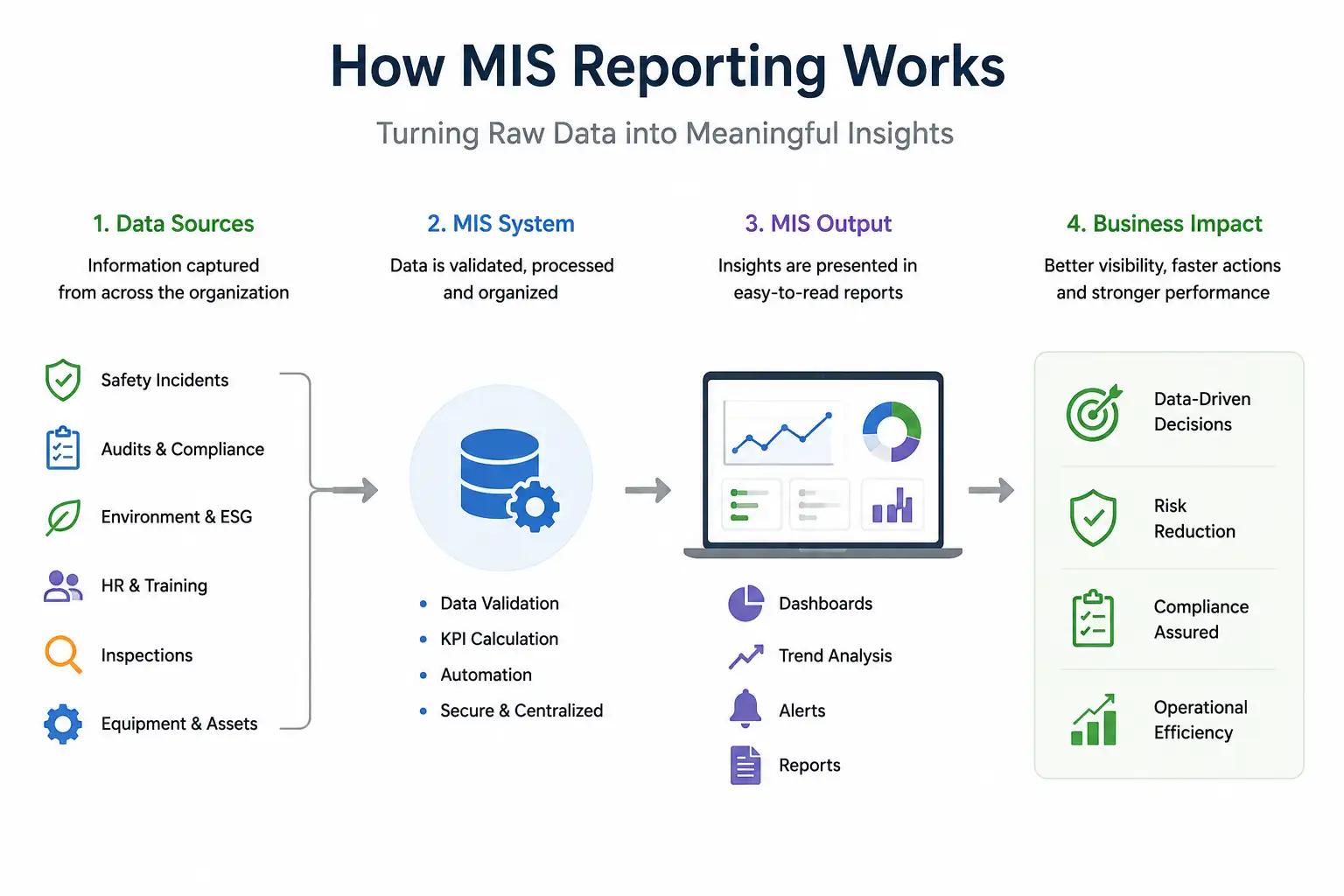
An MIS report is a carefully curated, consolidated set of data collected from multiple parts of an organization, run through centralized logic, and shown in a concise, easy-to-read format—like interactive dashboards, trend lines, or compliance summaries. The goal is pretty direct: it gives managers, stakeholders, and executive leaders a clear picture of company performance, so decisions can be proactive and grounded in evidence.
Unlike basic transactional receipts or daily log sheets that just document one event, management information system reports are naturally analytical. They don’t only tell you what happened on the factory floor or what happened at a project location. Instead, they add context, compare current numbers against historical benchmarks, show where results drift beyond regulatory thresholds, and sometimes even support forward-looking operational trend insights.
The Role of MIS in Modern Business Infrastructure
Large enterprises run on multiple moving pieces. EHS groups, operations leaders, HR teams , and sustainability professionals often all work at the same time. Without one centralized digital place to gather this information, departments can drift into silo thinking, and that’s when issues start building up quietly.
That’s where an enterprise-grade management information system software platform fits in. Think of it like the central nervous system for the organization. It pulls raw data from field mobile applications, site inspection notes, and facility smart meters, processes it using predefined business rules, then outputs standardized and structured insights.
When a company adopts dedicated MIS software, it tends to shift from reactive mode to proactive, prevention-first mode. Instead of finding out during an end-of-year audit that a plant breached environmental emissions permits or that safety training targets were missed, leadership can spot anomalies week by week and adjust fast before the problem becomes a bigger compliance headache.
Key Benefits of Automated MIS Reporting
Why are forward-thinking industries putting money into specialized MIS report tools and not just relying on old-school data collection routines? The business advantages are pretty clear, and they really touch operational longevity:
Flawless Decision-Making: It cuts out the guesswork entirely. Executives can justify every capital allocation, policy shift, or risk mitigation move using empirical evidence rather than “gut feel.”
Reduced Manual Reporting Effort: By automating data collection through field-ready applications, teams avoid that tedious, multi-hour loop of chasing site supervisors for monthly updates.
Enhanced Data Accuracy: When MIS reporting software supports multi-tiered review workflows, the common human errors and data padding get filtered out before the information shows up at corporate eyes.
Trend Analysis and Predictive Action: Stored historical logs within MIS software—securely managed of course—help businesses spot repeating incident clusters, seasonal surges in resources, and those lingering operational bottlenecks.
Streamlined Audit Readiness: A lot of industries get hammered by regulatory inspections. With an automated, auto-generated audit trail, your enterprise stays compliant, and honestly, the whole thing feels less like a panic exercise.
Core Components of an Effective MIS Report
An impactful MIS report isn’t merely a spreadsheet loaded with random numbers. For it to be genuinely useful to decision-makers, it needs a few structural traits that hold up under scrutiny:
Relevance: The data has to align with the manager’s area of responsibility. A Chief Sustainability Officer should see greenhouse gas metrics and corporate disclosures, while a Site Engineer needs fast, open action item logs and related constraints.
Accuracy & Verification: Bad data produces bad strategies and can trigger huge non-compliance penalties. The system should include data validation rules right at the point of entry, so mistakes are caught early, not later.
Timeliness: Operations move quickly. A report about a critical machinery risk or a jump in near-miss incidents becomes nearly useless if it reaches the plant manager three weeks late. Modern MIS reporting software can deliver reports through real-time interactive widgets or automated email reminders, depending on your setup.
Clarity and Visual Appeal: Busy executives don’t have time to decode dense raw tables. Strong reports use data visualization tools, like Power BI integrations, to transform thousands of entries into clean heatmaps, charts, and progress bars and the rest of the story becomes obvious.
Types of MIS Reports (With Real-World Examples)
Management information systems are pretty flexible, so depending on which department you’re talking about and also where the user sits on the hierarchy, MIS reports can show up in a few different formats.
Let’s walk through how these report categories actually show in a modern, compliance-driven company:
1. Incident and Safety MIS Reports
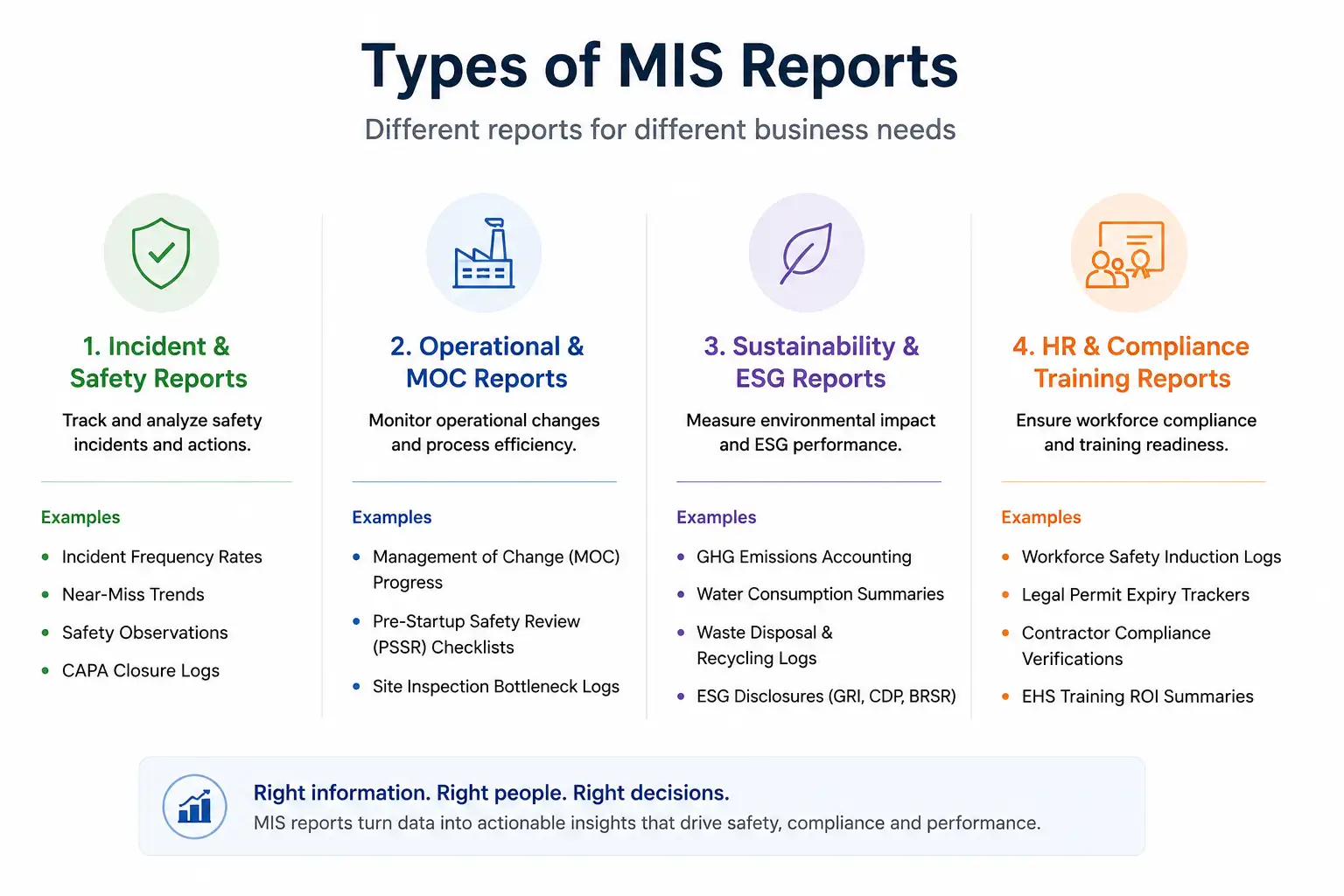
Keeping the workforce safe and watching for hazards on-site are like the main foundation blocks of corporate governance. These reports tend to track, categorize, and also analyze workplace safety incidents, kind of end to end.
Examples: Incident Frequency Rates, Near-Miss Trends, Safety Observation Overviews, and Corrective and Preventive Action (CAPA) Closure Logs.
Real-World Scenario: An operations director checks a monthly Safety Observation Overview. The report shows near-miss incidents for slips and trips went up by 25% at one regional warehouse. Right away, leadership uses those findings to launch focused safety campaigns plus floor-plan audits. The point is simple: reduce the risk before someone gets badly hurt.
2. Operational Efficiency and Change Reports
These reports are more about the day-to-day running of core activities. They monitor facility workflows, record any asset changes, and capture structural or operational shifts that happen over time.
Examples: Management of Change (MOC) Progress Reports, Pre-Startup Safety Review (PSSR) Checklists, and Site Inspection Bottleneck Logs.
Real-World Scenario: A plant manager relies on an MOC report to follow equipment upgrades across three separate processing lines. The report surfaces that two big action items are still waiting on the engineering head’s approval, so the line restart could get pushed. The system sends an alert automatically, and the team clears the bottleneck quickly, before it becomes a bigger drag on production.
3. Sustainability and ESG Reports
Corporate responsibility and environmental tracking used to be treated like optional busywork, but now it’s basically non-negotiable. ESG reports handle the hefty work of counting resource usage and mapping corporate carbon footprints.
Examples: GHG Emissions Accounting, Water Consumption Summaries, Waste Disposal and Recycling Logs, and Corporate ESG Disclosures (aligned with GRI, CDP, or BRSR frameworks).
Real-World Scenario: A company getting ready for its yearly sustainability disclosure uses advanced MIS report tools to compute location-based carbon emissions automatically. It pulls data from utility invoices uploaded during the year. That cuts out weeks of manual calculations and helps ensure the disclosure is audit-ready and consistent.
4. Human Resource & Compliance Training Reports
An organization has to confirm its people are qualified, authorized, and actually safe to work in high-risk conditions.
Examples: Workforce Safety Induction Logs, Legal Permit Expiry Trackers, Contractor Compliance Verifications, and EHS Training ROI Summaries.
Real-World Scenario: A compliance officer in HR opens an automated dashboard and gets a prompt: 15% of the heavy machinery operators at a critical site have safety certifications expiring within the next 30 days. The system then arranges the required refresher training sessions automatically. This helps protect the enterprise from regulatory penalties and also avoids unexpected operational stoppages.
Key Types of MIS Reports
| Report Category | Primary Target Audience | Core Key Performance Indicators (KPIs) | Strategic Business Value |
|---|---|---|---|
| Incident & Safety | EHS Directors, Safety Officers, COO | Total Recordable Incident Rate (TRIR), Near-Miss Trends, CAPA Closure Rate | Mitigates workplace hazards, protects the workforce, and reduces operational downtime. |
| Operational & MOC | Plant Managers, Operations Heads | Management of Change (MOC) Approvals, PSSR Status, Site Inspection Bottlenecks | Ensures operational changes are executed safely without risking asset integrity. |
| Sustainability & ESG | Chief Sustainability Officer, Investors | GHG Scope 1/2/3 Emissions, Water Intensity, Waste Diversion Rate | Satisfies global disclosure frameworks (GRI, BRSR) and improves corporate reputation. |
| Compliance & Training | HR Directors, Legal Counsel, Audit Teams | Statutory Permit Expiry Dates, Safety Training Completion %, Contractor Compliance Rates | Minimizes legal liabilities, eliminates regulatory fines, and ensures workforce readiness. |
From Traditional Spreadsheets to Modern MIS Reporting Software
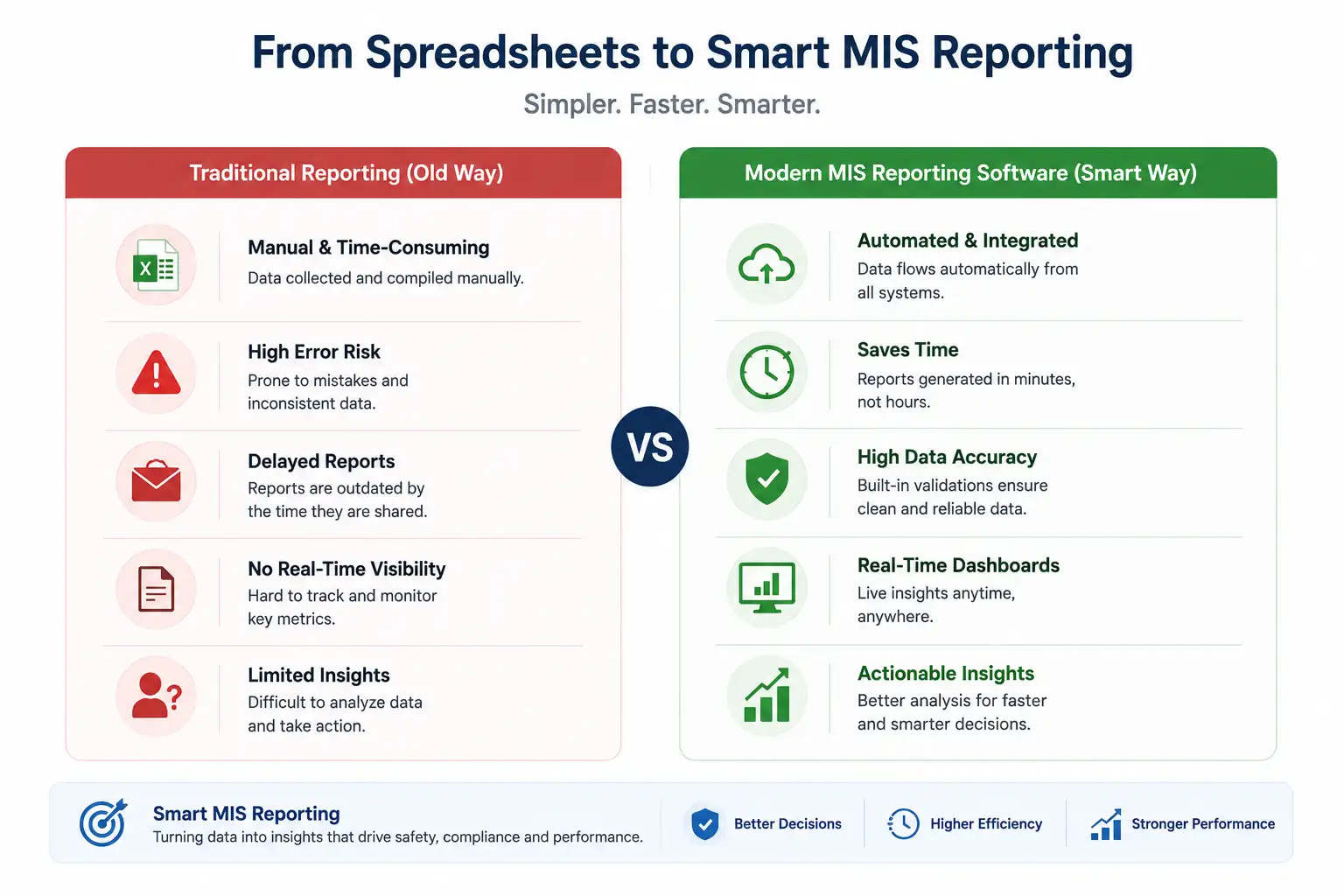
Historically, building an MIS summary was basically a grueling, manual job. At the end of every month, compliance officers and data analysts would download CSV files from a bunch of different systems, then paste everything into big Excel workbooks, write formulas that are kind of fragile, and spend days creating those static chart visuals.
That old way has some major, obvious problems, but nobody notices until it hurts:
Meanwhile, forward-looking organizations have pretty much ditched legacy spreadsheets and moved to dedicated, cloud-based MIS reporting software. Modern MIS tools integrate smoothly with your existing corporate ERPs, facility operations infrastructure, and even the field mobile apps. They handle data extraction automatically, push multi-layered verification loops, and show the numbers through dynamic interactive dashboards that can be accessed securely from pretty much any device.
How to Choose the Best MIS Reporting Software for Your Organization
Putting money into the right software setup is key if you want the full upside of automated monitoring across your enterprise. When you compare different management information system software options, you should look at these must-have criteria:
1. Enterprise Ready & Highly Flexible
No two organizations run the same, so a one-size-fits-all system might not work for you. Go with MIS software that allows customization and scaling of features, like incident tracking, audit processes, and ESG management, as your operations evolve.
2. Built-In Data Verification Workflows
To keep data accuracy rock-solid, the platform shouldn’t just accept everything blindly. The better solutions include a multi-step review pipeline so designated reviewers can accept submissions, ask for corrections, and also maintain an immutable audit trail for every edit made.
3. Native Mobile Integration
Data collection starts on the ground. Your reporting platform needs to come with field-ready mobile apps that let workers log hazards, capture image proof, and update checklist items directly from site work , even when there’s no internet connection.
4. Advanced Analytics & Power BI Compatibility
Raw metrics need to become clear strategic meanings. Make sure your platform supports native integration with analytics leaders like Power BI, so corporate teams and site-level teams can work with live data feeds, apply advanced filters, and spot operational anomalies quickly, or at least faster than before.
5. Role-Based Access and High-Tier Security
Workplace operations, occupational health indicators, and compliance records hold sensitive data. Your software infrastructure should include enterprise-level security controls, multi-factor authentication, and strict role-based access control, so each user only views information tied to their clearance level.
Digitally Transform Your Operations with TECH EHS
So if you’re done with chaotic spreadsheets, disconnected reporting methods, and those kinds of siloed tracking modules, then looking for a dedicated platform that fits your enterprise compliance ecosystem is kind of the next obvious move.
TECH EHS MIS Reporting Software is designed so you can centralize your enterprise compliance, EHS, and operational data into clean, actionable, audit-ready dashboards. It gives you the kind of precision metrics and advanced analytics techniques modern leadership teams need to push safe, sustainable, and very efficient operations forward.
We also support periodic local data entry, automated KPI calculations, multi-tiered data verification, and smooth integration with the enterprise infrastructure you already have. That means your leadership team stops spending time chasing numbers and starts actually executing strategy. If you want to see how that looks in practice, check out our product page: TECH EHS MIS Reporting Software.
Step-by-Step Guide: Implementing an MIS Framework Successfully
Switching to an automated reporting structure really does need careful planning. Use this five-step blueprint to keep the transition from getting messy:
Step 1: Define Your Strategic Objectives
Don’t begin by staring at raw data; start with the goals of your organization. Talk to your executive team and identify which metrics make a real difference. Are you chasing zero workplace incidents, or trying to streamline environmental compliance, or minimizing asset downtime? Write these targets down before you configure any dashboards.
Step 2: Establish Secure Field Data Pipelines
Figure out where your raw data currently lives. Is it trapped in localized spreadsheets, tucked into physical paper logs, or stuck inside siloed software? Build strong digital data pipelines by giving field teams mobile tools that are intuitive, so they can capture information right at the source.
Step 3: Implement Rigorous Review Workflows
If you want your corporate management information system reports to be reliably trustworthy, set up a multi-tiered data verification workflow. Let site managers and subject matter experts review, validate, and sign off on local submissions before anything rolls up into executive summaries.
Step 4: Train Your Teams for Maximum Adoption
Even the best software doesn’t help much if people don’t use it. Run training sessions across all levels of your organization. Make it clear how automated MIS reporting software cuts down the time site workers spend each week on tedious manual compilation and how that turns initial skepticism into real adoption across the company.
Step 5: Continuously Audit and Refine KPIs
Industrial rules and regulatory environments change, like constantly. A compliance framework or performance metric that mattered last year might get replaced by newer global guidelines today. So review your report configurations routinely to keep everything aligned with shifting corporate strategies and legal mandates.
