
Table of Contents
Introduction
You’d think the answer to this one is simple. Show workers a video, and they know what to do. But playing the video is the easy part; checking that it worked is where things get hard.
So why are workplace safety videos important for employee training, and where do they fall short? Let’s find out. If you manage EHS or training across sites in more than one country, this one is written for you.
The Numbers
Let us start with the size of the problem first. So the International Labour Organization(ILO) puts it at around 2.93 million workers who died from work-related factors in 2019 [1]. That’s the latest year their global estimates go up to. It’s a frightening number.
Country data tells the same story at a local level:
- 1In the United States, the Bureau of Labor Statistics counted 5,070 fatal work injuries in 2024 [2], and that’s just one country.
- 2
In India, the number of fatal injuries in registered factories was 1,090 in 2023 [3]. This is Ministry of Labour and Employment data, compiled by DGFASLI. The wider informal workforce is not included.
Do Safety Training Videos Actually Work?
Do safety training videos actually work? In short, yes. But they work better for some jobs than others, and it mostly comes down to how dangerous the job is.
Let’s start with the study most people quote. In 2006, Burke and colleagues pooled 95 studies covering 20,991 workers, which is a lot of workers. That is a lot of workers and the report was published in the American Journal of Public Health. They sorted training methods by how much the workers got involved, and videos landed in the “least engaging” group along with lectures and pamphlets.
That sounds bad for employee training videos, but it isn’t the whole picture. The more hands-on the training was, the more workers learned, and the bigger the drop in accidents, illnesses, and injuries. Every method still improved safety behavior in a meaningful way though; videos included [4].
Then a 2025 study in Safety Science came along and muddied things a bit. This one was done on real construction job sites, which we like. Workers got the same content in five different ways: a pre-recorded video, a lecture, an interactive lecture, a flipped format, and an interactive lecture with a hands-on activity.
The researchers only checked short-term results. That meant how well workers spotted hazards, high-energy hazards too, plus their risk perception and risk tolerance. The more interactive formats kept workers more engaged. But that extra engagement did not lead to significantly better results on the learning outcomes they measured [5].
So one study says hands-on training does better and the other found no real difference. Which one is right?
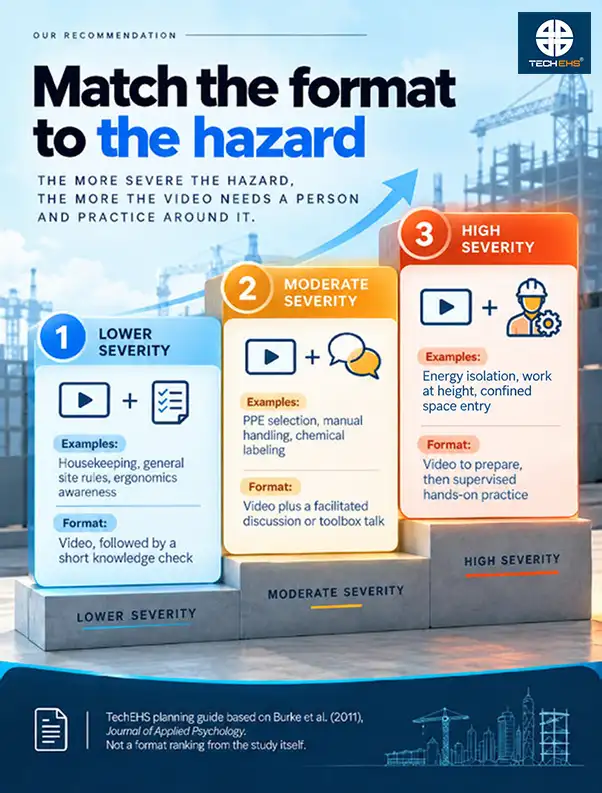
Burke’s team sort of answered this in a later meta-analysis [6]. When the hazard was severe, highly engaging training was considerably more effective. For lower-severity hazards, engaging and less engaging methods did about the same. So before you pick a format, ask how bad things get if a worker gets this task wrong.
Can a Video Alone Meet Legal Requirements?
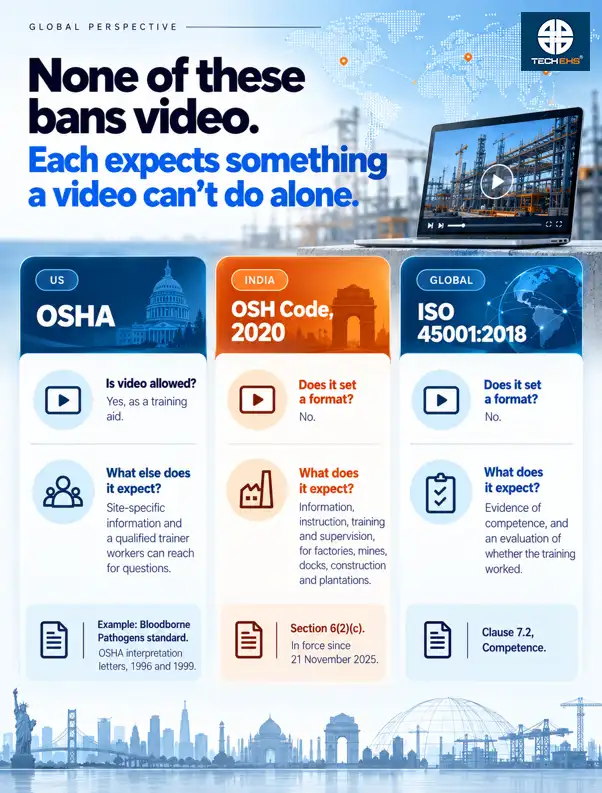
Usually not. None of the three frameworks below bans video. But each one expects something a video cannot do by itself.
| Framework | What the text says | What it means for your video program |
|---|---|---|
| US: OSHA | Under the Bloodborne Pathogens standard, OSHA has stated that training employees solely by film or video, with no chance for discussion, violates the standard. Videos can support training but must come with site-specific information and an accessible person [7]. For web-based courses, OSHA has accepted a hotline or email if workers get timely answers from a qualified trainer [8]. | Every video needs a named trainer workers can get hold of, plus the site-specific stuff the video can’t know. |
| India: OSH Code, 2020 | In force since 21 November 2025. Section 6(2)(c) lists, among employer duties for factories, mines, docks, building or other construction work and plantations, providing the information, instruction, training and supervision necessary for all employees’ health and safety [9]. | No format is set. The video can do the instruction part, supervisors still check that it lands on the floor. |
| Global: ISO 45001:2018 | Clause 7.2 requires organizations to determine the competence workers need, ensure they have it, take action where they don’t, “evaluate the effectiveness of the actions taken,” and keep evidence of competence [10]. | A completion record only tells you training happened. ISO 45001 wants to see that it worked. |
How to Build Safety Videos Into Your Program
This is roughly the order we’d follow for workplace safety training videos on a multi-site operation:
- 1Start with your own data: the incidents, near misses and audit findings that keep coming back across sites. A generic topic library is the lazy option.
- 2
Rate each topic by severity before you script any workplace safety videos; use the table above for that.
- 3
Localize properly. Translating the narration is only half of it; you also have to check the equipment, signage, and PPE on screen match what workers use at each site. Easier said than done, we know!
- 4Every one of your employee safety videos needs a person attached, a named supervisor or trainer who answers questions, plus the toolbox talk or practical session that follows.
- 5Check understanding, not views, with scenario questions, short practical demonstrations, or supervisor observation.
- 6
Refresh it when a task, tool or procedure changes, and on any schedule your applicable standards set.
Views vs Competence
Views and competence are two different things. An LMS log might say a worker watched 100% of the video, and all that proves is ONE thing: the video played. Completion records alone are insufficient to demonstrate that someone can perform the task safely. That’s why ISO 45001 has the requirement to evaluate effectiveness [10].
So how do you actually evaluate it? Start with a short evaluation test right after the session, built around scenario questions (“what would you do if…”) rather than recall. For higher-risk tasks, add a practical demonstration where the worker performs the task in front of a supervisor. Then follow up with an on-the-job observation a few weeks later to confirm the behavior has stuck. Record each result, whether it’s a passed test, a signed-off practical or a supervisor observation, and keep it next to the viewing record.
References
Official, regulatory and standards sources:
[1] International Labour Organization (2023). A call for safer and healthier working environments. Geneva: ILO. https://doi.org/10.54394/HQBQ8592
[2] U.S. Bureau of Labor Statistics (2026, February 19). Census of Fatal Occupational Injuries Summary, 2024. https://www.bls.gov/news.release/cfoi.nr0.htm
[3] Directorate General Factory Advice Service and Labour Institutes (DGFASLI), Ministry of Labour and Employment, Government of India. Standard Reference Notes (fatal and non-fatal injuries in registered factories). https://dgfasli.gov.in/Standard-reference-notes
[7] U.S. Occupational Safety and Health Administration (1996, August 28). Standard Interpretation: Use of video presentations to meet bloodborne pathogens training requirements. https://www.osha.gov/laws-regs/standardinterpretations/1996-08-28-0
[8] U.S. Occupational Safety and Health Administration (1999, October 20). Standard Interpretation: Web-based HAZWOPER refresher training, hands-on training and trainer access. https://www.osha.gov/laws-regs/standardinterpretations/1999-10-20-1
[9] Government of India. The Occupational Safety, Health and Working Conditions Code, 2020 (No. 37 of 2020), Section 6. Text: https://dgfasli.gov.in/public/Admin/Cms/AllPdf/650059fbb8f1a9.98699174.pdf. Enforcement date: https://www.indiacode.nic.in/handle/123456789/22041
[10] International Organization for Standardization (2018). ISO 45001:2018 Occupational health and safety management systems: Requirements with guidance for use, Clause 7.2. https://www.iso.org/standard/63787.html
[11] U.S. Occupational Safety and Health Administration (2010, April 28). Training Standards Policy Statement. https://www.osha.gov/laws-regs/standardinterpretations/2010-04-28
[12] U.S. Code of Federal Regulations. 29 CFR 1910.1030(g)(2), Bloodborne Pathogens: Information and Training. https://www.ecfr.gov/current/title-29/subtitle-B/chapter-XVII/part-1910/subpart-Z/section-1910.1030
Peer-reviewed research:
[4] Burke, M. J., Sarpy, S. A., Smith-Crowe, K., Chan-Serafin, S., Salvador, R. O., & Islam, G. (2006). Relative effectiveness of worker safety and health training methods. American Journal of Public Health, 96(2), 315-324. https://doi.org/10.2105/AJPH.2004.059840
[5] Raeisinafchi, R., Bhandari, S., Perry, L., Hallowell, M. R., Albert, A., & Correll, J. (2025). Comparing training delivery methods: Impact on learning outcomes and engagement among construction workers. Safety Science, 187, 106870. https://doi.org/10.1016/j.ssci.2025.106870
[6] Burke, M. J., Salvador, R. O., Smith-Crowe, K., Chan-Serafin, S., Smith, A., & Sonesh, S. (2011). The dread factor: How hazards and safety training influence learning and performance. Journal of Applied Psychology, 96(1), 46-70. https://doi.org/10.1037/a0021838
