

ehs software vs excel safety management

Table of Contents

Introduction

So if you’re weighing EHS management software against spreadsheet-based management, here’s the short answer, more or less. Spreadsheets are good at storing safety data; they do that part fine. But EHS software is built to control the data, which means one record per incident, inspection, or permit, with a named owner, an audit trail, and reports that don’t need rebuilding every month.

And most safety teams aren’t really choosing between the two anyway. A 2026 National Safety Council report found that only 11% of organizations have fully digitalized EHS systems [1], which is a pretty low number for 2026. Another 71% operate in hybrid environments that combine digital and manual workflows, while 18% rely primarily on manual or paper-based processes [1]. These hybrid workflows can leave safety data fragmented across systems, spreadsheets, and paper records, making information harder to consolidate and act on.
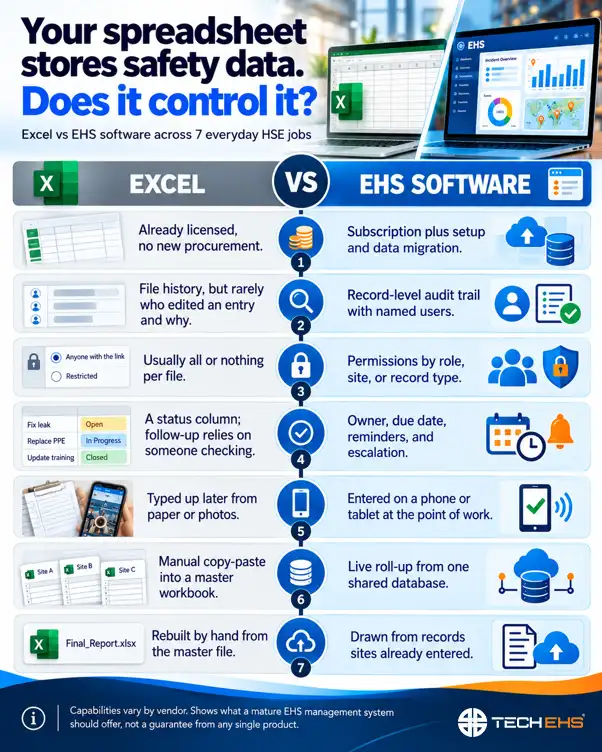
EHS Software vs Excel: How They Compare

EHS Software vs Excel Comparison
What you need Excel or shared spreadsheets EHS software
Cost to get started Already licensed in most organizations, no new procurement Subscription or licence, plus configuration and data migration effort
Knowing who changed a record Cloud versions keep file history, but rarely show who edited a specific entry and why Record-level audit trail tied to named users
Access control Usually all or nothing per file Permissions by role, site, or record type
Corrective actions A status column; follow-up relies on someone checking Assigned owner, due date, reminders, and escalation
Field data capture Typed up later from paper forms or photos Entered on a phone or tablet at the point of work
Multi-site consolidation Manual copy-paste into a master workbook Live roll-up from one shared database
Regulator submissions Rebuilt by hand from the master file Drawn from the same records sites already entered

Capabilities vary by vendor. The right-hand column describes what a mature EHS management system should offer, not a guarantee from any single product.

Why most safety teams are stuck in hybrid mode
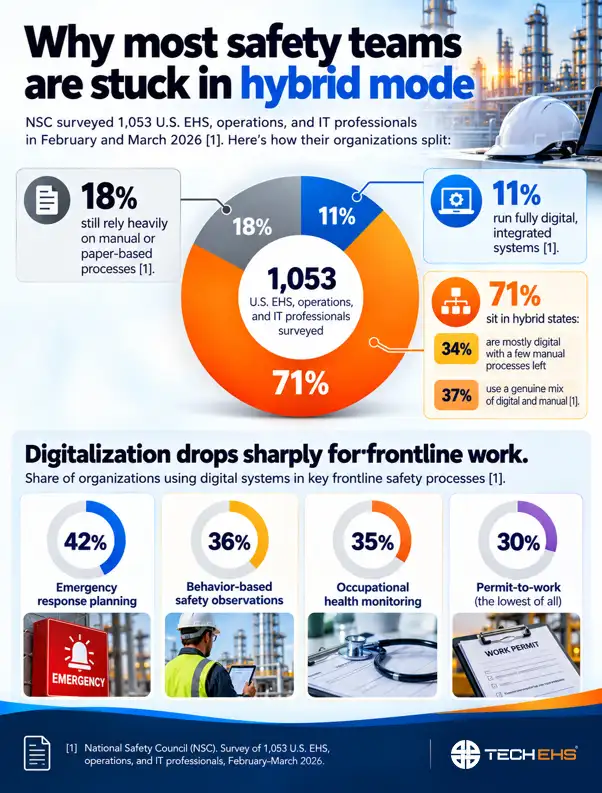
Why Safety Teams Are Stuck in Hybrid Mode

A survey co-published by the National Safety Council (NSC) polled 1,053 U.S. EHS, operations, and IT professionals in February and March 2026 [1]. Here’s how their organizations split:

  • 11% run fully digital, integrated systems
  • 71% sit in hybrid states: 34% are mostly digital with a few manual processes left, and 37% use a genuine mix of digital and manual [1]
  • 18% still rely heavily on manual or paper-based processes [1]

For most teams, in other words, EHS digital transformation is still a work in progress. The more telling finding sits underneath those numbers. Digitalization drops sharply for frontline work: emergency response planning (42%), behavior-based safety observations (36%), occupational health monitoring (35%), and permit-to-work, the lowest of all at 30% [1].

Those are frontline processes. They generate records every shift, and they carry real consequences when something gets missed. A paper permit can’t warn anyone that a second permit covers the same isolation point.

One caveat worth stating plainly: this is a U.S. sample. So treat the figures as a directional benchmark, not a global census.

Where hybrid handoffs break your safety data

Picture a typical hybrid flow. A supervisor fills in an observation card. A site administrator types it into the site spreadsheet. Once a month, someone merges every site file into a head office workbook, and your regulator submission gets built from that.

Every step in that chain involves retyping. Four things tend to go wrong:

  • 1
    Transcription errors. Handwriting gets misread and dropdown values get guessed.
  • 2

    Lag. A hazard spotted on Monday reaches head office weeks later.

  • 3

    Lost context. Photos, witness notes, and sketches stay in a site folder that nobody at HQ ever opens.

  • 4

    Silent truncation. The file opens, the totals add up, and records are still missing.

How common are spreadsheet errors?

You’ll see claims that “almost 90% of spreadsheets contain errors” across many vendor blogs. Most trace back to Raymond Panko at the University of Hawaii. In a 2000 paper for the European Spreadsheet Risks Interest Group, he reviewed field audits of real organizational spreadsheets. The audits that used stronger methods found errors in at least 86% of the spreadsheets they examined, and most of them counted only substantive errors [2].

Two honest caveats. Those audits covered financial and operational business spreadsheets, not EHS logs, and they date from the 1990s. Panko’s broader point still holds up well, though. He argued that spreadsheet errors stem from the limits of human attention, not carelessness, so simply being more careful doesn’t fix them [2].

Regulators already work digitally. Do your sites?

  • United States (OSHA). Under 29 CFR 1904.41, establishments with 100 or more employees in industries listed in Appendix B must electronically submit data from OSHA Forms 300 and 301 each year, alongside Form 300A, by March 2 [3]. Other covered establishments submit Form 300A data only. The rule requires electronic submission through OSHA’s secure website. It doesn’t mandate any particular software.
  • Gulf region. In Abu Dhabi, the City Municipality (ADM) oversees OSHAD-SF compliance for construction entities in Abu Dhabi City and handles incident reporting and mandatory forms through its electronic performance system [4], with entity registration running through the Al ADAA electronic application [5]. In Sharjah, the Prevention and Safety Authority’s audit checklist for its incident reporting code, OSHJ-COP-17, has auditors confirm that reportable incidents and periodic reports reached the authority on time, with verification through its OSHJ system where needed [6].

The risk sits in the manual handoffs: every retyping step between site and submission is another chance for a report to arrive late or incomplete, and digital portals record what arrived and when.
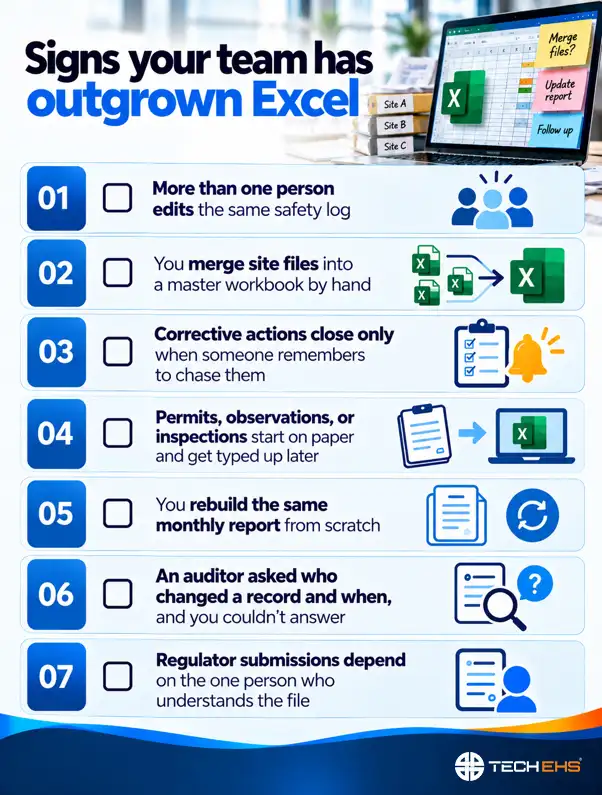
Signs your team has outgrown Excel

Signs Your Team Has Outgrown Excel

To be fair to spreadsheets: a single low-risk site with few incidents and one person maintaining the log can run on a well-protected workbook. That’s practical judgment, not a research threshold. If several of these sound familiar, though, you’ve likely passed that point.

  • More than one person edits the same safety log
  • You merge site files into a master workbook by hand
  • Corrective actions close only when someone remembers to chase them
  • Permits, observations, or inspections start on paper and get typed up later

  • You rebuild the same monthly report from scratch

  • An auditor asked who changed a record and when, and you couldn’t answer
  • Regulator submissions depend on the one person who understands the file

What to look for in an EHS management system

An EHS management system is your full set of policies, processes, and responsibilities. EHS software is the tool that runs them day to day, so it supports the system without replacing it. When you evaluate EHS management software or safety management software, check for:

  • One record per event that site and head office both work from
  • Role-based access with a record-level audit trail
  • Corrective action workflows with owners, due dates, and escalation

  • Configurable forms for your permits, inspections, and observations
  • Reporting outputs that match what your regulators actually ask for

  • Clean data export in different formats, so you’re never locked in

How to switch to EHS software without a failed rollout

Health and safety management software won’t fix a broken process on its own. A 2026 Verdantix report on EHS software implementation found that many projects miss their expected impact, and it flagged costs that climb through configuration creep and hidden AI-related expenses [7]. Each failure point it names maps to a step you can take before signing anything:

Common failure point What to do about it
Unclear requirements Map how each process works today, before you demo any EHS software solutions
Misaligned stakeholders Bring site managers, IT, and procurement in at the start, not at go-live
Underestimated data migration Clean your spreadsheets first, and decide how much history you actually need
Unprepared for system complexity Start with one lagging frontline process, such as permits or observations, at one site
Configuration creep and hidden costs Agree in the contract what counts as configuration, what counts as paid change

The Real Choice

The question isn’t really spreadsheets or software. It’s whether your sites and your head office work from the same record. Close that gap at the frontline first, where most organizations are still behind, and the reporting upstream gets far simpler.

References

Official and regulatory sources

Industry research and academic sources

Transparency note: We verified every regulatory statement in the first group directly against the regulator’s own page. The second group carries different kinds of weight. The 2026 survey [1] is a U.S. online sample commissioned by an EHS software vendor and the National Safety Council; we checked every figure against the full report, not the press release. The 71% and 18% totals combine two of the report’s response categories each, as the report itself does. The Verdantix findings [7] come from the publisher’s own summary of a paywalled report. Panko’s research [2] is academic but dates from 2000 and covers general business spreadsheets, not EHS records.

FAQs

For a single low-risk site with light record volume and one owner, a well-controlled spreadsheet can work. Once several people edit the same files, sites need consolidating, or auditors expect a clear change history, spreadsheets become hard to control. That’s usually when teams start comparing safety management software.

No. Under 29 CFR 1904.41, covered establishments must submit injury and illness data electronically through OSHA’s secure website by March 2 each year. The regulation doesn’t require any specific software to keep or prepare those records.

An EHS management system is your organization’s framework of policies, processes, and responsibilities, such as one built to ISO 45001. EHS software is a tool that helps you run and record those processes. Buying software doesn’t give you a management system by itself.

Start where your data breaks most often. For many organizations, that means frontline processes. In a 2026 NSC-published survey, permit-to-work was the least digitalized of the 11 processes measured, at 30%.

EHS Software

Our web-based and mobile-ready HSE software solutions are a comprehensive platform for small, mid-size, and large enterprises to streamline EHS processes and standardize information management.

Solve your EHS challenges and streamline safety operations with our help.

9 min read Views: 15 Categories: Safety Software

About the Author: TECH EHS

Avatar photo

Leave A Comment