

Table of Contents
Introduction
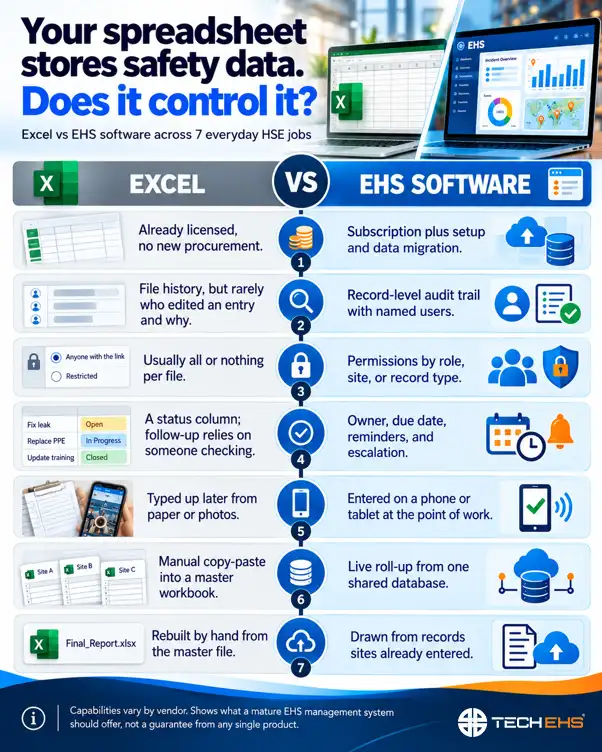
So if you’re weighing EHS management software against spreadsheet-based management, here’s the short answer, more or less. Spreadsheets are good at storing safety data; they do that part fine. But EHS software is built to control the data, which means one record per incident, inspection, or permit, with a named owner, an audit trail, and reports that don’t need rebuilding every month.
And most safety teams aren’t really choosing between the two anyway. A 2026 National Safety Council report found that only 11% of organizations have fully digitalized EHS systems [1], which is a pretty low number for 2026. Another 71% operate in hybrid environments that combine digital and manual workflows, while 18% rely primarily on manual or paper-based processes [1]. These hybrid workflows can leave safety data fragmented across systems, spreadsheets, and paper records, making information harder to consolidate and act on.
Why most safety teams are stuck in hybrid mode
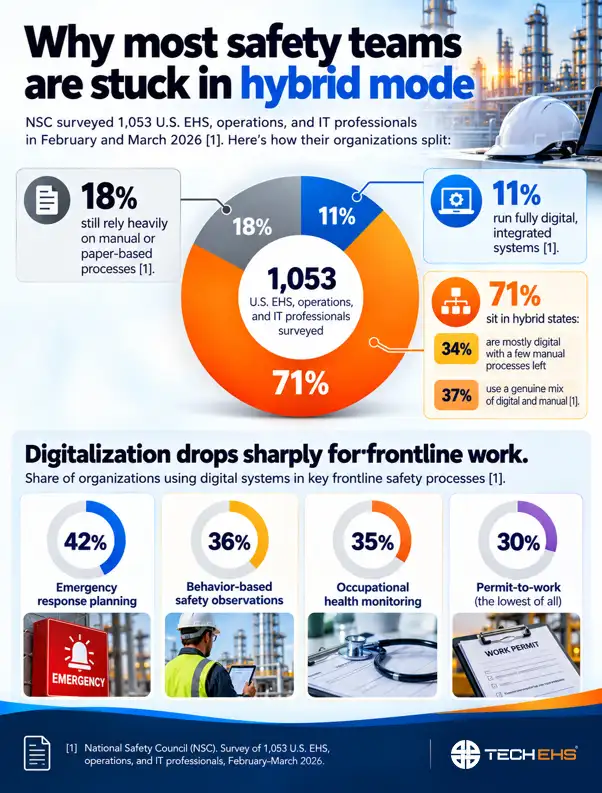
A survey co-published by the National Safety Council (NSC) polled 1,053 U.S. EHS, operations, and IT professionals in February and March 2026 [1]. Here’s how their organizations split:
For most teams, in other words, EHS digital transformation is still a work in progress. The more telling finding sits underneath those numbers. Digitalization drops sharply for frontline work: emergency response planning (42%), behavior-based safety observations (36%), occupational health monitoring (35%), and permit-to-work, the lowest of all at 30% [1].
Those are frontline processes. They generate records every shift, and they carry real consequences when something gets missed. A paper permit can’t warn anyone that a second permit covers the same isolation point.
One caveat worth stating plainly: this is a U.S. sample. So treat the figures as a directional benchmark, not a global census.
Where hybrid handoffs break your safety data
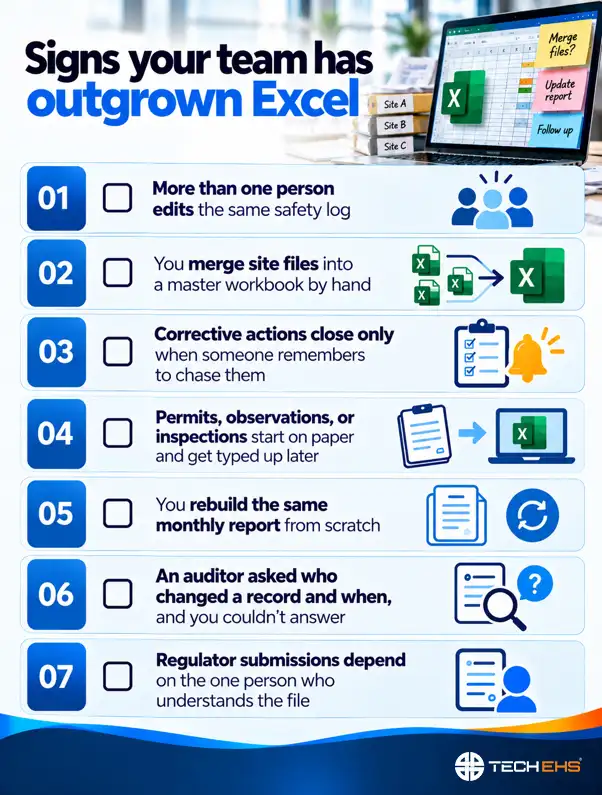
Picture a typical hybrid flow. A supervisor fills in an observation card. A site administrator types it into the site spreadsheet. Once a month, someone merges every site file into a head office workbook, and your regulator submission gets built from that.
Every step in that chain involves retyping. Four things tend to go wrong:
- 1Transcription errors. Handwriting gets misread and dropdown values get guessed.
- 2
Lag. A hazard spotted on Monday reaches head office weeks later.
- 3
Lost context. Photos, witness notes, and sketches stay in a site folder that nobody at HQ ever opens.
- 4
Silent truncation. The file opens, the totals add up, and records are still missing.
Regulators already work digitally. Do your sites?
The risk sits in the manual handoffs: every retyping step between site and submission is another chance for a report to arrive late or incomplete, and digital portals record what arrived and when.
What to look for in an EHS management system
An EHS management system is your full set of policies, processes, and responsibilities. EHS software is the tool that runs them day to day, so it supports the system without replacing it. When you evaluate EHS management software or safety management software, check for:
The Real Choice
The question isn’t really spreadsheets or software. It’s whether your sites and your head office work from the same record. Close that gap at the frontline first, where most organizations are still behind, and the reporting upstream gets far simpler.
