

Table of Contents
Introduction
Ask five EHS professionals what separates a Job Safety Analysis from a Risk Assessment, and you’ll probably get five different answers; we’ve heard most of them ourselves. Some people use the two terms like they mean the same thing. Others think one document can just cover for the other one, which it rarely does well.
So what’s the actual difference between JSA vs RA? Let’s find out.
They’re related, and that’s probably why they get confused so much. But they cover different scopes, get used at different points in a project, and involve different people. When a site mixes the two up, it ends up with real gaps in how it manages risk.
What Is a Risk Assessment (RA)?
Most often a risk assessment works at a bigger level than that. It looks at a broader activity, a process, or a whole work area, and it identifies the hazards across all of it, then evaluates them and works out which ones to prioritize. So the questions are things like what could cause harm and how likely it is to happen. And how bad would it be if it did, and what would bring that risk down to an acceptable level?
It sits more at the management and planning level; honestly, that’s the main difference. A risk assessment is the document a site uses to decide where the money goes, whether that ends up being controls, engineering changes, or extra supervision on the job.
What It Covers
A workplace risk assessment generally includes:
When You Need One
So what triggers a risk assessment? Usually it’s one of these:
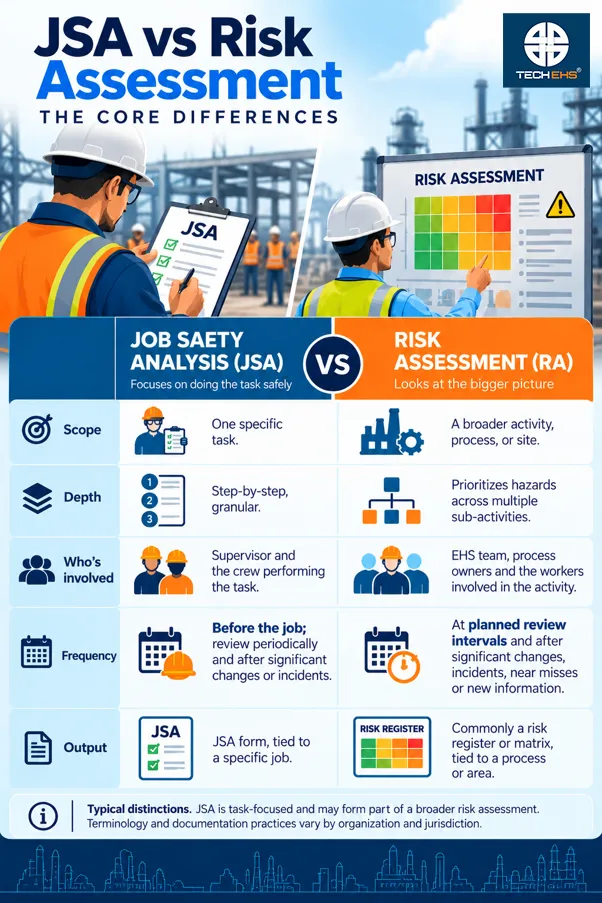
How They Work Together
The Shared Risk Matrix
A lot of organizations rate risk as likelihood times severity. The 5×5 matrix is one common format for this: you give likelihood a score from 1 to 5 and severity a score from 1 to 5, multiply the two together, and then band the result into Low, Medium, High, and Critical. Pretty simple, really. Nothing forces you to use this exact matrix, though, so whatever you go with, your site’s risk procedure should spell it out. And when the RA and the JSA share one scoring method, they speak the same language, and that’s what you want.
RA First, Then the JSA
This is the workflow we’d recommend. It’s good practice, not a regulatory sequence:
- 1Do the risk assessment for the broader activity or area (or review the one you already have)
- 2
Flag lines rated High or Critical, plus non-routine work, high-severity tasks, permit tasks, and any task with no safe work procedure
- 3For each flagged task, build a task-specific JSA, using the same likelihood and severity scale
- 4Reference the parent risk assessment in the JSA so the two stay linked
- 5Review both on their own cycles. If an incident or near miss reveals a new hazard or a failed control, review them promptly
Worked Example: Same Task, Both Levels
Let us take chemical storage and handling at a site and look at it at both levels.
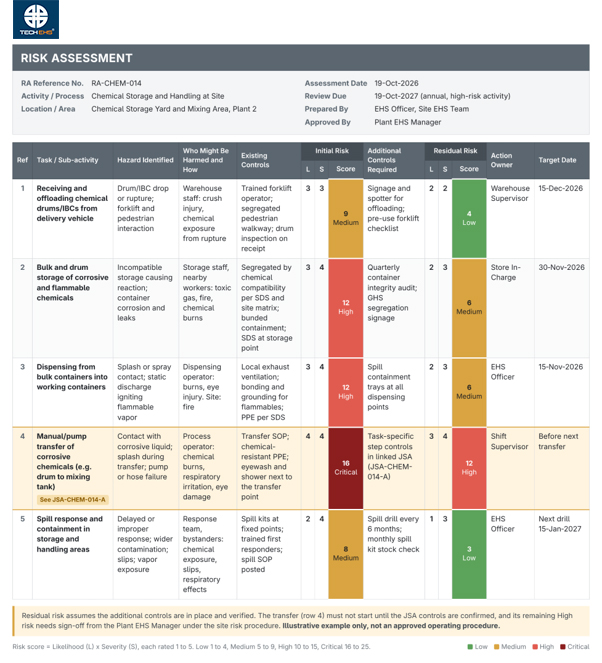
Risk Assessment sheet: Chemical Storage and Handling at Site
The risk assessment covers the full activity: receiving drums, storage, dispensing, transfer, spill response, and waste disposal. One line item in it reads:
Manual/pump transfer of corrosive chemicals between containers (e.g. drum to mixing tank), rated High risk, with a note pointing to a linked JSA for task-specific controls.
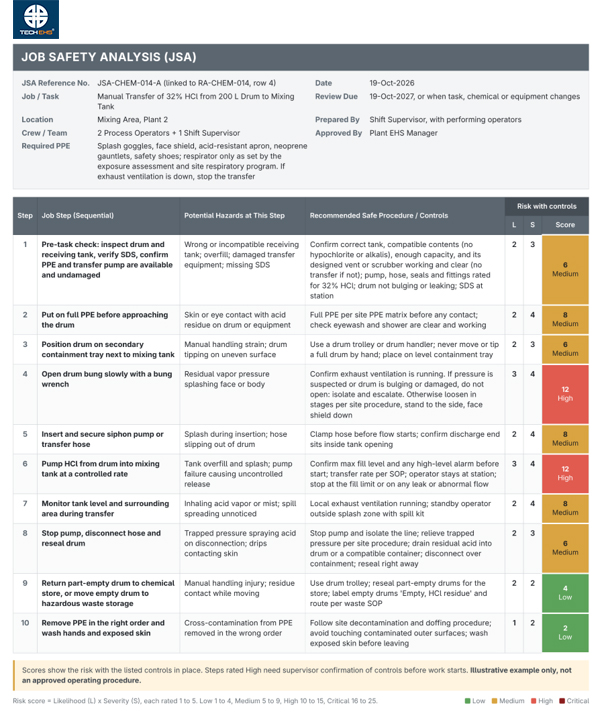
JSA sheet: Manual Transfer of Hydrochloric Acid from Drum to Mixing Tank
The JSA picks up that one line and expands it into sequential steps, from the pre-task equipment check to PPE removal and handwashing. Every step covers its own hazard and control. We also scored each step here, but that’s a procedure choice, not a must for every JSA.
Side-by-Side Takeaway
Illustrative example only. These sheets show how a risk assessment and a JSA connect. They are not an approved procedure for transferring hydrochloric acid at your site.
