

JSA vs Risk Assessment

Table of Contents

Introduction

Ask five EHS professionals what separates a Job Safety Analysis from a Risk Assessment, and you’ll probably get five different answers; we’ve heard most of them ourselves. Some people use the two terms like they mean the same thing. Others think one document can just cover for the other one, which it rarely does well.

So what’s the actual difference between JSA vs RA? Let’s find out.

They’re related, and that’s probably why they get confused so much. But they cover different scopes, get used at different points in a project, and involve different people. When a site mixes the two up, it ends up with real gaps in how it manages risk.

What Is a Job Safety Analysis (JSA)?

A Job Safety Analysis takes one task and breaks it into steps. Then, for each step, you work out the hazards and set the controls needed to do that step safely. You’ll also see it called a Job Hazard Analysis (JHA); the two terms generally mean the same thing.

That’s the whole idea behind JSA safety: before a worker starts the task, somebody has already thought about what could go wrong at each stage and put a control in place for it.

What It Covers

A well-built JSA usually has:

  • A clear task title. It should name exactly what job is being analyzed
  • The steps in that job, in order
  • The potential hazard at each step
  • The recommended safe procedure or control for each step, and this is the part that does the real work
  • Required PPE
  • Sign-off from the crew doing the task and also from their supervisor

The narrow scope is on purpose. A JSA for, say, “a manual transfer of a corrosive chemical from drum to mixing tank” covers that one task, not the whole storage yard.

When You Need One

In the US, you’ve got OSHA’s general industry PPE standard (29 CFR 1910.132(d)), and that’s the one that applies here. It requires employers to assess the workplace for hazards that require PPE, and then they have to confirm that assessment with a written certification. That certification names the workplace evaluated, the person certifying it, and the date of the assessment, so three things in total. The certification must identify the workplace evaluated, the person certifying the assessment, the date or dates of the assessment, and the document as a certification of hazard assessment. A JSA is a useful way to identify task-specific PPE needs, but it does not automatically satisfy every requirement of the standard.

Most sites also use JSAs for:

What Is a Risk Assessment (RA)?

Most often a risk assessment works at a bigger level than that. It looks at a broader activity, a process, or a whole work area, and it identifies the hazards across all of it, then evaluates them and works out which ones to prioritize. So the questions are things like what could cause harm and how likely it is to happen. And how bad would it be if it did, and what would bring that risk down to an acceptable level?

It sits more at the management and planning level; honestly, that’s the main difference. A risk assessment is the document a site uses to decide where the money goes, whether that ends up being controls, engineering changes, or extra supervision on the job.

What It Covers

A workplace risk assessment generally includes:

  • The activity or process being assessed, which is a wider scope than a single task
  • Every relevant sub-activity or hazard source inside that scope
  • Who might be harmed and how
  • Existing controls already in place
  • A likelihood and severity score for each hazard, combined into a risk rating
  • Additional controls required to reduce residual risk
  • An owner and target date for each action.

When You Need One

So what triggers a risk assessment? Usually it’s one of these:
  • ISO 45001. It calls for hazard identification and OH&S risk assessment under clause 6.1.2, and it also calls for eliminating hazards and reducing risks through the hierarchy of controls; that’s clause 8.1.2
  • Management of change (MOC), which covers things like bringing in a new chemical, process, or piece of equipment
  • Periodic review cycles (internal policy or regulation sets these)
  • Regulatory audits or client requirements. This one comes up especially in high-hazard industries like chemical manufacturing

JSA vs Risk Assessment: The Core Differences

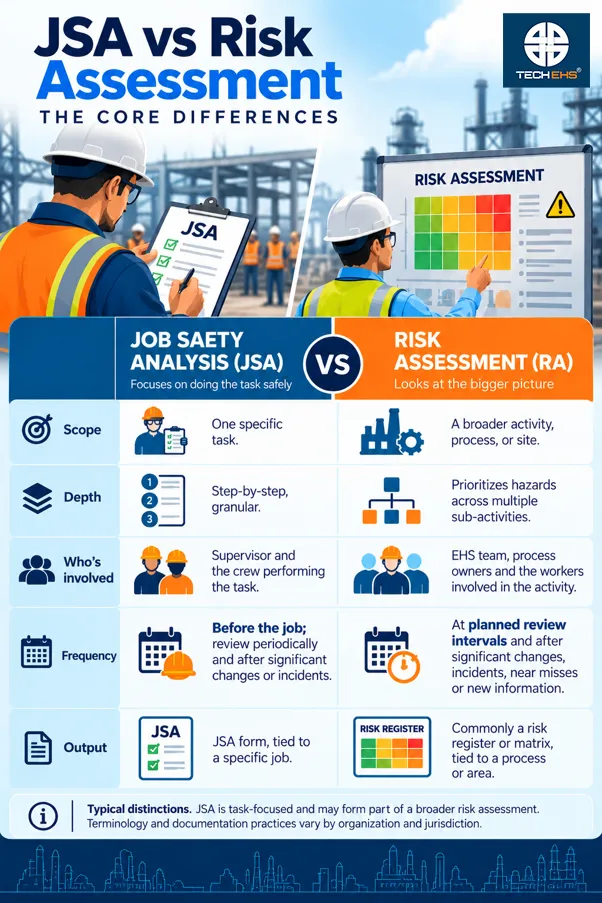
JSA vs Risk Assessment Core Differences
Factor Job Safety Analysis (JSA) Risk Assessment (RA)
Scope One specific task A broader activity, process, or site
Depth Step-by-step, granular Prioritizes hazards across multiple sub-activities
Who’s involved Supervisor and the crew performing the task EHS team, process owners, and the workers involved in the activity
Frequency Before the task; review periodically and when the task, conditions, equipment, or controls change, or an incident occurs. At planned review intervals and after significant changes, incidents, near misses, or new information.
Output JSA form, tied to a specific job Commonly a risk register or matrix, tied to a process or area

People also get tripped up by “task risk assessment.” Some organizations use it loosely for a JSA, since both zoom in on one task. But the terms aren’t universally interchangeable, and a task risk assessment can follow a different method. What matters more than the label is that the assessment covers the right scope and lands on controls that work.

How They Work Together

The Shared Risk Matrix

A lot of organizations rate risk as likelihood times severity. The 5×5 matrix is one common format for this: you give likelihood a score from 1 to 5 and severity a score from 1 to 5, multiply the two together, and then band the result into Low, Medium, High, and Critical. Pretty simple, really. Nothing forces you to use this exact matrix, though, so whatever you go with, your site’s risk procedure should spell it out. And when the RA and the JSA share one scoring method, they speak the same language, and that’s what you want.

RA First, Then the JSA

This is the workflow we’d recommend. It’s good practice, not a regulatory sequence:

  • 1
    Do the risk assessment for the broader activity or area (or review the one you already have)
  • 2

    Flag lines rated High or Critical, plus non-routine work, high-severity tasks, permit tasks, and any task with no safe work procedure

  • 3
    For each flagged task, build a task-specific JSA, using the same likelihood and severity scale
  • 4
    Reference the parent risk assessment in the JSA so the two stay linked
  • 5
    Review both on their own cycles. If an incident or near miss reveals a new hazard or a failed control, review them promptly

Common Mistakes

Let us look at the common mistakes.

Using a JSA instead of a site-wide RA

Using a JSA in place of a site-wide RA happens more than it should. A site can have dozens of well-written JSAs and still be blind to systemic risk, because nobody has ever assessed the whole operation, so that’s dozens of JSAs and not one look at the full picture.

Risk assessments that are too generic

So the risk assessment reads like a list of hazard categories, with no specific controls and no owners. A risk assessment like that won’t hold up in an audit, and it won’t change anything on site either, which makes it pretty useless.

Skipping worker consultation

ISO 45001 puts a lot of emphasis on worker consultation and participation. OSHA guidance recommends involving workers too, in hazard identification and in job hazard analyses. And that makes sense because their practical knowledge can reveal hazards that a desk-based review might miss; the people doing the job see things you won’t spot from a desk.

Worked Example: Same Task, Both Levels

Let us take chemical storage and handling at a site and look at it at both levels.
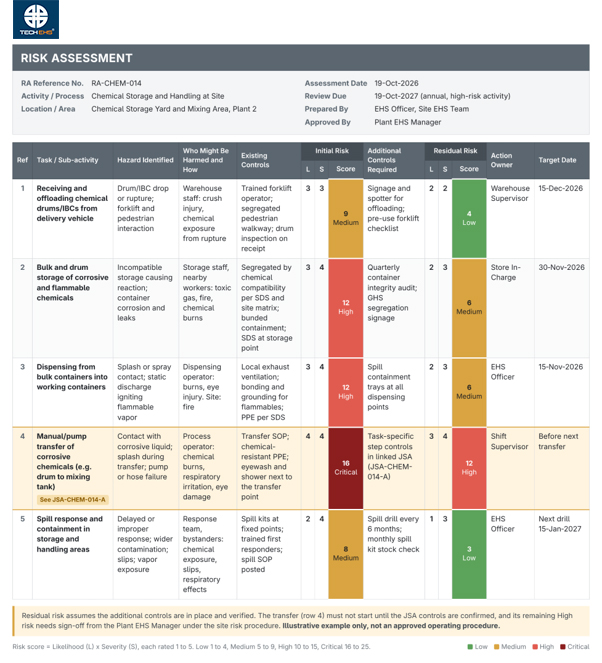
Risk Assessment sheet: Chemical Storage and Handling at Site

The risk assessment covers the full activity: receiving drums, storage, dispensing, transfer, spill response, and waste disposal. One line item in it reads:

Manual/pump transfer of corrosive chemicals between containers (e.g. drum to mixing tank), rated High risk, with a note pointing to a linked JSA for task-specific controls.
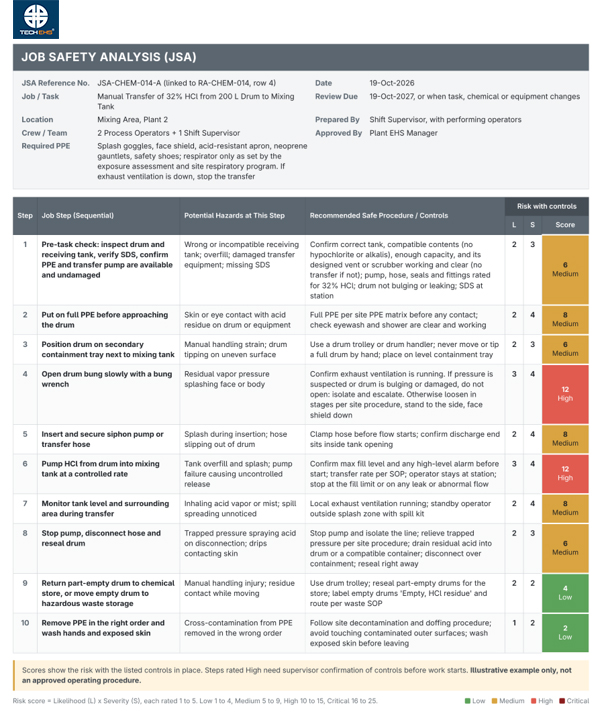
JSA sheet: Manual Transfer of Hydrochloric Acid from Drum to Mixing Tank

The JSA picks up that one line and expands it into sequential steps, from the pre-task equipment check to PPE removal and handwashing. Every step covers its own hazard and control. We also scored each step here, but that’s a procedure choice, not a must for every JSA.

Side-by-Side Takeaway

  • The RA line item is one row among many
  • The JSA is ten rows, all covering that one RA row in full operational detail
  • Both use the same scale, so the ratings compare
  • The JSA reference number links back to its RA line, keeping the two documents connected

Illustrative example only. These sheets show how a risk assessment and a JSA connect. They are not an approved procedure for transferring hydrochloric acid at your site.

FAQs

Mostly it’s scope. A JSA breaks one specific task into steps and controls the hazard at each step. An RA looks across a whole activity, process, or site, and ranks the hazards at a broader level.

A JSA often supports the permit by mapping each step’s hazards and controls before work like hot work or confined space entry starts. Whether it must be attached depends on your regulations and site procedures. A JSA never authorizes the work or replaces the permit itself.

A practical workflow, in line with OSHA’s JHA guidance:

  1. Select the job to analyze
  2. Break the job into sequential steps
  3. Identify the hazards at each step
  4. Define controls to remove or reduce each hazard
  5. Communicate, sign off, and review the JSA regularly

RA means risk assessment. It’s a structured process where you spot the hazards, judge how likely and severe the harm could be, and decide which controls bring the risk to an acceptable level.

The common approach, close to what the UK HSE describes:

  1. Identify the hazards
  2. Decide who might be harmed and how
  3. Evaluate the risks and choose controls
  4. Record your findings and put them into action
  5. Review the assessment and update it when things change

EHS Software

Our web-based and mobile-ready HSE software solutions are a comprehensive platform for small, mid-size, and large enterprises to streamline EHS processes and standardize information management.

Solve your EHS challenges and streamline safety operations with our help.

8.9 min read Views: 47 Categories: Safety Software

About the Author: TECH EHS

Avatar photo

Subscribe to Our Blog

Want some more? Get updates from TECH EHS, know about latest happenings, Technology news and updates.

Leave A Comment