
Table of Contents
Introduction
Every plant has a secret.
Not the kind that makes headlines. The silent kind. It lives inside a pressure vessel, behind a control panel, and underneath a 100-tonne machine. These are the exact places your operators can never actually look. And yet, every single day, they have to understand it anyway.
That’s the strange part at the heart of engineering. We build processes so complex that the human eye was never meant to see them work. Then we hand a new technician a manual, a diagram, and a two-hour classroom training session, expecting him to understand. Organizations expect that the 100-page document somehow becomes a retained lesson. They hope that the lesson becomes a solid understanding. They hope that understanding becomes muscle memory, on the one day it matters most.
Unfortunately, hope and an invalid expectation are not a safety system.
Why This Matters More Than It Looks Like It Does
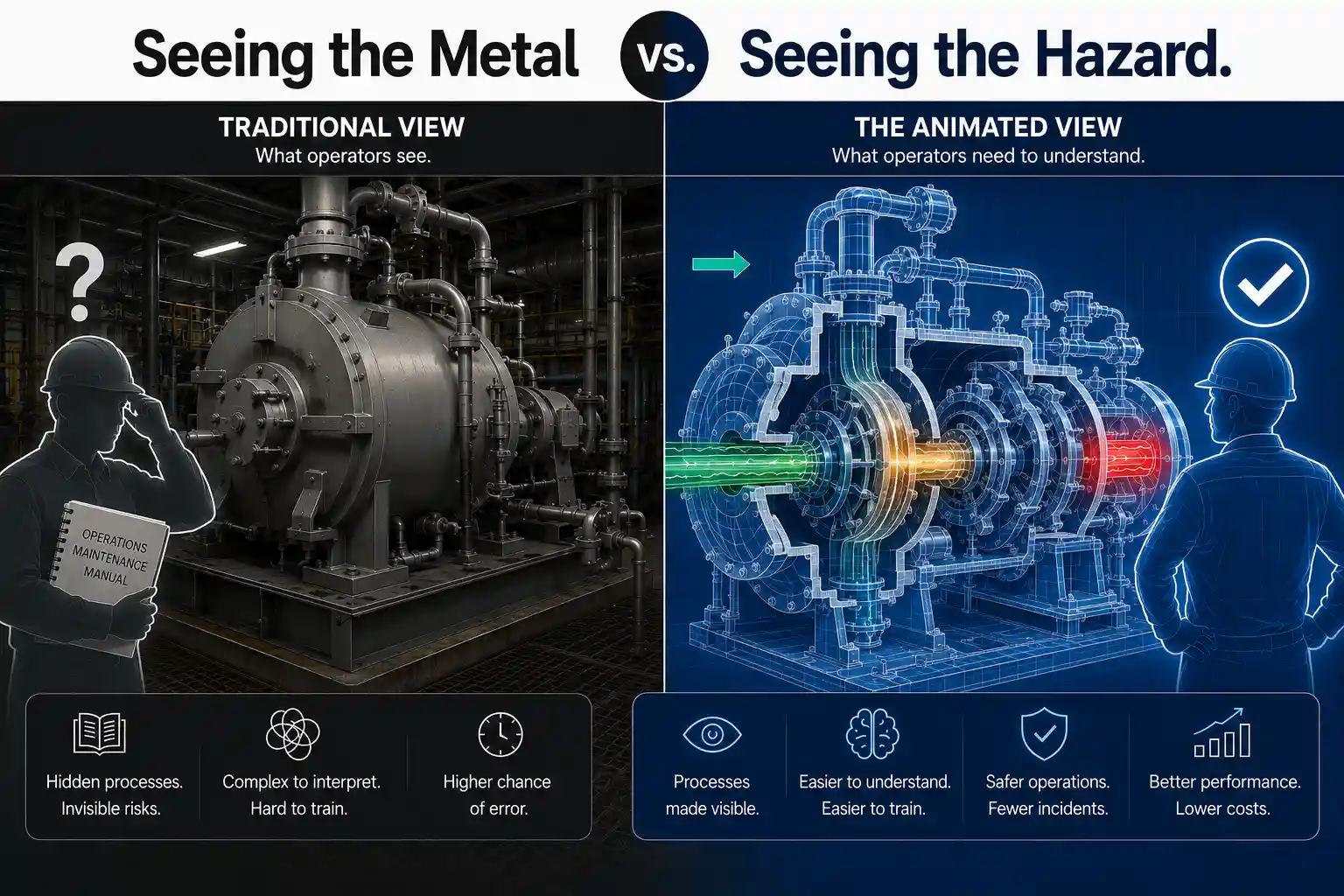
Here’s a truth most engineering organizations feel long before they can name it: you cannot make people careful about something they cannot picture.
It’s not a training problem. It’s not a compliance problem. It’s a visibility problem. Practically speaking, visibility problems don’t get solved by writing more pages into the SOP. They get solved by clearly showing people what has been invisible all along.
Did you know? OSHA estimates that 80-90% of serious workplace injuries trace back to human error, much of it rooted not in carelessness, but in a worker never truly understanding the process or the hazard they were standing next to.
That statistic should stop you for a second. Because it means the fix isn’t more discipline. It’s more clarity.
And clarity is exactly what gets lost in translation. On a multinational plant floor, “understanding the SOP” isn’t one conversation. It’s five, six, sometimes ten, each in a different language, each carrying its own risk of something getting lost.
Did you know? Studies by OSHA have found that language barriers are a contributing factor in roughly 25% of job-related accidents. On a production shop floor with a diverse workforce, a document written in one language is understood clearly by one but could be alien to another.
This is the universal truth underneath everything else: a process that can’t be seen clearly, can’t be followed safely, irrespective of the language the document is written in. Text describes. Diagrams suggest. Only motion, sequence, and visual cause-and-effect can actually show a process the way it truly behaves. That is the entire reason 3D animated process videos exist. Animated videos are not a fancy training aid, but the missing sense organ for the parts of your operation nobody can physically see.
How Invisible Becomes Understood
Knowing why visibility matters is one thing. Building it is another. This is where most organizations face hurdles. Making a technically accurate and genuinely watchable process video isn’t a video project. It’s an engineering project that happens to end in a video. Video creators might have to guess, and your engineers cannot become filmmakers overnight.
It starts with people who understand your process, not just videography.
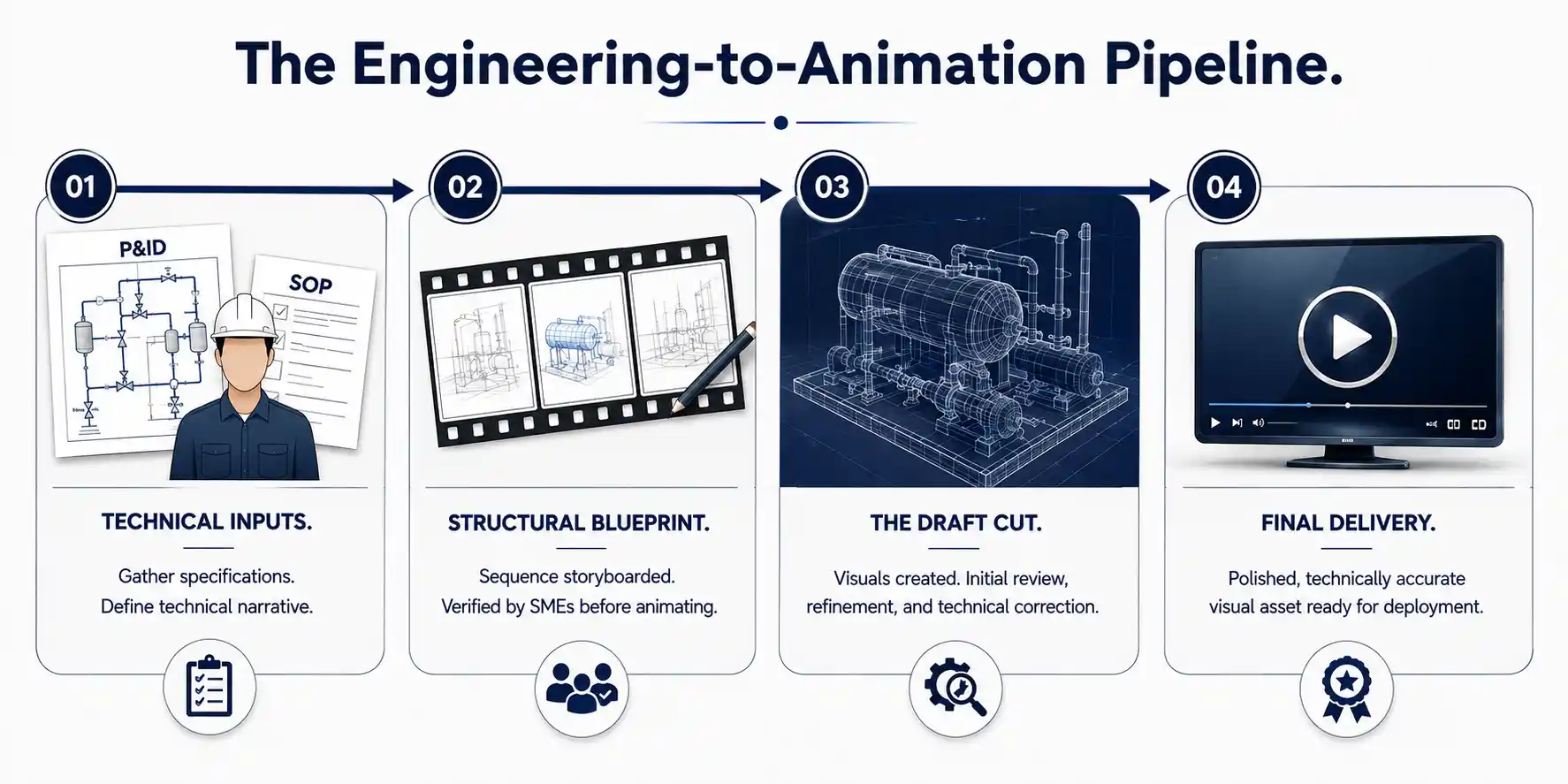
The two disciplines sit in the same room, and the process moves through four honest stages:
- 1
Script: The technical narrative accompanying the visuals is written and verified, so every sentence matches the real process.
- 2
Storyboarding: The engineering sequence is roughly sketched before even a single frame is animated.
- 3
Draft first cut: A working version made for review, refinement, and correction.
- 4
Final delivery: A fine-tuned and technically accurate video.
Notice what’s missing from that list: hours of your team’s time. That’s deliberate. You share what needs to be covered and why. You clearly underline the objective behind the video, and your service provider handles the rest. Your engineers get to stay engineers. They don’t have to become scriptwriters, storyboard artists, or video editors on the side of their real job.
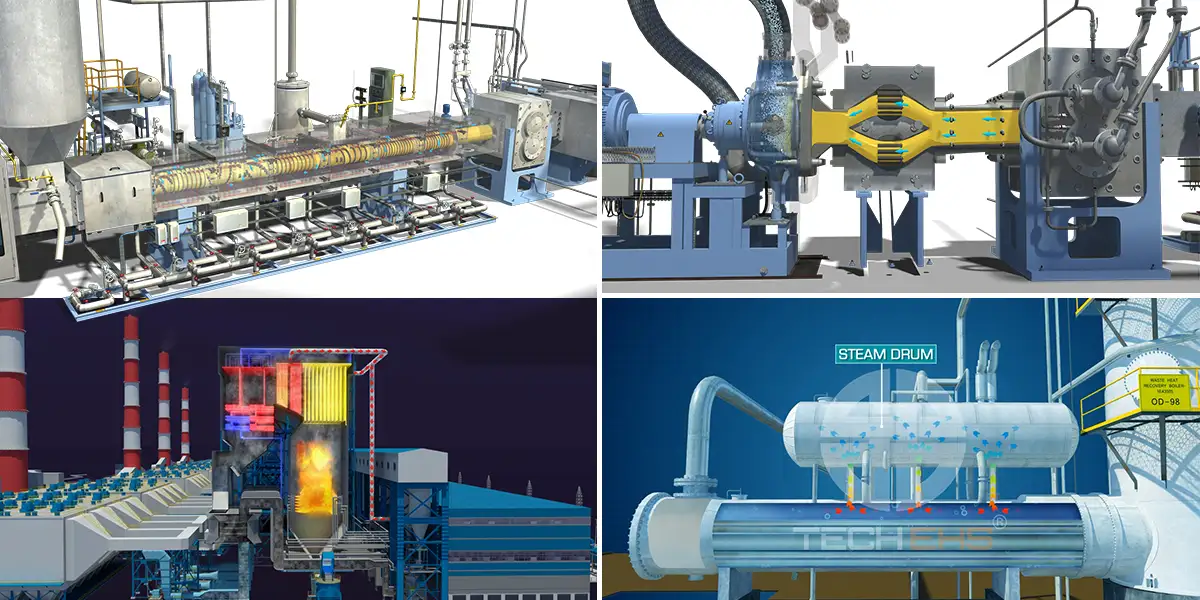
This is also where the real expertise shows up. A good process video doesn’t just animate a pipeline; it cuts away the housing on a pump to show the impeller spinning. It slows down the exact three seconds where pressure builds past a safe threshold. It makes the invisible visible by highlighting the machinery cutaways, hidden mechanisms, and critical decision points that a photograph or a paragraph never could.
What You Actually Walk Away With
A finished video is never really “just a video.” It’s an asset that keeps working long after the production is done. It earns that description because of how widely it can travel.
Where it gets used:
What it delivers:
Did you know? Research from the Research Institute of America found that video-based training improves retention by 25–60%, compared to just 8–10% for text-based training alone. A separate Forrester Research report found that employees are 75% more likely to watch a video than to read a document explaining the same thing.
Put plainly: the format you choose for training isn’t a style preference. It’s a compounding learning process that allows organizations to teach what actually happens on the job.
The Quiet Return on a Visible Process
Think back to that silent secret every plant keeps; the process nobody can quite see. An intricately developed 3D animated video doesn’t just explain it once. It sits in your training repository, plays at every induction, travels to every exhibition booth, and quietly keeps doing its job.
Here is the unwanted economics of it. The cost of not producing the video far outweighs the cost of producing the video. You can measure it in the near-misses that clarity could have prevented. You can see it in a safety culture that talks about transparency but didn’t actually show the intricate operations inside the machine.
The invisible doesn’t have to stay that way. The invisible parts of your operation that only existed as jargon and pressure gauges become something that your workforce can watch, understand, and trust. All this in the language they think in.
That’s not a marketing outcome. Not even just a promotional one. That’s a safety outcome that happens to look extraordinary.
