
Table of Contents
- Introduction
- 1. Process Safety Failures (Tier-1 / Major PSEs)
- 2. Asset Integrity & Corrosion-Induced Failures
- 3. Contractor & Work-At-Height / Turnaround (TA) Risks
- 4. Occupational Health & Chronic Exposure Risks
- 5. Transport, Logistics & Road Safety (Movement of People & Product)
- Real-Time Stories
- How EHS leadership should prioritise investment
- Conclusion
- FAQs
Introduction
It is always one thing that leads to another!! And no better industry than the oil and gas industry to explain the above line.
For oil & gas operators, the difference between steady production and catastrophic shutdown is the compounding of unmitigated hazards across process safety, integrity, people, and contract ecosystems.
Senior EHS teams are often tasked with sustaining uptime while managing complex, distributed assets (onshore plants, offshore platforms, pipelines, terminals, and terminals). It gets daunting with time. Plus, with remote locations and fluctuating weather, the tasks become more challenging.
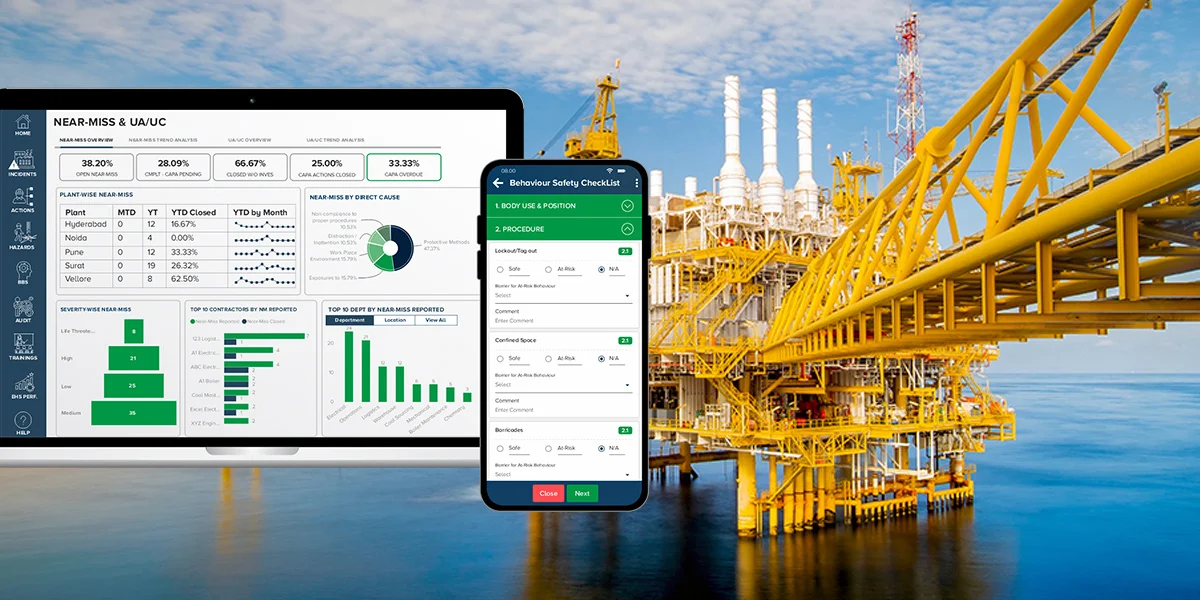
With experience curating EHS solutions for the oil and gas industry, we have outlined five hazards that, when left unchecked, cause disproportionate operational, regulatory, and reputational losses. The article also maps practical, technology-enabled interventions that TECH EHS delivers under its umbrella services.
1. Process Safety Failures (Tier-1 / Major PSEs)
Process Safety Events (PSEs) include hydrocarbon releases, fires, explosions, etc. that rapidly escalate into multi-day shutdowns, extensive asset damage, and severe regulatory scrutiny. These tier-1 events have outsized consequences, including lost production, emergency shutdowns, multi-million-dollar repair programmes, and long investigations that divert leadership bandwidth.
Industry consolidated PSE reporting (source: IOGP) shows that Tier-1 and Tier-2 PSE data remain the primary lens for process safety performance; even a single Tier-1 event can erase months of production and cost tens to hundreds of millions, depending on asset scale. Recent IOGP reporting highlights that while some fatality rates have fluctuated, process safety remains the primary driver of catastrophic losses.
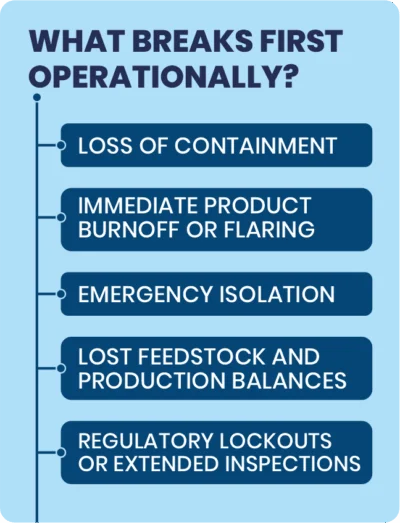
Typical root causes
Our solution:
TECH EHS provides HAZOP facilitation, LOPA screening, and compliance gap closure. See case studies where HAZOP outputs were integrated into the EHS software workflows to trigger corrective action tracking.
Also, our Digital MoC + e-PTW is used to prevent unauthorized scope changes during critical activities. The Equion case shows measurable improvement in permit compliance and approver decision latency after digitalising PTW.
2. Asset Integrity & Corrosion-Induced Failures
Corrosion and mechanical integrity failures commonly produce pipeline leaks, tank failures, and equipment downtime. In many geographies, corrosion-related incidents account for a large share of leak/rupture events and environmental fines. Corrosion can also be a slowly developing hazard that suddenly manifests under stress (pressure swings, temperature changes).
Technical studies and industry analyses identify corrosion as a significant causal factor in pipeline and facility failures. The rising market spend on corrosion monitoring and predictive maintenance confirms industry prioritization.
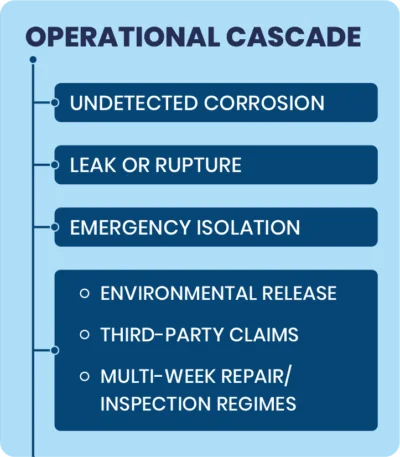
Technical failure modes
Our solution:
TECH EHS can integrate corrosion monitoring data (inline inspection, UT thickness readings) into dashboards and trigger RCM (reliability-centred maintenance) workflows.
3. Contractor & Work-At-Height / Turnaround (TA) Risks
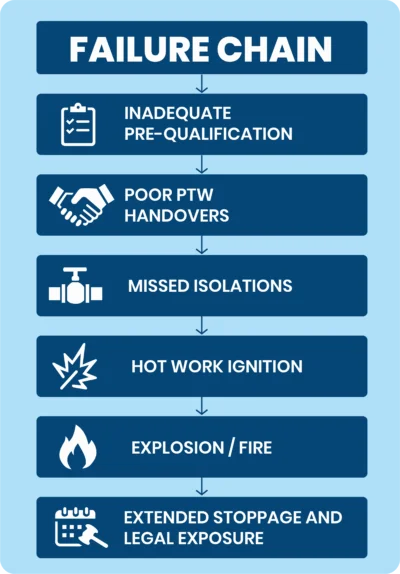
Turnarounds and third-party contractor activities create concentrated risks, such as multiple concurrent hot works, heavy lifts, scaffolding, confined spaces, and short timelines. Contracted work introduces heterogeneous safety competence, increasing the probability of human error. A single control failure during TA can halt production for weeks and create regulatory enforcement actions.
Global HSE datasets and national case studies frequently point to contractors being overrepresented in fatality/injury statistics during major maintenance windows. The Texas City (BP) and multiple refinery incidents have historically underscored the risks posed by contractor management failures and poor coordination.
Our solution:
TECH EHS’s contractor module centralises pre-qual, training records, JSA sign-offs, and access controls.
4. Occupational Health & Chronic Exposure Risks
Chronic exposures (noise, solvents, benzene, heat stress) degrade workforce health, lead to absenteeism, medical liabilities, and productivity loss. Occupational health risks are often under-priced until cumulative cases trigger compensation claims, union action, or regulator audits. Occupational exposures also increase the potential for human error on safety-critical tasks.
Technical failure modes
Our solution:
TECH EHS’s OHMS modules play a crucial role in managing baseline health data, conducting periodic medical assessments, and monitoring exposures. These features, combined with trend analytics, enable organizations to implement early intervention and targeted health, safety, and environmental (HSE) campaigns.
Furthermore, to support sustained compliance, especially during high-turnover contractor periods, TECH EHS offers tailored eLearning focused on personal protective equipment (PPE) and safety behaviors, as exemplified in the Glenmark case. Together, these solutions ensure a comprehensive approach to health and safety management, helping organizations maintain a safe working environment while effectively managing workforce turnover.
5. Transport, Logistics & Road Safety (Movement of People & Product)
For many oil & gas operations, transport incidents (worker commutes, heavy equipment movements, product road tankers) are the most frequent cause of fatalities and extended downtime. Poor route management, overloaded logistics, and a lack of telematics make transport risk persistent.
Failure modes
Our solution fit:
TECH EHS integrates driver qualifications, vehicle inspection checklists, and telematics feeds into incident-prevention dashboards.
Real-Time Stories
1. Digital PTW — Equion
Problem: fragmented paper PTW with approval bottlenecks during maintenance windows.
Intervention: TECH EHS implemented e-PTW with role-based approvals, mobile verification, isolation checklists, and automated risk flags.
Outcome: decision latency for permit approvals fell by >40% (internal client metric), isolation verification improved, and fewer near-misses occurred during subsequent TAs. (See full case study: Equion PTW Case Study).
2. Safety Data Automation — THINK Gas
Problem: manual incident capture and delayed analytics.
Intervention: TECH EHS onboarded digital incident capture and real-time dashboards to consolidate safety data.
Outcome: time to report and close corrective actions improved; leadership had near-real-time visibility for trending and predictive interventions. (See: Think Gas case study).
Conclusion
Each of the five hazards outlined here can individually trigger downtime, but together, they can dismantle years of safety culture and profitability.
For EHS leadership, the goal is operational resilience: the ability to predict, prevent, and recover from disruptions without losing control of safety or continuity. That demands data visibility, digital accountability, and decision speed — the three pillars where TECH EHS adds tangible value.
