
Table of Contents
Introduction
Envision this situation as you are reading.
It is Monday morning. The time is 8:15 at a large manufacturing plant.
The production has only started now.
A forklift goes very near to an employee who is crossing an aisle.
Fortunately, nobody is injured.
The supervisor records the incident on paper with the intention of making a report later on, but by the afternoon the note has gone missing.
A week later, another forklift crashed into a storage rack at that spot, resulting in damage to property and a halt in production!
Then who is to be blamed? The individual or the system?
The investigation shows an unpleasant truth namely, not that the organization had no safety procedures, but that it had no visibility. The unpopular fact was that near misses were not consistently recorded, corrective actions were not tracked, and management had no real-time insights into ongoing risks.
It is regrettable that this kind of thing is more common than many organizations are willing to admit.
The amount of safety data produced in today’s workplaces such as that from inspections, audits, observations, permits, incidents, contractor activities, environmental monitoring, and regulatory documentation is such that managing it using spreadsheets, emails, and paper records will always result in blind spots.
It is precisely in this area that EHS software makes a difference to workplace safety.
Rather than waiting until incidents have taken place, organizations can detect risks early on, automate their compliance activities, and take decisions based on data which will constantly enhance safety performance.
The following article looks at what EHS software is, examines its key features, reviews the benefits it offers, and describes the ways in which various industries make use of it to improve safety and compliance.
What Is EHS Software?
EHS software (that is, Environment, Health & Safety software) is a digital, centralised platform which enables companies to handle matters relating to workplace safety, environmental compliance, occupational health and meeting regulatory requirements by means of standard operating procedures, automated processes and real-time analytics.
Instead of having a number of separate and disconnected systems, EHS software brings all the important safety activities together on one platform.
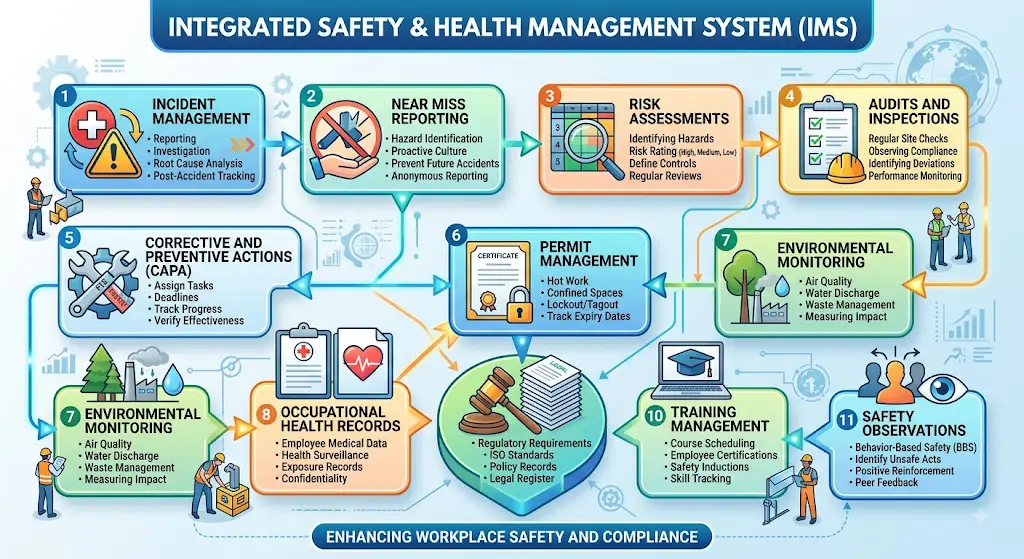
The aim is simple in that it involves setting up a proactive safety management system in which information is recorded once, followed through throughout its entire lifecycle, and turned into actionable insights.
It is now increasingly apparent to modern organizations that safety data constitutes operational data, and that it contributes to a reduction of incidents, greater productivity, and improved compliance when it is well managed.
During shutdowns and turnarounds, multiple high-risk activities often occur simultaneously:
Why Traditional EHS Management Falls Short
A large number of organizations continue to use spreadsheets, email conversations, paper checklists, and manual reporting procedures. At first, these methods seem reasonable. But as operations are carried out in a number of different locations, problems start to arise.
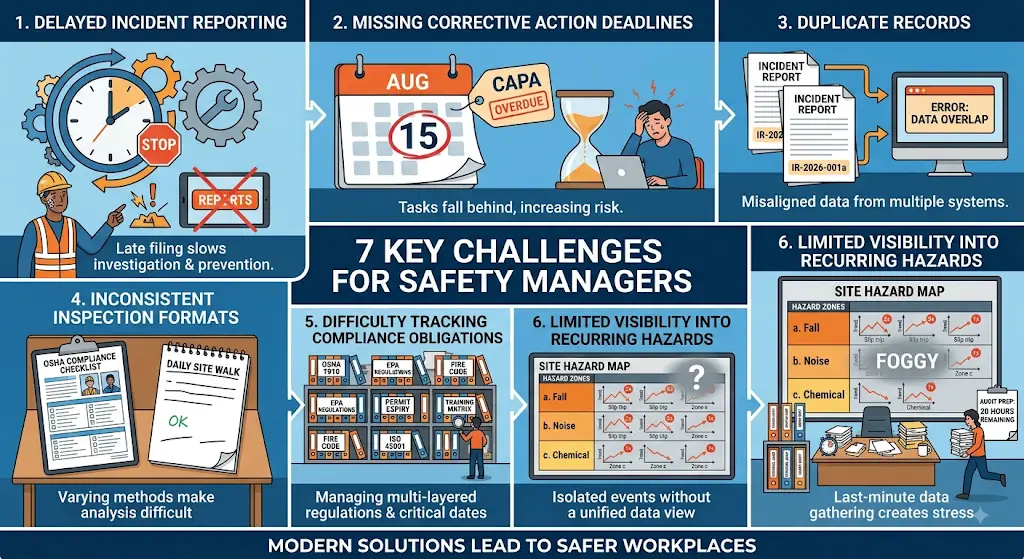
To be clear, the greatest challenge isn’t about gathering data; it’s about linking the data together.
Organisations are unable to easily detect trends such as repeated unsafe acts, frequent equipment failures, or departments that pose a high risk without centralised information. The gaps here are overcome by digital EHS software, which establishes standard operating procedures and gives leadership real-time visibility.
Why EHS Software Matters More Than Ever
The expectations placed on EHS professionals have changed considerably. Nowadays, safety leaders are expected to do more than just comply with regulations; they have the responsibility of creating resilient workplaces, helping to achieve operational excellence, reducing business risks, and promoting a strong safety culture.
Technology is now an essential means of fulfilling these responsibilities.
The International Labor Organization (ILO) states that nearly 2.93 million workers die each year as a result of work-related diseases and occupational accidents around the world, which shows that there is still a need for more effective occupational health and safety management systems.
Source: International Labour Organization (ILO), A Call for Safer and Healthier Working Environments.
The U.S. Bureau of Labor Statistics (BLS) also recorded 5,283 fatal occupational injuries in 2023, which shows that workplace safety is still a global priority even in the face of technological advances.
Source: 2023 Census of Fatal Occupational Injuries carried out by the U.S. Bureau of Labor Statistics.
These figures highlight an important fact, namely that safety has ceased to be merely a compliance function and has instead become one that relates to business performance.
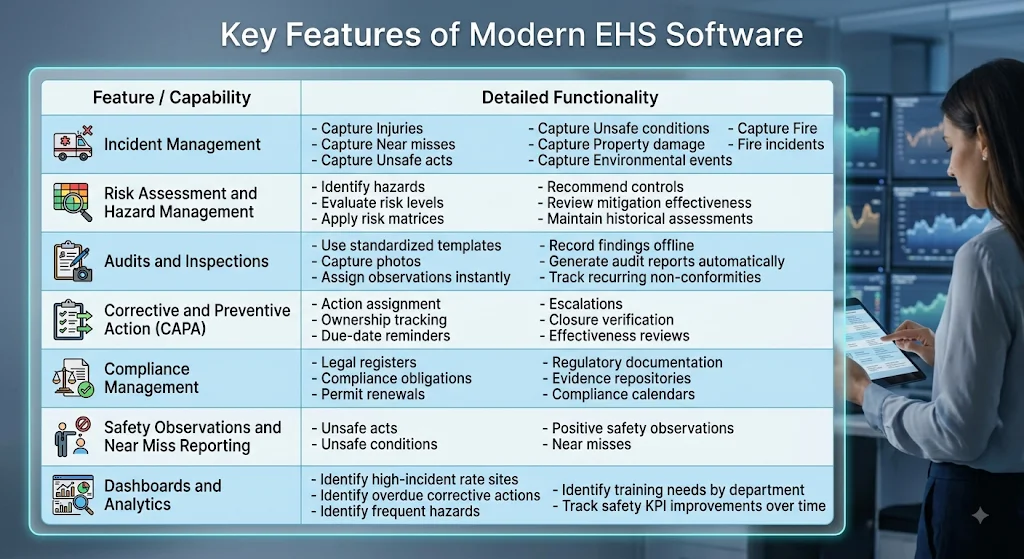
Key Features of Modern EHS Software
Benefits of Implementing EHS Software
EHS software is seldom bought in order to get rid of paper work, the real aim being to improve operations. Among the most important benefits are:
Industry Use Cases of EHS Software
The main aim stays the same making sure that people are protected and that compliance is achieved yet different industries apply EHS software in different ways.
Logistics and Warehousing
Choosing the Right EHS Software
Picking an EHS platform is not simply a matter of comparing feature lists; organizations should consider whether the solution is able to meet both their present requirements and their future growth.
Important considerations include:
The most effective EHS software is intuitive for end users at the same time as it matches operational processes.
Why Digital Transformation Is the Future of EHS
Safety professionals are now more and more dependent on data in order to predict risks rather than just recording the results.
As artificial intelligence, predictive analytics, IoT-enabled monitoring, and connected worker solutions continue to develop, EHS software will take on the role of the operational backbone by integrating these features.
Organizations that digitize today position themselves to:
Digital transformation is not any longer a future initiative; it has now become the standard for effective EHS management.
Why TECH EHS Is Built for Modern Safety Management
All organizations have their own particular operational risks, compliance requirements, and workflows; a one-size-fits-all method usually results in unnecessary complexity or fails to address important areas.
TECH EHS has been developed to assist organisations in digitising and streamlining their Environment, Health & Safety processes by means of a centralised and configurable platform. It provides safety teams with the means to manage the entire EHS lifecycle in one place, covering everything from incident reporting and inspections to risk assessments, audits, corrective actions, compliance management, and analytics.
TECH EHS enables organizations to go beyond reactive compliance and develop a proactive, data-driven safety culture that can be extended across various sites and industries by offering real-time visibility, standardized workflows, and actionable insights.
Moreover, TECH EHS has a proven track record of success in a number of industries when it comes to implementing EHS software; a well-known steel company recorded more than 100% growth in safety observations as a result of the manual process. In a pharma plant, the EHS software has become the organisation’s proactive safety governance because of careful configuration, the modular rollout and a design that is focused on the end user.
