

Table of Contents
- Introduction
- 1. SIMOPS Risks Remain Hidden Until Something Goes Wrong
- 2. Large Permit Volumes Overwhelm Manual Systems
- 3. Isolation Dependencies Across Multiple Jobs Are Hard to Manage
- 4. Work Sequencing & Interdependency Management Is Weak
- 5. Shift Handover Gaps Increase Operational Risk
- 6. Contractor Coordination Becomes Fragmented
- 7. Permit Closure & Restart Readiness Are Poorly Governed
- 8. Real-Time Operational Visibility Is Missing
- What to Weigh Before You Switch
- Conclusion
- FAQs
Introduction
Plant shutdowns, turnarounds and simultaneous operations (SIMOPS) are among the most demanding phases in industrial operations. Maintenance workload spikes, contractor headcount multiplies, and high-risk activities start overlapping in ways that don’t happen during routine operations.
Yet many facilities still run this high-pressure period on paper permits and spreadsheets, the same tools that work adequately when permit volumes are low, but start to break down exactly when the stakes are highest.
During turnaround management, even minor coordination failures can cause contractor idle time, schedule overruns, safety incidents, and delayed plant restart. This isn’t a hypothetical risk; it’s one of the most consistent patterns reported across the process industries: turnaround overruns are rarely caused by a single major failure, but by an accumulation of small coordination gaps that a paper-based system simply can’t catch in time.
An electronic permit to work (PTW) system addresses this by giving teams the visibility, sequencing control, and audit trail that manual processes can’t sustain at scale. Below are eight reasons traditional permit systems fail during shutdowns, turnarounds and SIMOPS: what causes each failure, how digital PTW solves it, and what to actually weigh before making the switch.
1. SIMOPS Risks Remain Hidden Until Something Goes Wrong
Why Traditional Systems Fall Short
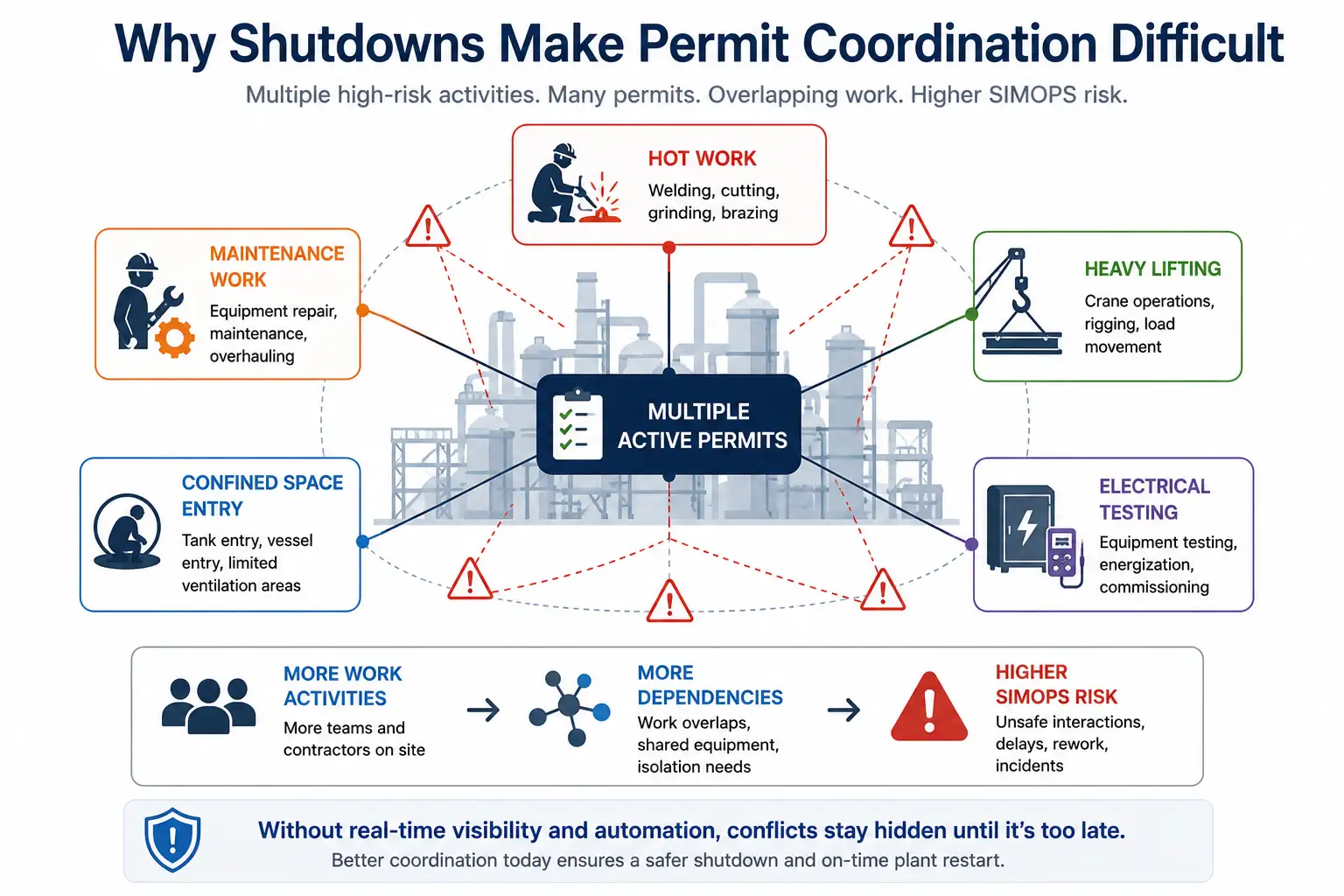
During shutdowns and turnarounds, multiple high-risk activities often occur simultaneously:
In a paper-based system, catching these conflicts depends on manual permit reviews, coordination meetings, human memory, and Excel trackers that go stale within hours. As permit numbers climb, conflict detection becomes a matter of luck rather than process.
The result: unsafe simultaneous work conditions, last-minute work stoppages, re-planning, and elevated incident risk. In most facilities, SIMOPS failures don’t happen because procedures are missing; they happen because visibility is fragmented across people, paper, and departments.
How Modern PTW Software Solves It
An electronic PTW system automatically flags overlapping work based on location, timing, equipment, isolation dependencies, and permit type surfacing conflicts to approval authorities before work begins, not after an incident. Key capabilities:
2. Large Permit Volumes Overwhelm Manual Systems
Why Traditional Systems Fall Short
Permit volumes during a shutdown can run several times higher than normal operations. Physical paperwork has to move for signatures, approvals stack up, and contractor crews sit idle waiting for permit release.
Every delayed permit has a downstream cost of postponed isolation, scaffolding, mechanical work, inspection, testing, or commissioning. Accumulated across hundreds of permits, these delays are what push return-to-service dates.
How Modern PTW Software Solves It
Digital PTW removes the dependency on physical movement of paperwork entirely:
3. Isolation Dependencies Across Multiple Jobs Are Hard to Manage
Why Traditional Systems Fall Short
Shared equipment isolation is one of the highest-consequence coordination problems in a turnaround. One team needs equipment isolated for repair, another wants it temporarily energized for testing, a third depends on that same isolation remaining in place. Manual cross-checking of paper isolation certificates doesn’t scale and when it fails, an operational issue can become a serious safety incident fast.
How Modern PTW Software Solves It
By linking permits directly to isolation workflows, digital systems provide:
4. Work Sequencing & Interdependency Management Is Weak
Why Traditional Systems Fall Short
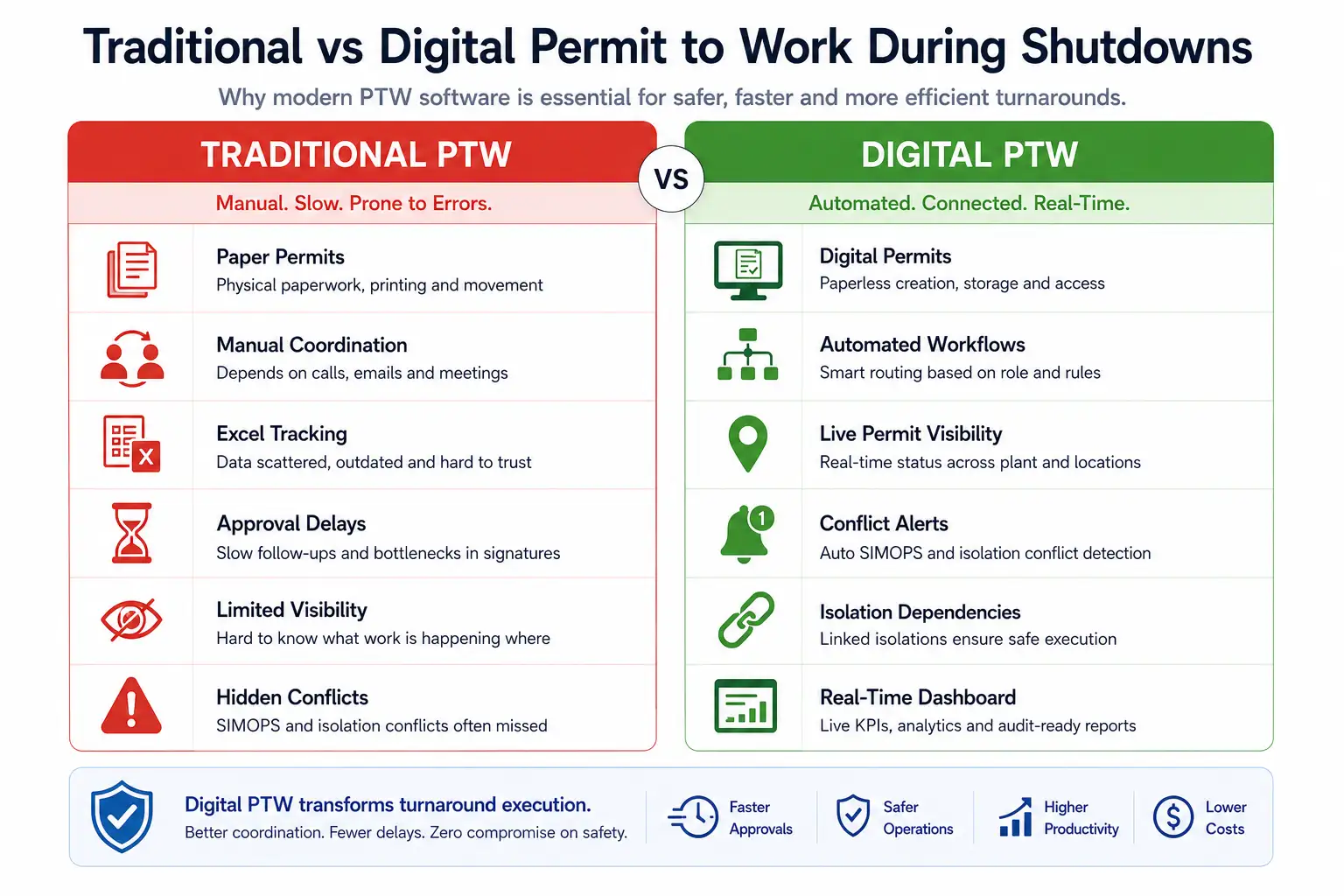
Shutdown activities are rarely standalone, scaffolding must finish before maintenance starts, gas testing must precede confined space entry, isolation must be confirmed before mechanical work begins. Paper systems rarely enforce this sequencing, so contractors arrive before prerequisites are met, sit idle, and critical-path work slips.
How Modern PTW Software Solves It
Modern PTW software enforces prerequisite workflows excavation approval, then isolation, then gas testing validation, then permit activation along with:
5. Shift Handover Gaps Increase Operational Risk
Why Traditional Systems Fall Short
Turnarounds typically run continuously across multiple shifts. When handover relies on handwritten notes and verbal briefings, incoming crews often don’t know what hazards have changed, whether gas tests are still valid, or which isolations remain active. That gap creates duplicate work, unsafe restarts, and missed precautions exactly when fatigue is highest.
How Modern PTW Software Solves It
Structured, workflow-driven handover replaces verbal handoffs:
6. Contractor Coordination Becomes Fragmented
Why Traditional Systems Fall Short
Large turnarounds bring in mechanical, electrical, welding, scaffolding, lifting, and inspection contractors simultaneously. Coordinating them through meetings, phone calls, and physical permit exchange gets harder as headcount grows and contractor waiting time quietly becomes one of the largest hidden cost drivers of the entire event.
How Modern PTW Software Solves It
7. Permit Closure & Restart Readiness Are Poorly Governed
Why Traditional Systems Fall Short
Most PTW systems are built around issuance, not closure. As work wraps up, critical questions often go unanswered in any structured way: Have temporary isolations been removed? Is housekeeping complete? Is the equipment actually ready for service? A rushed, ungoverned restart can create bigger problems than the shutdown itself equipment damage, repeat shutdowns, or unsafe startup conditions.
How Modern PTW Software Solves It
8. Real-Time Operational Visibility Is Missing
Why Traditional Systems Fall Short
Operations teams often can’t answer basic questions at the moment: Which permits are active right now? Where is hot work happening? Which areas are congested? What might conflict? When that information is spread across paper folders, whiteboards, and separate departments, decision-making becomes reactive instead of proactive.
How Modern PTW Software Solves It
A centralized, real-time view lets teams monitor live permit status, identify congestion, prioritize critical-path work, and visualize activity through dashboards and permit maps with a live digital register available at daily permit planning meetings.
What to Weigh Before You Switch
Digital PTW solves real problems, but it isn’t a plug-and-play fix, and a credible evaluation should account for the following before a shutdown, not during one:
Connectivity in the field. Confined spaces, remote units, and congested plant areas often have weak or no signal. A system that only works with a strong connection will fail exactly where it’s needed most look for offline capture with automatic sync once connectivity returns, not just a mobile-friendly interface.
Adoption curve. Contractors rotate in and out for the duration of a single turnaround. A system that takes weeks to learn won’t help a crew that’s only on site for ten days. Evaluate onboarding time and interface simplicity as seriously as feature depth.
Integration with existing systems. PTW doesn’t operate in isolation; it typically needs to talk to CMMS, isolation registers, gas testing equipment, and sometimes the DCS. Confirm integration paths before committing, not after go-live.
Change management. Crews accustomed to paper permits will resist a new process under time pressure unless it’s introduced and tested before the shutdown starts; piloting on a smaller planned maintenance window first is generally safer than a first-time rollout during the turnaround itself.
Auditability. Beyond convenience, digital systems create a defensible, tamper-evident record timestamped approvals, isolation confirmations, and closure checklists that hold up during incident investigations or regulatory audits, which paper trails frequently can’t reconstruct after the fact.
These considerations align with how process safety management is typically framed under frameworks like OSHA PSM, API RP 2220 (guidance on safe hot tapping and related permit disciplines), and ISO 45001 occupational health and safety management systems, all of which emphasize documented, verifiable control of high-risk work, not just its authorization.
