
Table of Contents
Introduction
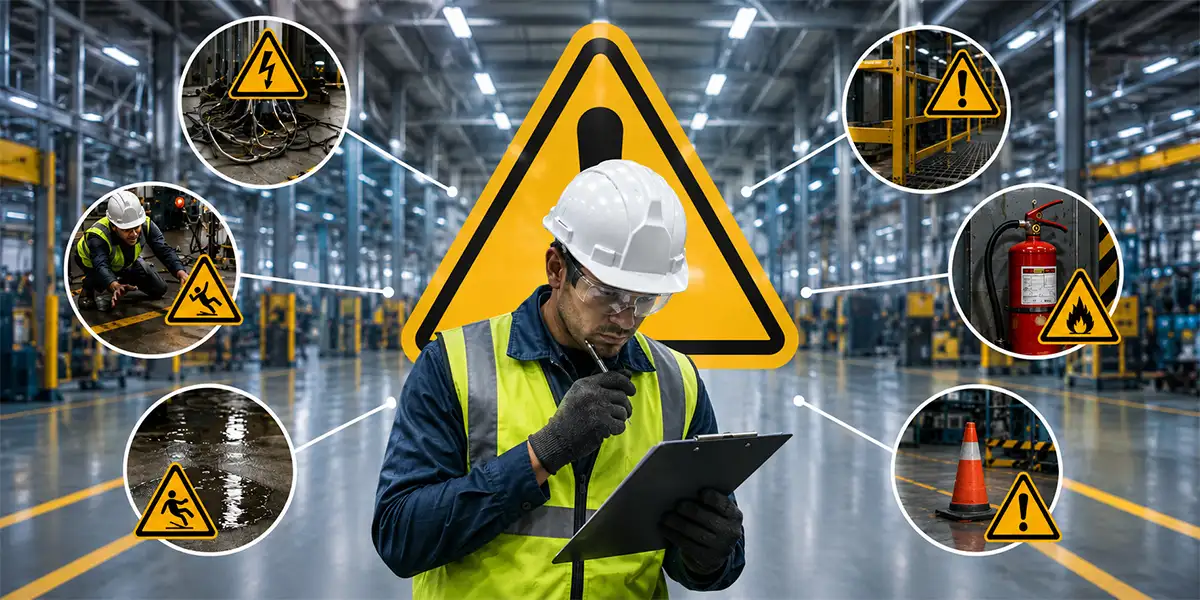
Every workplace has things that can hurt people. Some are easy to see like machines that move, systems or working in high places. Others happen slowly because of how people do their jobs, how work changes or how things are made. The problem for companies is not just knowing these hazards exist. The real problem is making sure employees can see them before they cause injuries, break equipment stop production or harm the environment.
This is where finding hazards and figuring out the risks become very important. A methodical approach helps companies find hazards, look at the risks and put in place controls before bad things happen. Many companies spend a lot of money on safety procedures. Following rules but they still struggle with helping employees recognize hazards. In cases the problem is not that they do not have safety systems. It is that they do not have practical training that helps employees use those systems in real-life situations.
Let’s have a look at how companies can develop ways to find hazards at work, make employees more aware and improve safety through practical and sustainable training.
Why Finding Hazards is Still a Challenge at Work
Accidents at work happen after there are warning signs. Workers may notice that equipment is not working right, emergency exits are blocked, materials are not stored properly, tools are. People are not wearing the right protective gear. However these observations do not always lead to fixing the problems on time. Several common things contribute to this gap such as:
Research from the International Labour Organization says that millions of work-related injuries happen around the world each year. This shows how important it is to manage workplace safety.
One thing that is clear from looking at factories is that experienced workers can sometimes stop noticing hazards because they have done the job for so long. New employees might see risks more easily while experienced workers might miss them because they are used to doing the job. This makes it very important to have training on finding hazards and assessing risks for all levels of experience.
Concept of Identifying Hazards and Evaluating Risks
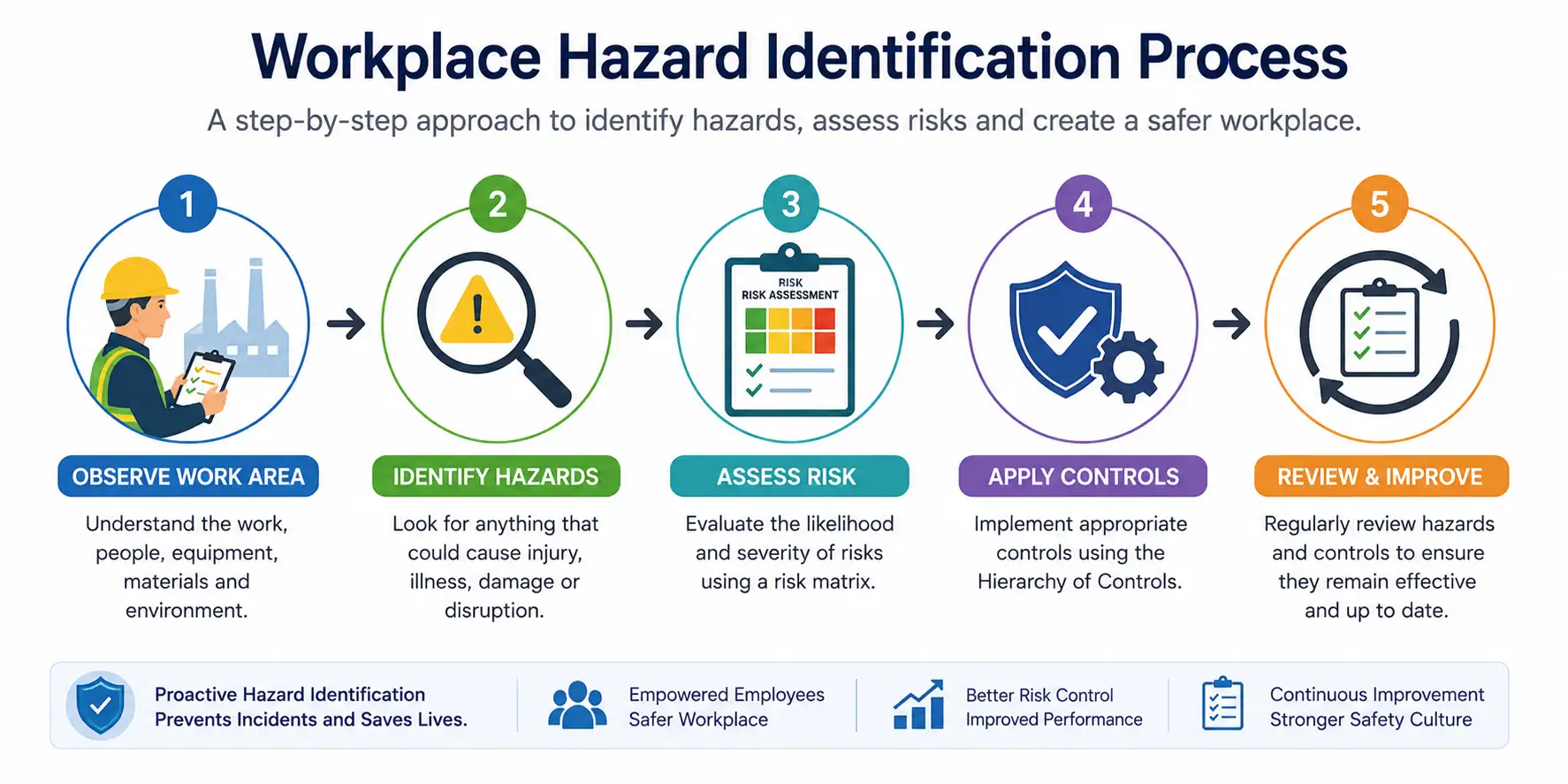
Finding hazards and evaluating risks is essentially a process of helping organizations discover their potential hazards, assess risks associated with them, apply necessary measures to control such risks and monitor the effectiveness of such measures on an ongoing basis.
The task of finding hazards is about identifying any elements of the working environment that might potentially lead to injuries or illnesses of the workers, damage to the property, harm the environment or affect normal working processes in other ways. The source of hazards can be found in equipment, processes, materials used in work, in the environment, or simply in the course of routine work. Evaluating risks consists of determining two things:
Together they form the foundation of safety management systems.
Common Types of Workplace Hazards
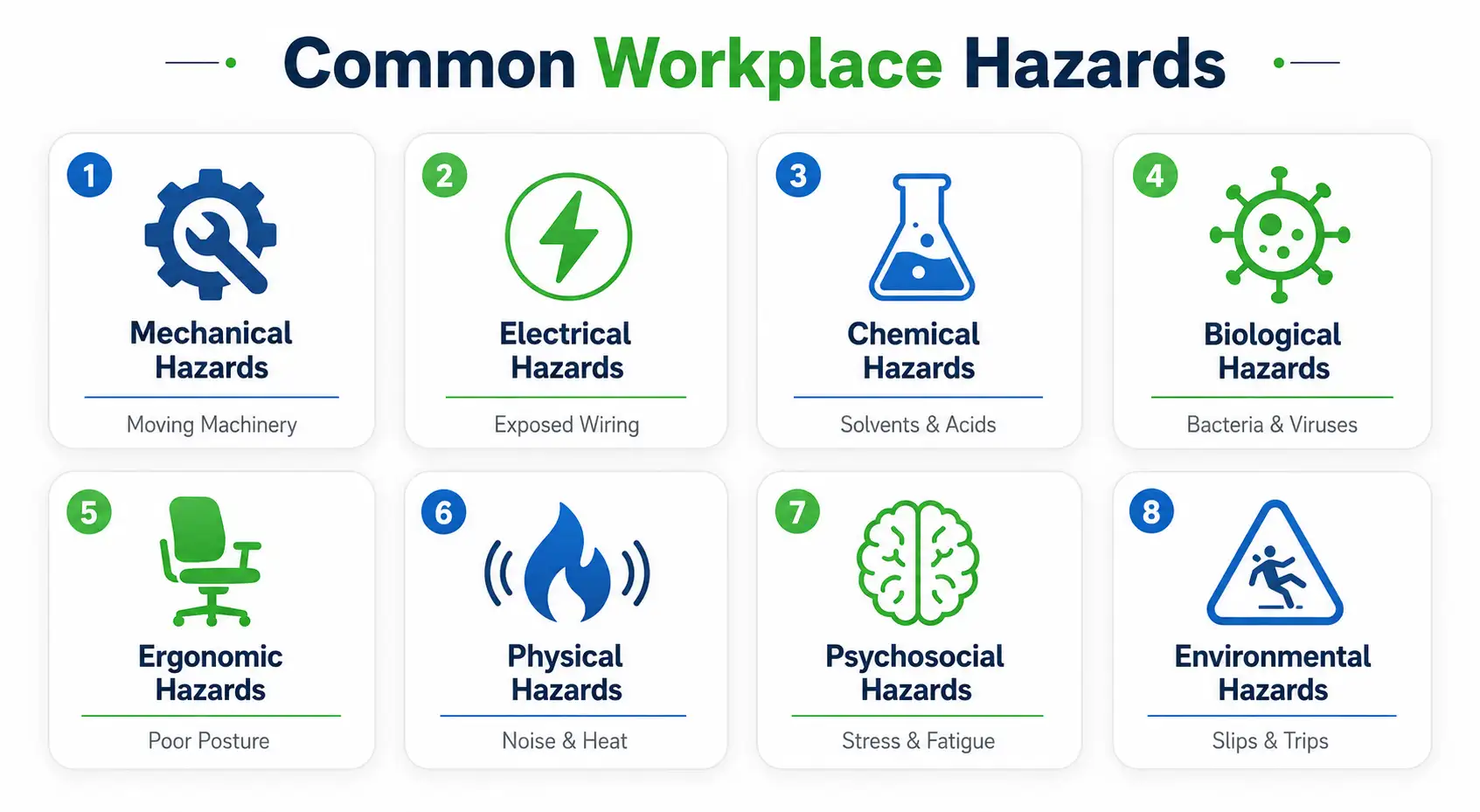
To effectively find hazards at work it is necessary to understand the types of hazards that exist across industries.
| Type of Hazard | Examples |
|---|---|
| Physical Hazards | Noise, vibration, heat, radiation |
| Mechanical Hazards | Rotating equipment, conveyors, moving machinery |
| Chemical Hazards | Solvents, gases, acids, materials that can catch fire |
| Biological Hazards | Bacteria, viruses, contaminated materials |
| Ergonomic Hazards | Doing the same movement over and over poor posture, lifting things by hand |
| Electrical Hazards | Exposed wiring, faulty equipment, risks of electrical arcs |
| Psychosocial Hazards | Stress, fatigue much work |
| Environmental Hazards | Slipping, tripping, falling poor housekeeping |
Training programs should teach employees to recognize hazards in all these categories, not just the obvious physical dangers.
The Hazard Finding Process
An effective hazard finding process must have a structure and a way of doing it that leads to effective controls. This typically involves the following:
Step 1: Understand the work activity
Understand the activity being conducted – the tasks, the people doing them, the equipment used, the materials used, the environment. Get the context first.
Step 2: Find the hazards
Examine each work activity closely. Ask questions such as:
Try to avoid making assumptions, as it’s the workplace itself that will provide the clue to potential hazards.
Step 3: Assess the risk
Once hazards are found, the next step is to assess the risk – in other words, the likelihood of an incident and the severity of the possible consequences. This risk should then be multiplied by the frequency with which individuals might be exposed to the hazard. It’s useful to have a simple way of evaluating the risk and this is usually done using risk matrices.
Step 4: Implement controls
The control measures put in place should address the risks identified using the Hierarchy of Controls. First the hazards should be eliminated, if at all possible, then replaced with something safer, followed by engineered controls, then administrative controls such as procedures and then Personal Protective Equipment (PPE) as the last resort.
Step 5: Review and Update
Hazards can change as operating practices, equipment or working conditions alter. Hazards and controls need to be reviewed, to make sure they continue to be effective, and updated. Reviews are needed when a significant change occurs, when there’s been an incident, following investigation, after equipment has been installed or upgraded, after organizational changes or when changes to regulations have been introduced.
Hazard Finding Methods Used in Industry
The various methods that businesses use to discover hazards vary according to the level of risk in their activities and the sophistication of their operations. In most workplaces, combining several approaches to find hazards results in the most success.
Workplace inspections – These help to discover hazards prior to an event occurring. For example, a poorly housekept workplace, poorly maintained machinery, an unsafe condition or that people aren’t following procedure, are all common hazards that might be identified during a workplace inspection. Workplace inspections can be more effective when involving employees, especially the front line workers, together with managers and supervisors. The different views can make for better hazard discovery.
Job Safety Analysis (JSA) – A JSA breaks down a job into its basic steps, then looks at the potential hazards and consequences of each step. JSA can lead to a better understanding of a task by all employees, the identification of ways to eliminate or control those hazards, and employee involvement in establishing and maintaining safety practices.
Hazard and Operability Studies (HAZOP) – The HAZOP is typically a process for high-risk industries such as oil and gas, chemical and pharmaceutical manufacturing processes. It is a method for systematic hazard identification used to analyse the safety of the process and to prevent or minimize operational disruptions, or material loss, due to an unintended process change.
Behavioral Observations – Watching workers as they go about their work may uncover hazards that inspections don’t find. These can be situations like failing to follow safety procedures, not using correct lifting technique, not wearing the correct personal protective equipment (PPE), or taking shortcuts to get the job done quicker. These observations identify what work actually looks like and where the unsafe behaviors exist.
Incident and Near Miss Investigations – An accident-free workplace usually identifies both incident and near-miss events. A near miss, as well as an actual accident, are both indications that a hazard exists, and can serve as an early warning that something could happen. Organizations with strong cultures of safety consider near-misses an important learning opportunity and will thoroughly investigate them to prevent a similar incident from occurring.
Building an Effective Hazard Finding Training Program
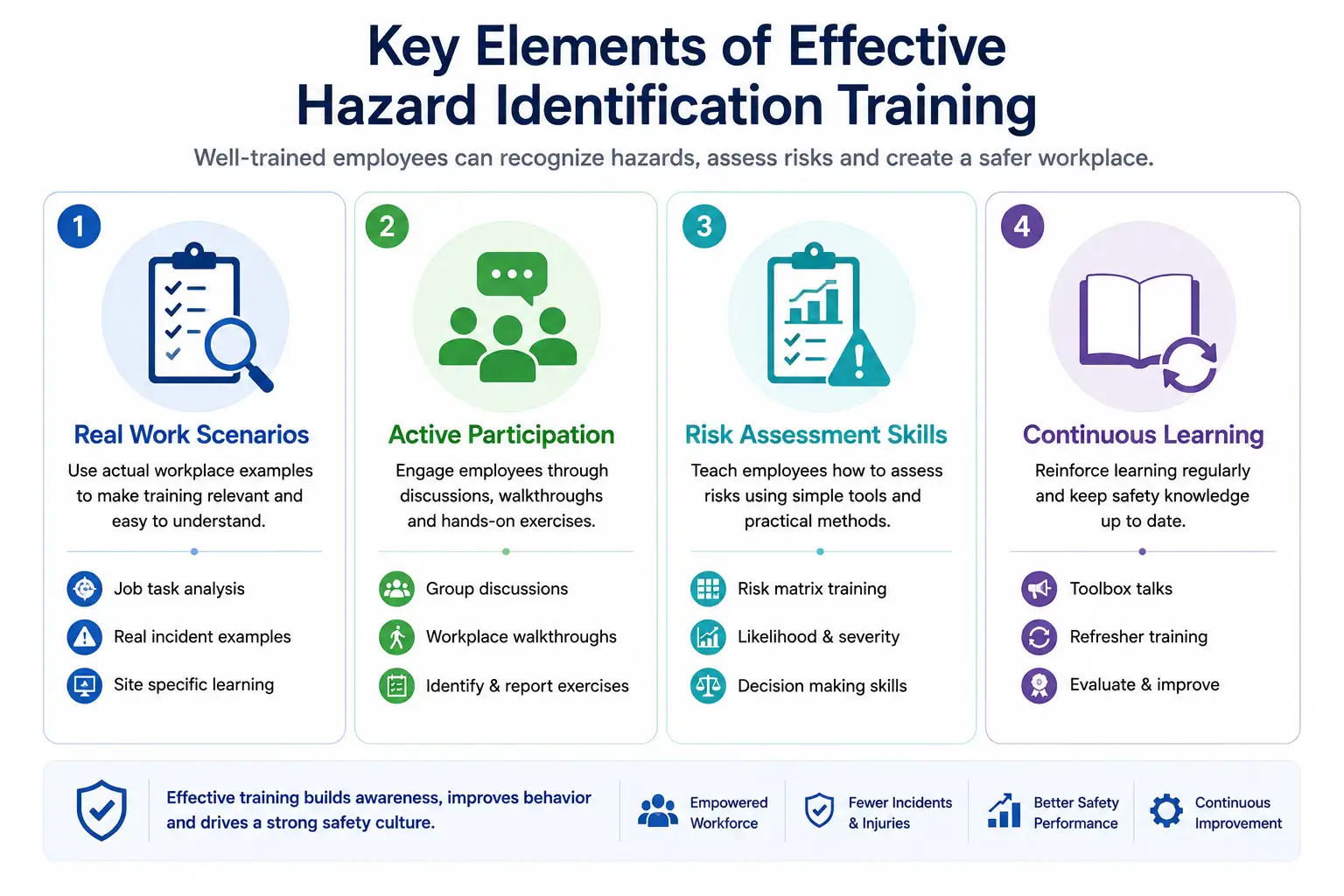
We have many organizations offering their annual safety training. However, it does not mean the employees’ awareness of hazards around the workplace improves in the long run. It could be because the training is only centered on satisfying the compliance and does not involve a practice-based application of the concepts learned in their daily tasks. An effective hazard finding training aims to inculcate practical observation and decision-making abilities among employees in their routine tasks.
Relate Training to Real Work Scenarios – The training should mirror the work scenarios employees can expect on-site. For instance, using real workplace photos, equipment-specific examples, industry-related hazards, and task-related activities will have a significant impact on knowledge retention and practice among workers.
Promotes Active Participation – Instead of listening passively to presentations, trainees should be given opportunities to participate actively in training sessions through the following methods:
Builds Risk Assessment skills – Hazard finding alone isn’t adequate, employees should also be equipped to perform risk assessment. It encompasses evaluating the likelihood of an event happening, the severity of its outcome, exposure frequency and the efficiency of the current control measures.
Consistent Reinforcement – Training cannot simply be a one-time affair; a consistent reinforcement process needs to be in place. Regular tool box talks, short learning sessions, e-Learning, and reminder emails/posters would be highly beneficial.
The Role of Digital Learning in Hazard Finding Training
Even with a workplace safety training classroom still an integral component of workplace safety in its current workplace training method and digital learning comes with numerous benefits to provide an interactive, available and consistent workplace safety education for everyone on your staff. Companies use a variety of the digital learning methods such as e-Learning, the interactive learning programs of simulation programs, and the use of scenario-based learning programs, the usage of mobile learning technologies and a LMS (Learning Management Systems). Animation learning can deliver an image of behavioral demonstrations on how workers ought to behave, or demonstrate procedure anomalies, process incident cycles, as well as activities that involve a variety of risks as they are not able to practice it physically.
Instead of reading about dangers or hazards in their surroundings, digital learning can be utilized to illustrate it as what a disaster can look like. The companies that are managing locations on different locations will find it easier to standardize the information they convey by utilizing a digital learning approach for it guarantees that each worker has actually been taught precisely the exact same thing.
Benefits of Strong Hazard Finding and Risk Assessment Programs
Enhancing your organization’s ability to discover hazards and conduct risk assessments provides more advantages than meeting regulatory compliance. Through this enhancement your organization will contribute to safer working conditions and the enhanced efficiency of its operations and increase employee engagement in safety.
Workplace injuries – Organizations identifying hazards in a timely manner have opportunities to rectify them prior to them resulting in injuries. Workplace incidents that are averted through early identification of hazards include; workplace injuries, equipment malfunction, releases of substances to the environment, property damage.
Employee engagement – When an organization educates its employees to identify hazards and evaluate risk, it changes them from simply working through the process of safety to playing an active role in the creation of workplace safety. The employees play a critical role in finding and reporting hazards and in doing so develop a greater connection to workplace safety.
Regulatory compliance – The standards for most occupational safety and health programs will require organizations to maintain documentation of risk assessments and hazard evaluations, which includes; ISO 45001, OSHA regulations and various industry specific regulations. This organized method of finding hazards ensures that the organization will be able to prove compliance while promoting and contributing to an organization committed to improvement.
Operational reliability – Hazards do not solely impact employee safety but can also impact overall operational efficiency. By identifying potential equipment and working conditions issues early organizations can reduce down-time and associated maintenance costs as well as minimize lost production time, therefore enhancing operational reliability.
Safety culture – As employees are taught hazard recognition and assessment they become more engaged in and committed to workplace safety and the idea of ownership and responsibility of the environment. It becomes increasingly apparent that proactive hazard identification and communication leads to better decision-making practices and eventually a stronger safety culture.
Practical Example: Hazard Finding in a Manufacturing Facility
Example: At a production facility, workers often use forklifts to transport materials. During an observation for workplace safety, workers notice: a blind corner by a rack for storage, high traffic for pedestrians by other forklifts, insufficient visibility of floor lines or faded lines and lack of signage or warning marks. Each may seem like small individual problems; however combined the impact on safety, such as collisions and workplace injuries or disruptions can be great. Using the hazard finding process the company conducts a risk assessment and implements controls:
| Hazard | Risk | Control |
|---|---|---|
| Blind Corners | Vehicle collision | Install convex mirrors |
| Mixed Traffic Areas | Pedestrian injury | Create segregated walkways |
| Poor Signage | Reduced awareness | Replace and standardize sign |
| Congestion | Material handling incidents | Redesign traffic flow |
As a result near-miss reports decrease and traffic management improves without major investment.
This example shows how effective workplace hazard finding can drive improvements through relatively simple interventions.
Common Mistakes Companies Should Avoid
Mature safety programs can face challenges. Common mistakes include:
FAQs
