
Table of Contents

Introduction

A quiet risk is reshaping high-hazard industries!

You may have noticed that on paper, many high-risk facilities appear compliant.

Audits are closed. Permits are signed. Safety statistics look stable. ESG reports are published on time.

Yet, when major incidents are investigated, whether in refineries, chemical plants, LNG terminals, power stations, or extensive manufacturing facilities, the root causes tell a different story. And that too not of one failure, but of a converging triad of systemic risks, like;

  • Aging assets operating beyond original design assumptions.
  • A shrinking pool of experienced process safety talent
  • Heavy dependence on contractors executing critical operations

Individually, these risks are manageable. Together, they create latent process-safety failure conditions, often invisible until they align.

This blog explores why this triad has emerged globally, how it is manifesting across India, the Middle East, and mature industrial economies, and why digital discipline will define the next decade of process safety leadership.

Let us discuss these three, one by one.

Aging Assets

Across high-risk industries, a large percentage of critical assets were commissioned decades ago.

  • Refineries operating at 110–120% of original design throughput
  • Chemical plants were extended through brownfield modifications.
  • Power and utilities assets running past initial lifecycle estimates
  • Storage terminals repurposed for new materials without holistic re-validation

Let us be clear that aging assets are not inherently unsafe. The bigger risk lies in the loss of operational context.

  • Like, why was a particular interlock designed that way?
  • Under what assumptions was a relief system sized?
  • Which deviations were once acceptable and which were not?

As experienced engineers retire or rotate out, this tacit knowledge disappears. Documentation may exist, but without lived experience, it is often incomplete or misinterpreted.

According to global incident reviews, a significant proportion of process safety events in aging facilities are linked not to equipment failure alone, but to:

  • Incorrect assumptions during maintenance
  • Incomplete isolation during non-routine jobs
  • Permit approvals made without full asset condition awareness

In high-risk environments, asset age magnifies human decision risk. Therefore, the root causes of aging assets must be addressed and updated regularly.

Limited Skills

Globally, process industries are facing a generational transition:

  • Senior safety professionals with 25–35 years of field experience are highly sought after.
  • Mid-career talent is stretched thin across larger operational scopes.
  • Younger professionals enter with a firm, theoretical grounding, but limited exposure to abnormal situations.

This has created a skills asymmetry!

While digital tools, dashboards, and reporting systems have evolved rapidly, unfortunately, process safety competence has not kept pace.

Let’s make one thing sure:

Compliance knowledge ≠ process safety judgment

Many leaders have finally recognized that their teams are trained to follow procedures. A very few of them are trained to follow procedures.

Therefore, in incident investigations, this shows up repeatedly:

  • Permits issued correctly—but for the wrong scope
  • Risk assessments completed—but hazards underestimated.
  • Contractors supervised—but deviations missed

The risk is not negligence. It is cognitive overload combined with experience gaps. And without structured systems that embed process safety thinking into daily workflows, even competent teams become vulnerable.

Contractor Dependence

In a significant number of organizations, contractors today execute,

  • Maintenance and shutdowns
  • Hot work and confined space entry
  • Electrical, instrumentation, and mechanical interventions
  • Construction alongside live operations

As a matter of fact, in many facilities, contractors now outnumber permanent employees!

Now this illusion of transferred responsibility has raised some issues. While contracts transfer execution, process safety accountability remains with the asset owner. So the challenges that persist are,

  • Contractors rotate frequently
  • Safety culture varies across vendors
  • Permit literacy and hazard awareness differ widely
  • Communication breaks down across language and hierarchy

We have noticed that several anonymized case studies across regions reveal a consistent pattern: “The procedure was followed, but the intent was not understood.

This is where paper-based permits and fragmented contractor onboarding fail because they document compliance but do not ensure comprehension.

And this is how major incidents are born!!

We understand that a single factor rarely causes a catastrophe. Instead, incidents emerge when:

  • An aging system behaves unexpectedly.
  • A less-experienced team misjudges the deviation.
  • A contractor executes work without a full hazard context.

So technically, these are not black swan events. They are predictable outcomes of systemic strain. What distinguishes resilient organizations is not the absence of these risks, but how deliberately they manage their intersection. So, do we have the solutions? Well, read on to know more!

Digital Transformation as Process Safety Discipline (Not Automation)

We generally hear digital transformation in EHS has often been misunderstood as:

  • Faster reporting
  • Better dashboards
  • Automated approvals

But for process safety leaders, the real value of the EHS management suite lies elsewhere. More than automation, it is about embedding safety thinking into execution.

Digital EHS systems actually do the following more than just automation:

  • Force clarity of scope before work begins.

  • Standardize hazard identification across skill levels.

  • Create traceability of decisions, not just signatures.

  • Reduce reliance on memory and informal communication.

For example, a well-designed EHS management system does not replace judgment. In fact, it supports consistent judgment, especially in high-risk and high-pressure scenarios.

Let’s share three digital implementation examples to show that digital solutions are more than automation.

1. Permit To Work Software (ePTW)

Permit-to-Work failures remain one of the most common contributors to serious incidents.

The features say

  • End-to-end digitization of permits
  • Strengthens compliance and operational efficiency

But an ePTW actually does the following:

  • Structuring permits around risk logic,
  • Linking permits to real-time asset and area data

  • Enforcing prerequisite checks and isolations
  • Creating a shared understanding between the issuer, the executor, and the approver

Importantly, ePTW does not eliminate human control, but it elevates it by making unsafe shortcuts harder to justify.

2. Visual Communication

In multilingual, multi-contractor environments, written procedures alone are insufficient.

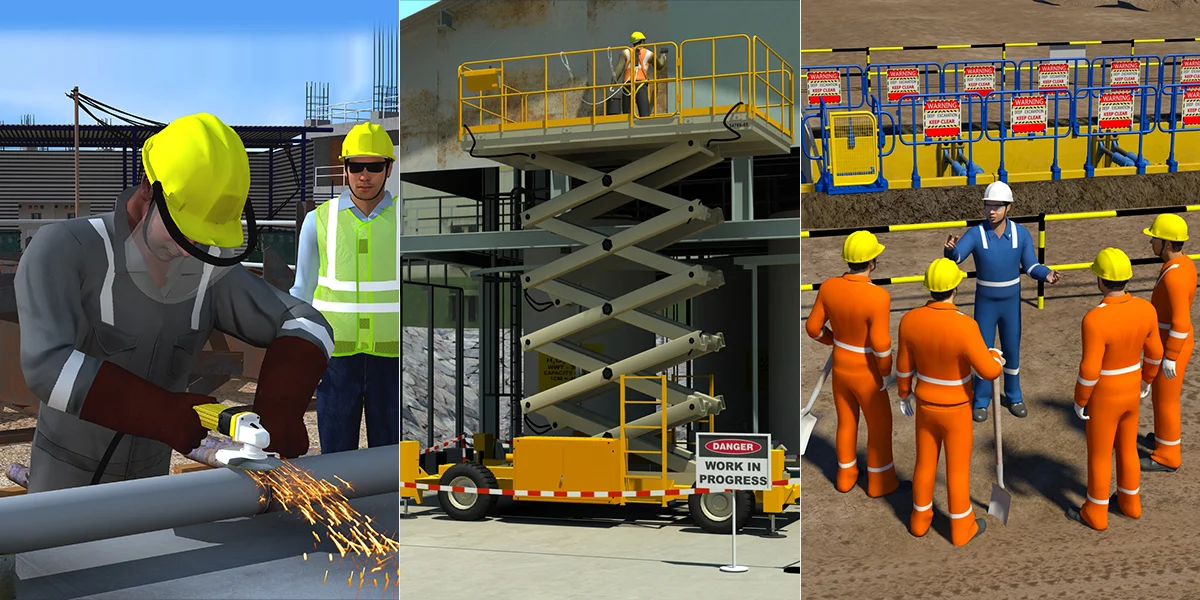
This is where animation services play a critical but often underestimated role. Animations should be used instead of traditional slide decks or manuals. Animations not only educate but also ensure comprehension. They are proven to help in the following ways:

  • Complex hazards can be visualized before work begins.
  • Abnormal scenarios can be demonstrated without exposure.
  • Contractors can understand “why” before executing “how.

See the video below for example.

This video breaks down key rules you can’t afford to forget when dealing with electricity. It also presents the real-life incident in a way that helps the viewer understand it and take the necessary action without overwhelming them.

3. The Role of Experienced EHS Partners

As organizations navigate this triad of risk, many recognize the need for external EHS expertise, but not as auditors, but as system thinkers.

These decades of experience across high-risk industries can support organizations in:

  • Structuring scalable EHS management systems
  • Digitizing permit-to-work and risk workflows
  • Designing safety communication aligned to workforce realities
  • Strengthening governance without operational disruption.

With proper EHS expertise, you can ensure that your valuable digital tools translate process safety principles into practical, field-ready systems.

Conclusion

It is not the time to grapple with an overwhelming volume of procedures, checklists, and reports that create noise rather than clarity. The real question is not about adding more layers of bureaucracy; it was about weaving safety into the very fabric of decision-making throughout the organization.

The pivotal moment is when leaders realize that the accurate measure of their commitment to safety lies not in the number of safeguards but in the robustness of their systems to withstand the inevitable convergence of the three risks above. In that moment of insight, they understand that the future of process safety hinges on their ability to foster resilience and forethought, ensuring that safety is not just an afterthought but a core element of every critical decision.

FAQs

Because asset life extension often outpaces documentation, skills retention, and hazard revalidation, it increases the risk of latent failure.

Limited experience reduces the ability to recognize abnormal conditions, increasing reliance on procedures without a clear understanding of their intent.

Contractors may lack site-specific hazard knowledge, cultural alignment, and continuity—especially when structured digital controls are absent.

It embeds risk logic, standardizes decisions, ensures traceability, and supports consistent judgment across diverse teams.

ePTW ensures permits are risk-driven, visible, and understood—reducing miscommunication and unsafe work execution.

They improve cross-language comprehension, clearly visualize hazards, and reinforce correct behaviors before exposure.

Safety Animation videos

Educating employees about safety-critical activities, hazardous conditions, and company safety policies and procedures is crucial to safety training.

TECH EHS animation services ensure employees have the knowledge and skills to maintain a safe work environment.

7 min read Views: 58 Categories: Safety Animation