
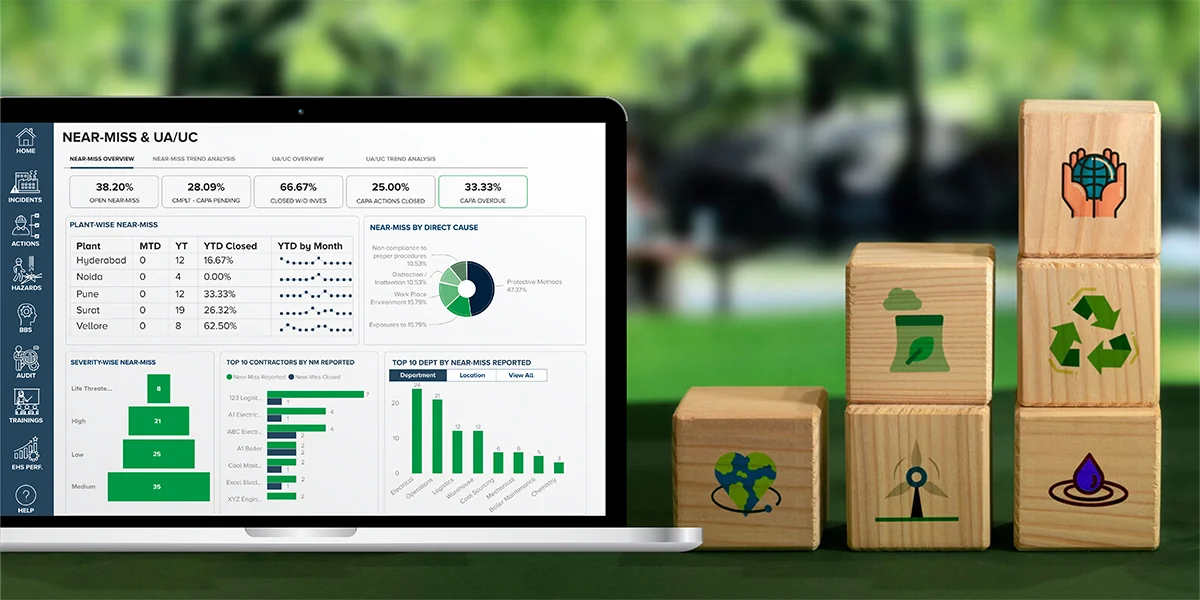
Business Intelligence for EHS ESG The Architect of Data Synergy

Table of Contents

Introduction

You’re an ESG manager responsible for driving, managing and reporting ESG performance across multiple global facilities. Your corporate office demands a unified ESG performance report for the quarter. But here’s the problem:

  • Site-wise energy consumption is recorded monthly in Excel or CSV exported from local utility portals.
  • Training is tracked in a proprietary LMS, with no integration to group systems.
  • Procurement data is managed centrally in SAP with vendor spend.
  • Governance data is stored in corporate legal software.

The problems sound familiar?

Well, the real problem is not that your data is distributed. The real problem is the lack of a centralized, reliable structure that transforms scattered inputs into coherent insights.

For example, as environmental regulations tighten and ESG expectations grow, businesses are increasingly expected to report emissions across Scope 1 (direct emissions), Scope 2 (indirect energy-related emissions), and Scope 3 (value chain-related emissions). That includes emissions from:

Operations

Operations

Contractors

Contractors

Suppliers

Suppliers

Investments

Investments

Transportation logistics

Transportation & logistics

Waste and recycling systems

Waste and recycling systems

maybe more

And maybe more

According to a 2023 McKinsey report, Scope 3 emissions account for 75% of total emissions for many companies, but they are the hardest to track. Why? Because the data lies with hundreds of suppliers, dozens of internal teams, and across multiple geographies and units.

Let’s say your European unit logs electricity in megawatt-hours (MWh), your Indian unit in kilowatt-hours (kWh), and your American suppliers in BTUs. Without data normalization, how can you produce a unified ESG report or compare performance?

Okay, we know we’re raising too many questions. But there is one unified solution to all the above problems.

This is where Business Intelligence Tools emerge as game-changers. Let us examine them comprehensively to see how these BI tools are not just a vision for collaborative data, but can do so much more when incorporated in the right way.

Power BI for Permit-to-Work and ESG

Most organizations are familiar with Power BI as a dashboarding tool. However, in EHS and ESG, it plays a much deeper role—namely, data harmonization.

Let’s break this down.
In large organizations, we find that different sites use individual Excel sheets for tracking PTWs. If a PTW software is in place, it operates independently. Now, the challenge is that there’s no single dashboard showing how many hot work permits are issued daily, how many confined space entries are audited, or which site has the highest PTW violations.

The solution:

You can create a near/real-time PTW analytics dashboard that pulls data from each site’s local systems or spreadsheets, normalizes it, and displays:

  • Permit trends by type, region, and risk level
  • Comparison of PTW compliance across sites
  • Visual heat maps showing permit density and violations
  • Correlation with incidents (e.g., 22% of confined space work didn’t conducted gas testing at regular intervals)

The result? A single version of truth that helps site teams act faster, and gives management the high-level insights they need to prevent accidents and ensure compliance.

Let’s say your company has five operational units, over 100 suppliers, and offices in eight countries. So how do you prepare your ESG report?

Data Points Include:

  • Scope 1: Fuel usage, on-site emissions
  • Scope 2: Electricity and utility bills
  • Scope 3: Supplier data, transport, investments, procurement data
  • HR: Headcount, training hours
  • Finance: ESG-linked spend

Now the pain points for a unified reporting are;

  • Dozens of fragmented systems – HR, EHS, ERP, supplier portals and spreadsheets
  • Different data units across regions (litres, gallons, MWh, kWh)
  • Lack of real-time visibility
  • Manual data consolidation with high risk of errors
  • Limited drill-down capability
The solution:

Power BI connects with multiple data sources, including Excel, SharePoint, SQL databases, ESG portals, and even APIs from third-party vendor systems. Using Power Query and DAX, you can:

  • Standardize units and measurement systems
  • Automate comparisons across geographies
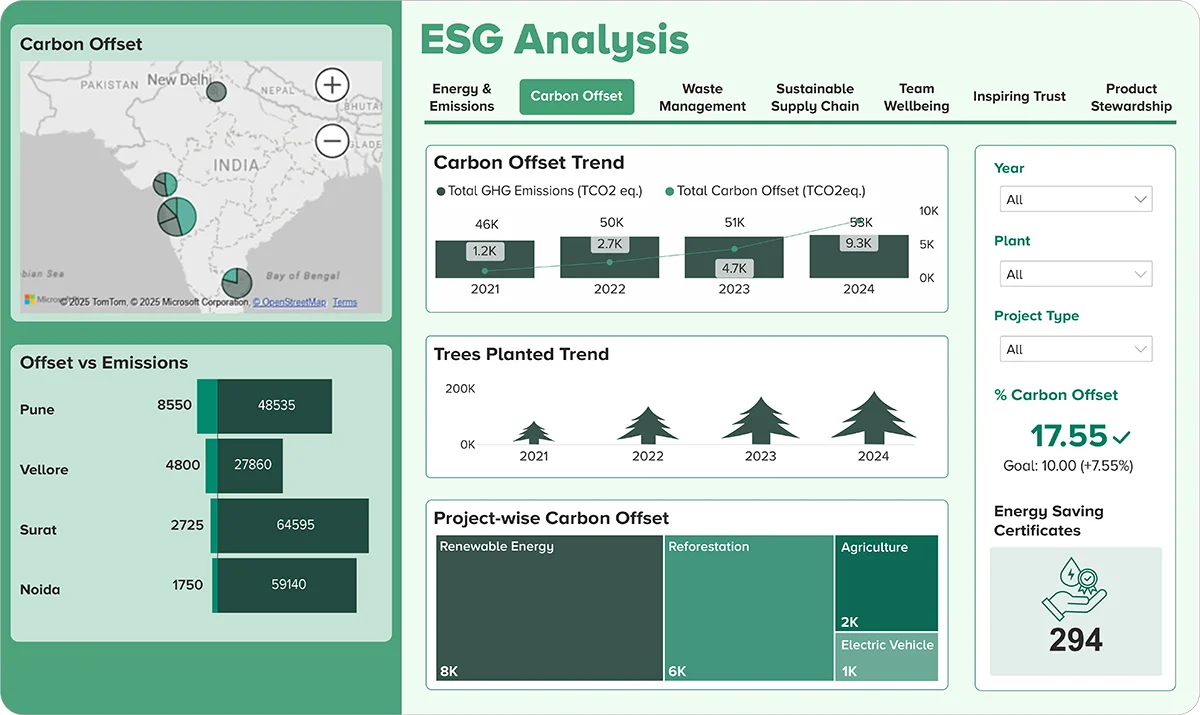
  • Design near/real-time ESG dashboards (emission intensities per site, training hours vs incident rate, supplier sustainability metrics, etc.)
  • Track progress on ESG goals and initiatives
Example Dashboard:
Business Intelligence for EHS ESG

But, Data Coalition ≠ Data Management

It’s essential to understand that a Business Intelligence tool doesn’t replace your existing data management systems. It does not store data; it visualizes it.

The real heavy lifting, in terms of data gathering and validation, still lies with your internal tools. If you’re using siloed software for:

  • PTW
  • Training
  • Incident Management
  • Energy Management
  • Finance or HR

BI connects to these systems, consolidates data, and offers customized dashboards for every level.

Personalized Dashboards for Smart Decision-Making

In large organizations, each department sees ESG and EHS differently:

  • Site-level users need granular hazardous waste management and incident insights
  • Regional heads want performance comparison and compliance flags
  • Top management wants ESG ROI and risk exposure.

BI tools and corporate dashboard allows role-based dashboards using row-level security and user filtering.

Let’s elaborate.

Your safety head in Pune sees PTW insights for their unit. The global ESG director sees a consolidated ESG performance while the CEO sees ESG-linked cost savings and investment potential.

That’s what real-time decision intelligence looks like!!

Why BI is the Future of EHS & ESG Analytics

In today’s regulatory environment, ESG and EHS data must be unified, visual, and actionable, which is precisely what Power BI provides.

Why is it the best solution?

  • It transforms scattered Excel sheets and data silos into visual insights
  • Enables comparisons, benchmarking, and proactive decision-making
  • Handles unit conversions, standardization, and geographic variations
  • Integrates with existing systems without needing expensive overhauls
  • Empowers different stakeholders with personalized dashboards

Final Thought

Remember, data without context is noise. And context without action is wasted. BI tools (combined with the power of Power BI) give professionals the superpower to turn scattered data into strategy, risk into resilience, and compliance into a competitive advantage.

If your current reports look like a spreadsheet jungle, maybe it’s time to turn your data into a dynamic story—with Power BI.

Want help setting up your EHS or ESG dashboards? Comment and we will respond as soon as possible.

Corporate Dashboard and KPI

Make your EHS decisions smarter with data that speaks.

Our BI tools help you uncover patterns in incidents, audits, and compliance gaps with precision. With a centralized corporate dashboard, get real-time visibility into safety performance across all your sites. And with intelligent KPI tracking, monitor leading indicators that drive proactive safety.

5.3 min read Views: 656 Categories: Safety Software

Subscribe to Our Blog

Want some more? Get updates from TECH EHS, know about latest happenings, Technology news and updates.