
Table of Contents
Introduction
Here’s a story:
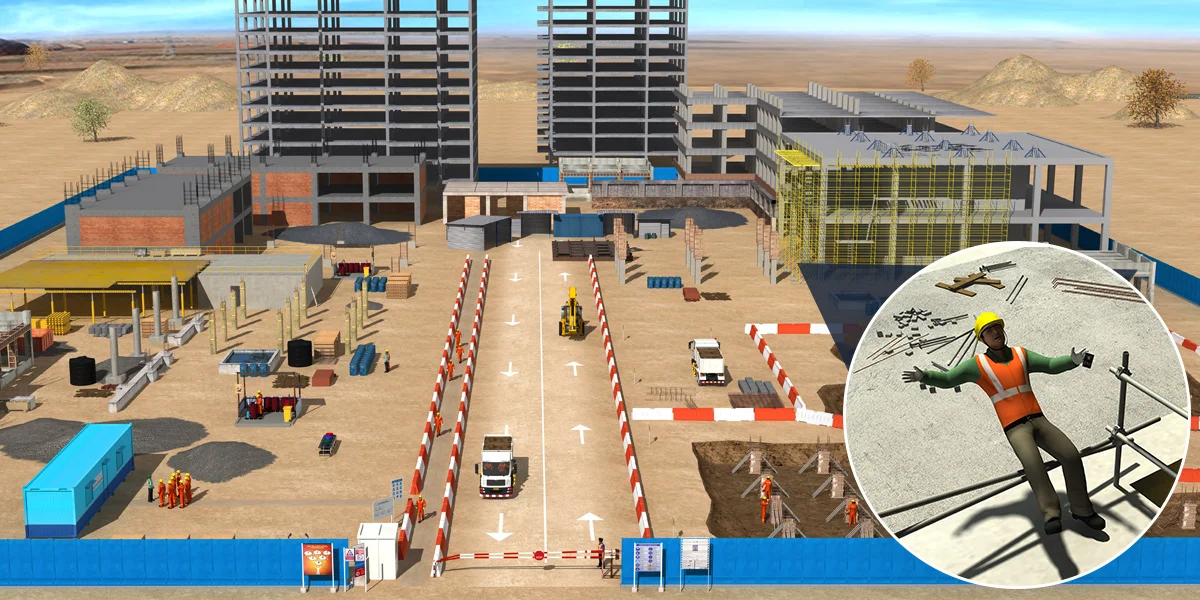
At a construction site, a crew was working on the 12th floor: erecting external façade panels. A young subcontractor was stepping off a scaffold platform to access a ladder. A sudden gust, combined with a misaligned plank, caused their balance to shift; their safety harness anchor clip was not properly locked. In the heartbeat that followed, they felt the scaffold buckle slightly beneath them.
Fortunately, their fall was arrested by a shock-absorbing lanyard anchored overhead. They survived with only bruises. However, the incident triggered a full-site shutdown, dozens of questions, and an internal safety audit. The EHS team needed to answer: “How could this happen? And how do we ensure it never happens again?
That incident is not uncommon in the construction industry. According to U.S. data, in 2017, more than a third of construction fatalities (366 of 971) resulted from falls. As safety managers and business leaders, your job is to convert such near-miss alarms into systemic solutions before tragedy strikes!
In this blog, we’ll walk through the top hazards in construction, explore how they manifest, and demonstrate how EHS software, animation/eLearning, manpower strategies, and other tech-enabled solutions work together to deliver robust safety outcomes.
The 5 Key Hazards & Their Realities
The Problem Statement
You might ask: “We already have training, toolbox talks, PPE, inspections then why still these disasters?”
So here are some common shortcomings.
Fragmented data & visibility: Incident records, audits, risk registers, and checks often reside in spreadsheets or on paper, resulting in silos, delays, or loss.
Reactive mindset: Many safety systems activate only after something goes wrong, not before.
Training that’s static and disengaging: Slides or lectures don’t simulate real dynamics.
Manual audits & inspections: Tedious, inconsistent, prone to human error.
Contractor management gaps: Subcontractors often fail to adhere to the same safety standards.
Lack of real-time alerts & mobility: On-site changes go uncommunicated to central teams.
That’s where EHS Tech and human strategy come in to plug these gaps.
The Solution Architecture
Let’s revisit the hazards one by one, but now with a solution overlay:
Conclusion
To nurture sustainability, organizations must emphasize continuous culture building, celebrating achievements through dashboards, leaderboards, and recognition programs that highlight safe behavior. Embedding video storytelling of real near-misses and lessons learned adds emotional depth, helping workers internalize safety values beyond compliance. Finally, a robust Audit and Assurance Team ensures data integrity and compliance through periodic digital reviews and red-team audits, ensuring that processes remain transparent, validated, and accountable.
When manpower, process, and technology converge through an integrated EHS framework, safety transforms from a static rulebook into a living ecosystem.
Construction remains one of the world’s most hazard-intensive industries. Today, as safety managers, CEOs, CFOs, and EHS leaders, we can weave together animation & simulation, EHS software, smart sensors, and strategic manpower deployment into a digital safety fabric. In that fabric lies the capacity not only to prevent tragedies but also to enable better schedule certainty, lower costs, higher morale, and an improved brand reputation.
FAQs
