

Why Digital Permit-to-Work Is a Business Continuity Tool

Table of Contents

Business Continuity Is No Longer a Crisis-Only Conversation

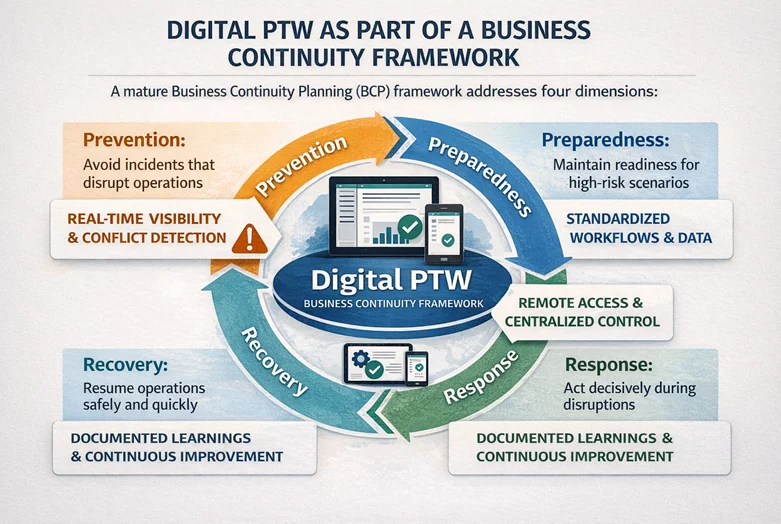
For decades, Business Continuity Planning (BCP) was treated as a contingency exercise. Basically, it was activated only during rare, high-impact events such as natural disasters, major accidents, or pandemics. But in 2026 and beyond, this definition is no longer sufficient! Business continuity today is shaped specifically by day-to-day operational resilience. This defines the ability to prevent disruptions before they occur, and the capability to sustain safe operations even under pressure.

Now, one of the most underestimated contributors to business disruption is the way high-risk work is controlled on the ground. For example,

  • Hot work executed near live utilities
  • Maintenance performed during production hours
  • Contractors unfamiliar with site-specific risks
  • Overlapping activities that are never meant to coexist
  • And more.

As we know, these are not exceptional scenarios. They are routine realities in modern industrial environments.

So, this is where Digital Permit-to-Work (PTW) moves beyond an EHS digitization initiative and becomes a business continuity tool!

When implemented correctly, Digital Permit-to-Work (PTW) becomes a system of control that

  • Protects operational uptime
  • Ensures regulatory continuity,
  • Safeguards workforce availability
  • Enables organizations to respond decisively during crises.

The Hidden Link Between Permit-to-Work and Business Continuity

Most organizations still view Permit-to-Work systems through a very narrow compliance lens. Permits are often treated as “only paperwork required to satisfy auditors” rather than as live operational controls. This mindset creates a dangerous gap between documented safety and actual risk management.

In reality, Permit-to-Work sits at the intersection of:

  • Operational control
  • Risk isolation
  • Contractor coordination
  • Asset protection
  • Emergency preparedness

Any failure in the PTW system, such as missed approvals, outdated risk assessments, or poor visibility into simultaneous activities, can escalate into incidents. And these incidents halt operations, trigger regulatory action, and also compromise workforce safety. Each of these outcomes directly threatens business continuity, and, of course, the brand and reputation. So you see, it is the domino effect at work.

A Digital Permit-to-Work (PTW) system seamlessly closes this gap by transforming permits from static documents into real-time operational intelligence.

Now, let us study the evolution of PTW to ePTW.
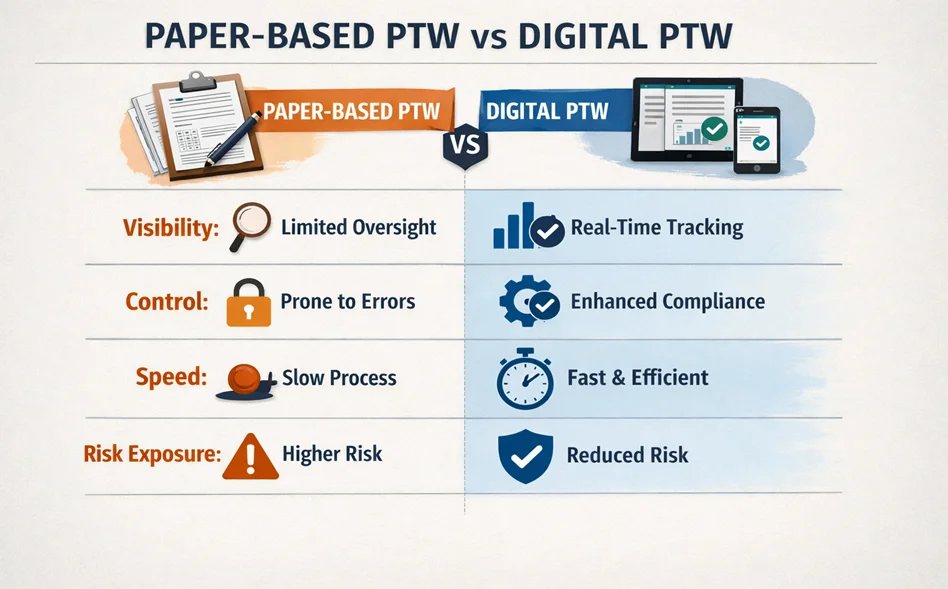
From Paper-Based PTW to Digital PTW: An Evolution of Risk Control

Though paper-based systems started the PTW system, which eventually evolved into Excel-based systems, they were workable in traditional times. With today’s modern tools and large workforce, a digital permit-to-work system is the need of the hour.

Paper-based/traditional PTW systems struggle to keep pace with operational complexity.

Key limitations include:

  • No real-time visibility of active permits
  • Inability to detect conflicts between simultaneous jobs
  • Manual approvals that delay critical work
  • Poor traceability for audits and investigations
  • Heavy dependence on individual discipline rather than system control

For example, when two high-risk jobs are approved in isolation, one being welding near a live gas line and the other being electrical maintenance adjacent to hot work. The paper system offers no mechanism to flag the conflict. Hence, the result is often an incident that forces shutdowns, investigations, and production losses.

On the other hand, a Digital Permit-to-Work (PTW) system fundamentally changes how risk is managed. It introduces:

  • Real-time visibility across all active permits
  • Conflict detection between jobs, locations, and energy sources
  • Integrated isolation and LOTO workflows
  • Role-based approvals with full traceability
  • Seamless EHS software integration across safety modules

This digital system is designed to prevent operational surprises, which are the primary enemy of business continuity.

Why Digital Permit-to-Work Is a Business Continuity Tool

Let us dive deep into how digital PTW serves as a business continuity tool. And how it is more than just issuing permits and an audit-ready tool.
1. Operational Uptime Through Real-Time Visibility

Operational downtime rarely starts with a single catastrophic event. More often, it begins with a series of small, unmanaged risks. Even a trip, spill, or even overconfidence can lead to unimaginably dangerous incidents. Thus, a real-time visibility into the working of every task reduces the occurrence of even the smallest risks.

Digital Permit-to-Work (PTW) provides real-time visibility into:

  • Who is working
  • Where they are working
  • What type of work is being performed
  • Which hazards and isolations are involved

This visibility enables supervisors and operations leaders to make informed decisions instantly. And also if a critical asset is at risk due to overlapping activities, permits can be paused, rescheduled, or re-scoped before disruption occurs.

In this way, Digital PTW actively protects operational uptime rather than reacting after incidents.

2. Conflict Detection Prevents Shutdown-Triggering Incidents

One of the strongest arguments for Digital Permit-to-Work as a business continuity tool is its ability to detect conflicts.

Consider a common scenario.

A contractor is approved for hot work in one zone.

Another team receives approval for maintenance on a gas line in an adjacent area.

Both permits are valid, but also incompatible!

Now, in a paper-based system, this conflict is invisible. But in a Digital Permit-to-Work (PTW) system, the conflict is flagged automatically even before work begins.

By preventing these high-risk overlaps, organizations avoid:

  • Fires and explosions
  • Emergency shutdowns
  • Regulatory investigations
  • Extended asset downtime

Therefore, thanks to ePTW, conflict detection directly translates to incident prevention and shutdown avoidance, making it a core business continuity capability.

3. Regulatory Continuity and Audit Readiness

Regulatory non-compliance is a major source of business disruption. There is no need for an incident to happen. Sometimes, even stop-work orders, penalties, and license suspensions can halt operations. Therefore, a digital ePTW will ensure your organization is compliant and that everything required for an audit is in place and ready!

Digital Permit-to-Work ensures regulatory continuity by:

  • Enforcing standardized workflows aligned with regulations
  • Capturing digital audit trails for every permit
  • Ensuring only authorized personnel approve and execute work
  • Maintaining historical data for inspections and investigations

When audits occur, organizations using Digital PTW do not scramble for paper records. But they demonstrate control, consistency, and accountability. All essential for business continuity!

4. Workforce Availability and Contractor Safety

An injured worker is not only a human tragedy, but it is also an operational disruption. Workforce availability is a critical but often the least prioritized dimension of business continuity. So, how does ePTW help in this area?

Digital Permit-to-Work strengthens workforce resilience through:

  • Standardized risk assessments
  • Clear communication of hazards and controls
  • Integrated contractor management workflows
  • Digital acknowledgment of permit conditions

By reducing accidents and improving contractor onboarding and control, organizations protect their most critical asset: their employees and their people. A stable, safe workforce ensures continuity even during periods of operational stress.

5. Crisis Response and High-Risk Maintenance Readiness

During crises like pandemics, emergency shutdowns, or urgent maintenance, organizations cannot afford procedural chaos. They need a fool-proof backup, and that too without causing much commotion over the sudden changes.

Digital Permit-to-Work supports crisis response by:

  • Enabling remote approvals
  • Maintaining visibility during reduced staffing
  • Supporting rapid but controlled decision-making
  • Ensuring compliance even under time pressure

Whether managing skeleton crews during a lockdown or executing emergency repairs after an incident, Digital PTW ensures that speed does not come at the cost of safety or continuity.

Case Study: Digital PTW in Action

#1. Improving Data Center Safety and Continuity

In a high-availability data center environment, even minor disruptions have major consequences. By implementing a Digital Permit-to-Work system, a leading data center operator improved coordination between maintenance teams, enhanced real-time visibility, and reduced the risk of unplanned outages caused by conflicting activities.

#2. Building a Dynamic PTW System for Facility Operations

A large facilities management group transformed its PTW into a dynamic digital system. The result was improved contractor management, faster approvals, and stronger compliance across multiple sites, directly supporting uninterrupted service delivery.

#3. Automating Shipyard Permit Processes

In a complex shipyard environment with multiple simultaneous high-risk activities, Digital PTW enabled better planning, conflict detection, and regulatory compliance, reducing downtime and strengthening operational continuity.

Conclusion

Digital Permit-to-Work (PTW) is a business continuity enabler. It protects uptime, ensures compliance, safeguards people, and strengthens organizational resilience.

In an era of frequent disruptions and minimal tolerance for downtime, organizations that invest in Digital PTW are not just improving safety. They are securing their ability to operate, adapt, and grow.

Frequently Asked Questions (FAQs)

No. Any organization managing high-risk work benefits from Digital PTW, regardless of size.

It prevents disruptions, ensures regulatory compliance, and enables controlled response during crises.

Yes. Modern solutions support EHS software integration, creating a unified safety ecosystem.

Yes. When training data is linked to operational indicators, leadership gains visibility into capability gaps and risk trends.

EHS Software

Our web-based and mobile-ready HSE software solutions are a comprehensive platform for small, mid-size, and large enterprises to streamline EHS processes and standardize information management.

Solve your EHS challenges and streamline safety operations with our help.

7.1 min read Views: 96 Categories: Safety Software