From Reactive to Predictive How AI is Transforming EHS Management Software

Table of Contents

Introduction

A refinery shutdown begins with something small.

It was not an explosion, not a catastrophic failure, just a worker skipping a routine inspection because the previous shift was delayed.

Hours later, a pressure fluctuation went unnoticed. And even the maintenance logs were incomplete. Thus, communication gaps widened. By the time alarms were activated, the incident was no longer preventable.

For decades, this has been the reality of environmental health and safety management across high-risk industries.

  • Organizations investigated incidents after they happened.
  • Audits reviewed what went wrong.
  • Corrective actions addressed yesterday’s risks.

But the nature of industrial risk has changed.

Today’s operations move faster, are more connected, and are under more public and regulatory scrutiny than ever before. Rules and expectations keep shifting. ESG reporting has moved from a checkbox exercise to a core boardroom priority. And now, keeping operations running smoothly depends on real safety intelligence.

This is where AI Solutions for EHS are reshaping the conversation.

The Problem with Traditional Safety Systems

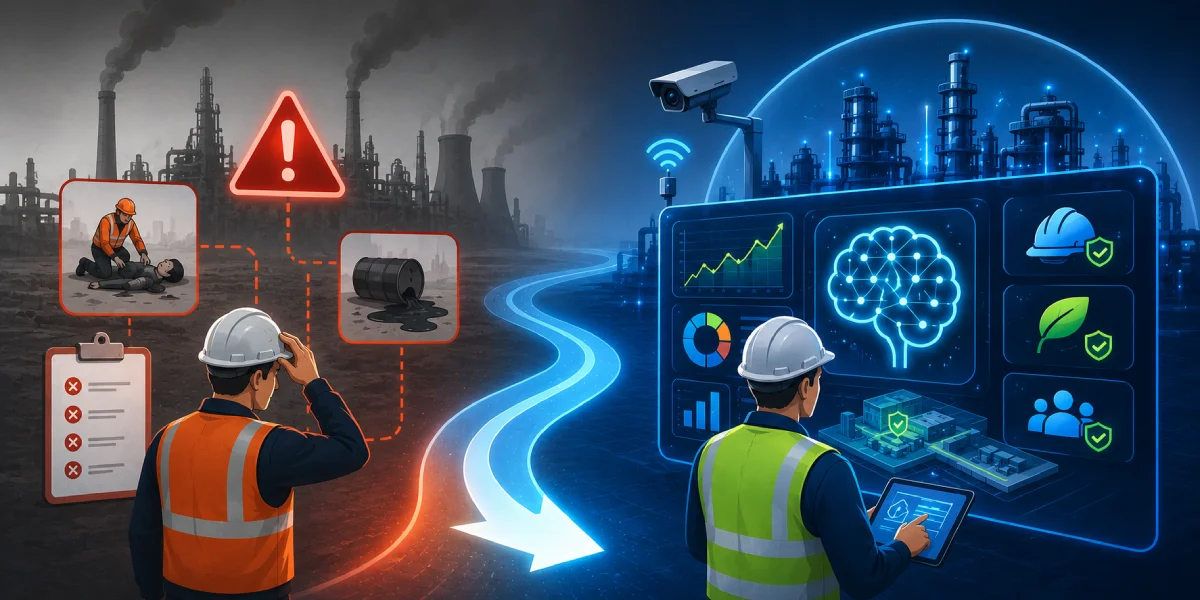
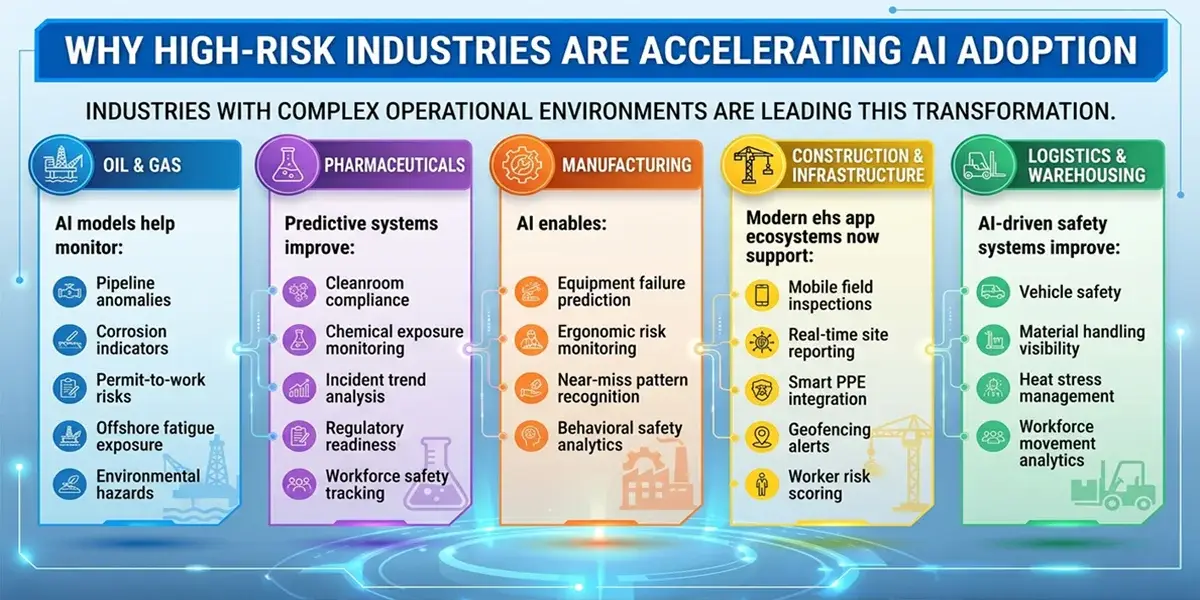
Today’s organizations are moving from reactive safety programs toward predictive ecosystems powered by data, automation, machine learning, and intelligent analytics. The evolution of EHS management software is about anticipating risk before incidents occur. And across industries like oil & gas, pharmaceuticals, manufacturing, energy, logistics, and construction, this shift is accelerating rapidly.

Most legacy EHS software platforms were designed around recordkeeping.

Their core purpose was straightforward:

  • Capture incidents
  • Maintain audit trails
  • Store compliance documentation
  • Generate reports
  • Support investigations

While these systems improved standardization, they remained fundamentally reactive.

A safety manager would only know about a hazard after:

  • An incident occurred
  • A near miss was reported
  • A compliance deviation surfaced during inspection
  • An employee escalated a concern

In high-risk industries, delayed visibility creates operational exposure. A modern facility may already generate enormous amounts of operational intelligence through:

  • IoT sensors
  • Permit systems
  • Wearables
  • Maintenance logs
  • Incident records
  • CCTV feeds
  • Workforce behavior data
  • Environmental monitoring systems

Traditional EHS management systems often capture this information but fail to interpret it dynamically.

AI is here to change the equation.
Predictive Safety Intelligence

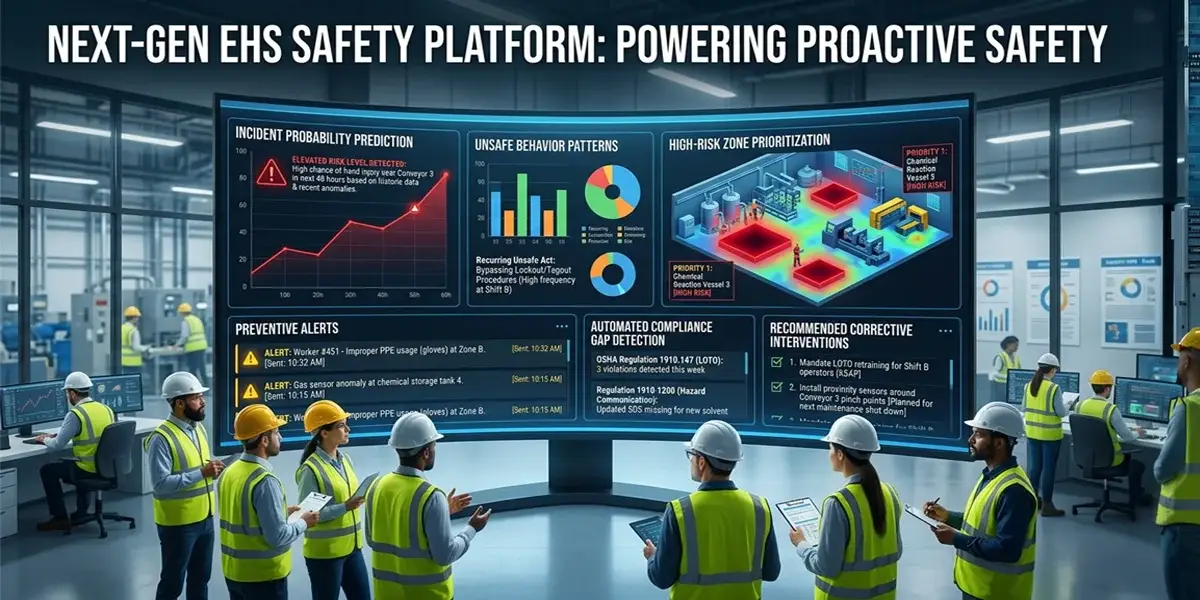
Predictive safety is built on a simple but powerful principle. The conditions leading to incidents often appear long before the incident itself. AI-powered systems identify patterns invisible to human review.

Instead of merely documenting past failures, AI-enabled EHS Software evaluates:

  • Historical incidents
  • Near-miss trends
  • Unsafe behavior patterns
  • Fatigue indicators
  • Inspection deviations
  • Environmental conditions
  • Equipment performance anomalies
  • Corrective action delays

The result is forward-looking risk visibility. This transforms safety leadership from reactive firefighting into strategic risk orchestration.

Predictive Safety Intelligence

How AI is Reshaping Modern EHS Software & Management System Architecture

The evolution of intelligent safety systems is happening across multiple layers simultaneously.

1. Real-Time Hazard Detection

AI-powered monitoring systems can analyze:

  • Heat stress conditions
  • Gas exposure levels
  • Unsafe worker movement
  • PPE non-compliance
  • Equipment abnormalities
  • Vehicle proximity risks

For example:
A logistics facility may identify forklift collision risk patterns before accidents occur based on route congestion, worker movement density, operator behavior, or even shift fatigue indicators.

2. Intelligent Incident Prediction

The most transformative capability of modern EHS software solutions is predictive analytics. AI models evaluate combinations of variables simultaneously:

  • Time of shift
  • Workforce turnover
  • Environmental stress
  • Equipment condition
  • Contractor history
  • Training completion
  • Previous incidents
  • Behavioral trends

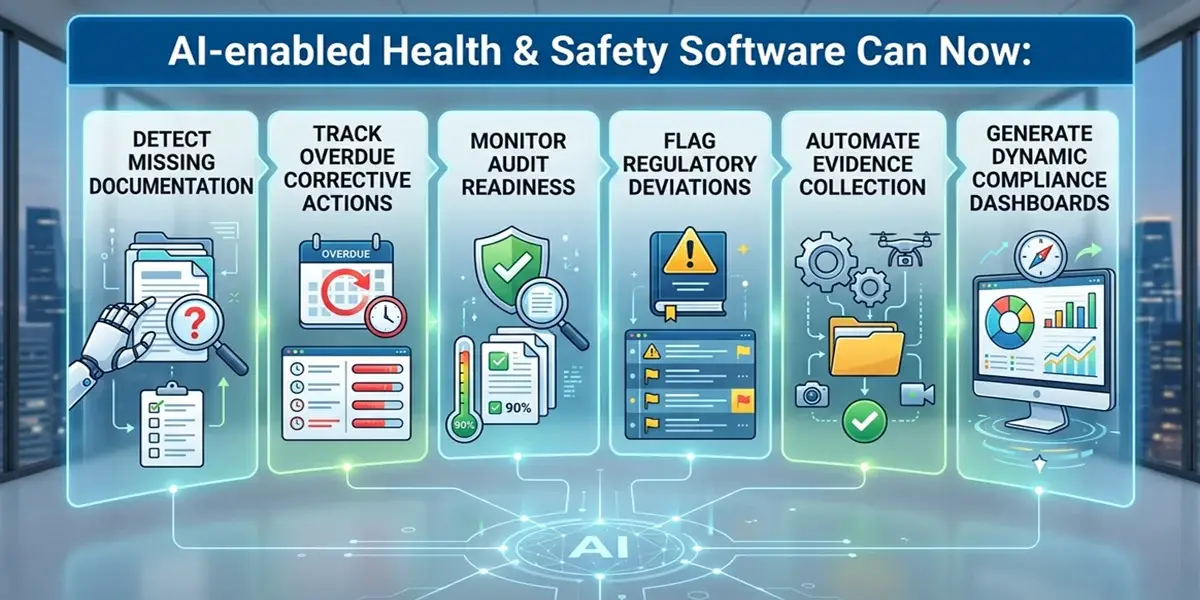
3. Automated Compliance Intelligence

Compliance complexity is increasing globally. Organizations operating across India, the Middle East, Europe, and the US must navigate:
  • OSHA requirements
  • ESG disclosures
  • ISO frameworks
  • Environmental regulations
  • Contractor compliance mandates
  • Region-specific reporting standards
Automated Compliance Intelligence

The ESG Connection: Why AI Matters Beyond Safety

One of the biggest changes in this space is how everything is starting to come together — safety, sustainability, governance, workforce wellbeing, and operational resilience. These areas used to be handled as separate priorities. Now, leaders are realizing they’re all connected and together they shape long-term business performance and risk.

Because of this, boardrooms no longer see EHS as just a box-ticking compliance function. Instead, it’s becoming a strategic lever that supports ESG goals, keeps operations running, and strengthens overall organizational resilience.

This change is also reshaping how companies look at EHS management software. Leadership teams now want real-time visibility into ESG performance, strong environmental monitoring, and insights into how carbon and climate-related factors affect safety. They also expect clearer transparency around contractor governance and integrated sustainability reporting. On top of that, they’re looking for systems that can surface early warning signs of operational risk so they can act ahead of time, instead of only responding after an incident has already happened.
The Rise of Connected Safety Ecosystems

The next generation of EHS software is not standalone. It is interconnected.

Modern platforms increasingly integrate with core operational and enterprise systems, such as:

  • ERP systems for asset, production, and financial data

  • HRMS platforms for workforce profiles, roles, and shift patterns

  • IoT sensors for real-time equipment and environmental readings

  • Access control systems for location, entry, and movement data

  • Environmental monitoring tools for emissions, air quality, and noise levels

  • Learning management systems (LMS) for training records and competency tracking

  • Maintenance software (CMMS) for work orders, equipment health, and downtime

  • ESG dashboards for sustainability, compliance, and governance reporting

Together, these integrations create a unified operational intelligence layer that enables organizations to see risk in context—not as isolated events.

When a single risk event occurs, the system can now trigger a series of coordinated, automated responses, such as:

  • Automated alerts to supervisors, safety teams, and affected workers

  • Escalation workflows when thresholds, SLAs, or critical parameters are breached

  • Training assignments to address skill gaps or repeated unsafe behaviors

  • Investigation workflows with guided root cause analysis and evidence collection

  • Compliance tracking to ensure regulatory obligations and corrective actions are met

  • Executive reporting with real-time dashboards and trend insights for leadership

This level of interconnectedness is redefining what organizations expect from EHS software solutions: not just recordkeeping and compliance, but intelligent, predictive, and orchestrated risk management.

Example: Heat Stress Risk in a Manufacturing Plant

Consider a large manufacturing plant operating in a hot climate. Traditionally, heat-related incidents were investigated after a worker reported dizziness or after a near miss.

In a connected, AI-enabled EHS ecosystem:

  • IoT environmental sensors detect rising temperature and humidity in a specific production zone.

  • HRMS data shows that several workers in that zone are on extended overtime, increasing fatigue risk.

  • LMS records indicate that two temporary workers have not yet completed the advanced heat-stress training module.

  • Maintenance software flags that a critical ventilation unit in the same area is overdue for service.

Once the system identifies this combination of risk factors, it automatically:

  • Sends real-time alerts to the safety manager and shift supervisor

  • Triggers an escalation workflow if conditions remain above safe limits for a defined period

  • Assigns heat-stress awareness training to at-risk workers through the LMS

  • Creates a high-priority maintenance work order for the ventilation unit

  • Logs the entire event for compliance tracking and ESG reporting

  • Updates executive dashboards with a leading indicator: “Heat Stress Risk – Zone B,” enabling leadership to see emerging patterns across sites

Through this integrated, proactive response, the organization can prevent a potential heat-related incident rather than simply documenting it after the fact. This is the new standard of performance that organizations are beginning to demand from modern EHS software solutions.

The Human Side of Predictive Safety

Despite technological advances, AI is not replacing safety professionals.

It is augmenting decision-making.

The future EHS leader is becoming:

  • Data-driven
  • Strategically aligned
  • Predictive-focused
  • ESG-aware
  • Operationally integrated

AI removes repetitive administrative effort and surfaces high-priority insights faster.

Challenges Organizations Must Navigate

The transition to intelligent EHS management systems is not without complexity.

Data Quality Issues

AI models depend heavily on clean, structured, consistent data.

Poor reporting practices reduce predictive accuracy.

Legacy System Integration

Many organizations still operate disconnected systems, resulting in fragmented visibility.

Workforce Resistance

Operational teams may distrust AI-generated insights without proper change management.

Privacy & Ethics

AI-based monitoring introduces governance concerns around:

  • Worker surveillance
  • Data ownership
  • Ethical analytics
  • Privacy protection

Organizations adopting predictive technologies must balance innovation with transparency and trust.

Conclusion

Technology alone does not create safer workplaces. But intelligent systems create better visibility. And better visibility enables better decisions.

Organizations adopting predictive approaches are not simply investing in software. They are redesigning how risk is understood, monitored, and managed across the enterprise.

That is why modern discussions around AI-enabled EHS Software increasingly center on resilience, foresight, and operational maturity — not just compliance.

The organizations leading this transition are building:

  • Connected safety cultures
  • Real-time operational awareness
  • Data-driven governance
  • Predictive risk ecosystems

And in high-risk industries, that shift may define the next decade of operational excellence.

FAQs

Predictive EHS management uses AI, machine learning, analytics, and operational data to identify workplace risks before incidents occur. Unlike traditional reactive systems, predictive models analyze patterns and trends to support preventive action.

High-risk industries gain the most value, including:

  • Oil & gas
  • Pharmaceuticals
  • Manufacturing
  • Construction
  • Mining
  • Energy
  • Logistics
  • Chemicals

No. AI supports EHS professionals by reducing manual administrative work and surfacing actionable insights faster. Human expertise remains critical for leadership, decision-making, workforce engagement, and the development of strategic safety culture.

{ "@context": "https://schema.org", "@type": "FAQPage", "mainEntity": [{ "@type": "Question", "name": "What is predictive EHS management?", "acceptedAnswer": { "@type": "Answer", "text": "Predictive EHS management uses AI, machine learning, analytics, and operational data to identify workplace risks before incidents occur. Unlike traditional reactive systems, predictive models analyze patterns and trends to support preventive action." } },{ "@type": "Question", "name": "What industries benefit most from AI-driven ehs management software?", "acceptedAnswer": { "@type": "Answer", "text": "High-risk industries gain the most value, including: Oil & gas Pharmaceuticals Manufacturing Construction Mining Energy Logistics Chemicals" } },{ "@type": "Question", "name": "Is AI replacing EHS professionals?", "acceptedAnswer": { "@type": "Answer", "text": "No. AI supports EHS professionals by reducing manual administrative work and surfacing actionable insights faster. Human expertise remains critical for leadership, decision-making, workforce engagement, and the development of strategic safety culture." } }] }

EHS Software

Our web-based and mobile-ready HSE software solutions are a comprehensive platform for small, mid-size, and large enterprises to streamline EHS processes and standardize information management.

Solve your EHS challenges and streamline safety operations with our help.


About the Author: Purva Mishra

Purva Mishra
Purva Mishra is a seasoned content strategist with years of experience in creating high-impact B2B digital content. She focuses on simplifying complex topics in safety, compliance, and digital transformation. Her work helps organizations translate safety strategy into actionable, scalable solutions.
7.8 min read Views: 36 Categories: E-Learning

Leave A Comment