
Table of Contents
Introduction
For decades, safety training has been treated as a milestone, something to be completed, documented, and archived. Well, induction programs are rolled out, attendance is tracked, certificates are issued, and compliance boxes are checked. Yet as industries become more complex, workforces more distributed, and risks more dynamic, this traditional view of safety training is no longer sufficient. And we all know that!
But thankfully, things are changing.
In 2026, leading organizations are reimagining safety training as a living operational system. These systems continuously
Yes, a training program that actually does it all! And the shift underway is not incremental. It is structural.
Hence, this is the moment to move decisively from training delivered to risk reduction.
Why Safety Training Must Evolve in 2026
If we look closely, the global workplace today looks very different from even five years ago. Many things have changed.
In this environment, static training models are not enough. And not because they lack intent, but because they were never designed for continuous risk adaptation.
Modern safety leadership must recognize that training effectiveness is not defined by completion rates but by what workers actually do when faced with real-world hazards. The most progressive organizations are therefore reframing safety training around a simple question:
Is our training shaping decisions and actions at the point of risk?
And surprisingly, answering that question requires a fundamentally different approach, not just scanning numbers or dashboards. So let’s discuss this further.
The Maturity Curve: How Safety Training Is Advancing
Safety training in modern ways is highly engaging and, if done properly, very reassuring. Even the retention of modern training is more. But as the saying goes, the proof of the pudding lies in the eating! So first start by modernizing safety training in the best possible ways.
Organizations typically progress through three broad stages as they modernize their training approach.
Technology as an Enabler in Safety Training
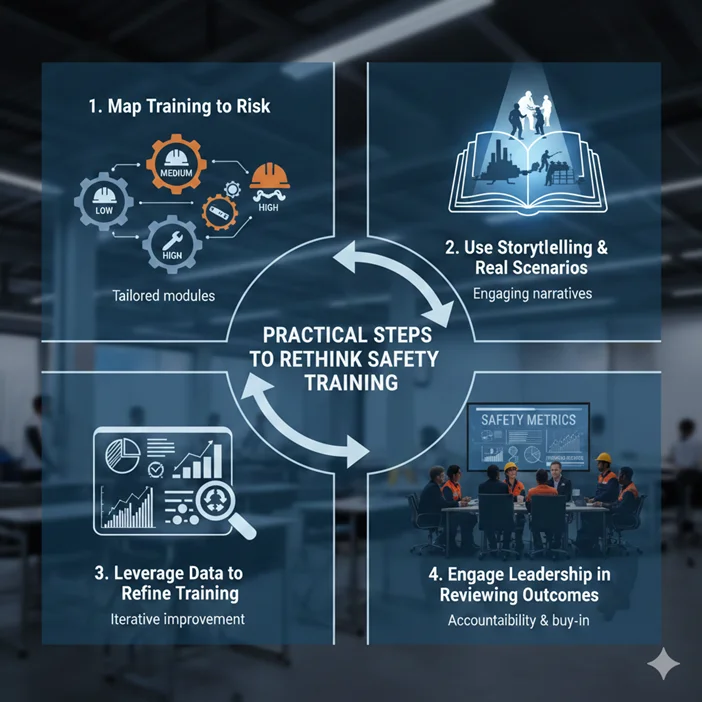
Technology plays a pivotal role in enabling this transition, but only when applied with purpose.
Let us go through the points below and see how technology can be an enabler when properly implemented in safety training.
A Transformation Example
Consider a multi-site industrial organization operating across regions with diverse regulatory expectations and workforce profiles.
Historically, safety induction was standardized and centrally managed. While compliance requirements were met, site leaders observed variation in on-ground behaviors and inconsistent responses to similar risks.
In response, the organization redesigned its safety training framework around digital inductions, followed by task-linked microlearning and mobile refreshers triggered by operational changes.
Supervisors gained visibility into training engagement linked to permits and shift activities. Leadership reviewed training effectiveness through operational indicators rather than attendance metrics.
Within months, safety conversations shifted from “Who has completed training?” to “Are our people equipped for today’s risks?”
Training had moved from orientation to impact!!
Why the Boardroom Is Paying Attention
In 2026, safety training is no longer viewed solely as an HR or compliance function. It is increasingly recognized as a strategic capability that influences operational continuity, workforce confidence, and enterprise risk.
Boards and executive teams are asking sharper questions:
Answering these questions requires leadership alignment, governance oversight, and a willingness to evolve long-standing practices.
Looking Ahead
The future of safety training lies in its ability to anticipate, adapt, and reinforce. Organizations that embrace this shift will find that training becomes a catalyst for stronger safety culture. This means more confident workforces and more resilient operations.
In 2026, Safety training has reached a pivotal moment. As risks evolve and operations accelerate, organizations have an opportunity to elevate training from a compliance obligation to a strategic enabler of safe performance.
