
Table of Contents
Introduction
Let’s start with the story of the two factories.
Factory A and Factory B are both in the heavy industry sector, with complex operations, numerous employees, multiple shifts, a large number of contractors, and a high risk of accidents.
Factory A relies on paper forms, emails, and spreadsheets. When something happens, such as a near-miss or an incident, it is reported in text, briefly analyzed, and then filed away. Corrections are slow. Repeats of similar accidents happen because lessons aren’t absorbed.
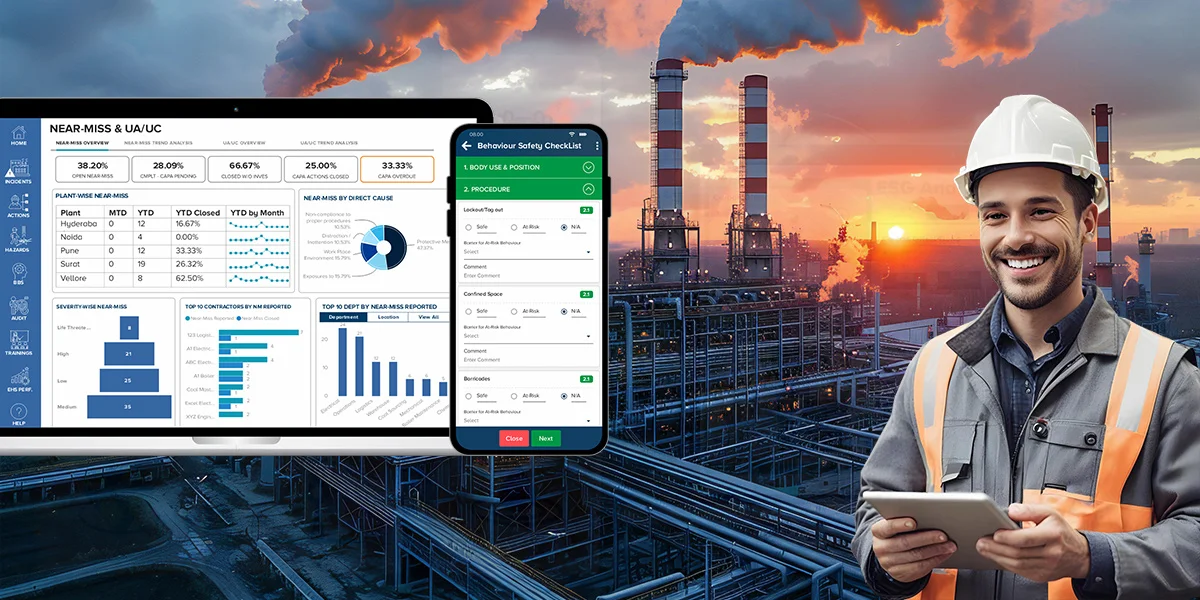
Factory B invests in modern EHS software: digital incident/near-miss reporting, analytics dashboards, mobile apps, permit-to-work (PTW) workflows, and safety awareness tools (animations, e-learning). Factory B still poses a risk, but when incidents occur, they are communicated globally, lessons learned are disseminated, and corrective actions are tracked. Over time, incident rates drop, compliance improves, and costs fall.
Which looks more desirable as a CEO?
The Statistics That Demand Attention
Which looks more desirable as a CEO?
These numbers aren’t just abstractions. They represent what Factory A could become with the right tools and resources.
From Awareness to Action
Let’s bring in the real example from TECH EHS and see how a large multinational achieved concrete outcomes. This case study underlines how carefully chosen EHS software + safety education can shift culture, reduce risk, and deliver ROI.
The ePTW (Electronic Permit-to-Work) Software: Another Lever
Another product that shows both risk reduction and efficiency improvements is the e-PTW system. Let’s see what this delivers, based on their description.
Key Features and Benefits:
While TECH EHS does not publish a fully quantified before/after on that page, the qualitative outcomes are strong: improved safety, better compliance, reduced delays, and faster approvals.
Putting It All Together: Strategy for CEOs & Safety Leaders
What Happens When You Don’t Move Forward
Returning to our “Factory A” mindset: risks include repeated incidents, higher insurance premiums, regulatory/legal exposure, wasted time, and demotivation of workers. Also, in many industries, ESG and sustainability reporting are now expected by investors; poor EHS performance or lack of data could threaten access to capital or contracts.
So the cost of inaction may be greater than the combined cost of software and processes.
Conclusion: A CEO’s Call to Action
For CEOs, the case is strong: EHS software is all about operational excellence, risk management, brand value, worker well-being, and ultimately financial performance.
For safety managers, the message is: ask for tools that speak in visuals, integrate PTW, incident reporting, and BI dashboards, and engage every layer of the workforce.
As GKN’s case, via TECH EHS, shows: simple shifts in how incidents are communicated (e.g., animated videos), combined with enforcing and digitizing workflows (such as Permit-to-Work), lead to real results. Not only is there safer work, but awareness also rises, costs fall, and leadership gains clearer insight.
