Permit to Work System: A Complete Guide to PTW, Types, Process & Software

Table of Contents

Introduction

It is said that the human brain understands better when a story is involved. So let’s begin with one!

Imagine a routine maintenance activity at a large chemical manufacturing site. A contractor began hot work on a pipeline that they believed was isolated.

The permit had been issued.

The signatures were there.

The checklist was complete.

But a near miss happened!! That is because isolation was incomplete. And the loopholes included fragmented communication, and the permit was treated as a mere formality.

Why does this happen?

Thankfully, due to rising awareness, the question is no longer “Do you have a PTW system?”

It is: “Is your PTW system actually preventing risk or just documenting it?”

So let us dive deeply into what PTW is and how it has evolved in ePTW?

What is a Permit to Work System (PTW)?

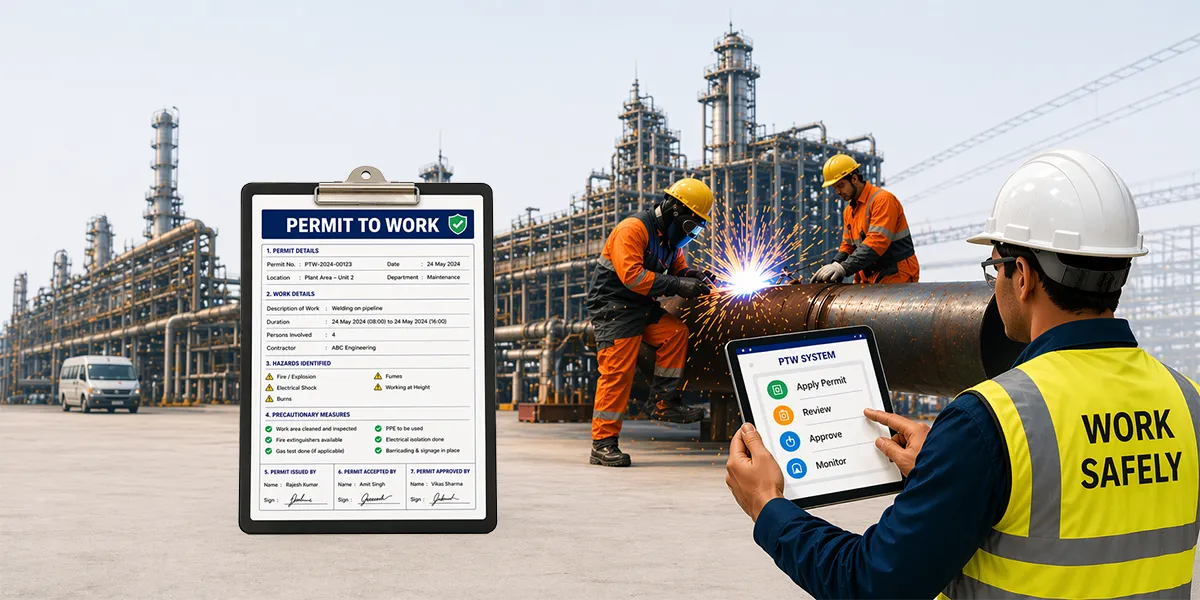
A proper definition implies that A Permit to Work System is a formal, documented process used to control high-risk work activities. It ensures that hazards are identified, risks are mitigated, and work is authorized under controlled conditions.

At its core, a PTW system is a risk governance framework, not just a safety checklist.

Key Objectives:

  • Ensure safe execution of hazardous tasks
  • Establish clear accountability and authorization
  • Enable cross-functional communication
  • Integrate risk controls into operations

Example:

A maintenance technician needs to fix a leaking pipeline. They need a proper permit even though it is a 10-minute job. They need to fill out a Hot Work Permit.

As soon as the hot work permit is issued, a safety check is conducted to ensure the maintenance work proceeds without incident. Only after everything is safe is the maintenance allowed.

Why PTW Systems Matter More Than Ever

Global safety data continues to highlight gaps in operational risk control:

  • According to the International Labor Organization, over 2.3 million workplace deaths occur annually worldwide
  • A significant percentage of these incidents are linked to failure in permit systems or procedural controls
  • In high-risk industries, up to 40% of serious incidents involve inadequate work authorization processes

The implication is clear. A weak permit-to-work system is not just a compliance issue; it is a strategic risk. Therefore, organizations, especially high-risk ones, must not treat the permit-to-work system as a mere checklist.

Now, let us discuss a few types of permits.

Types of Permit to Work Systems

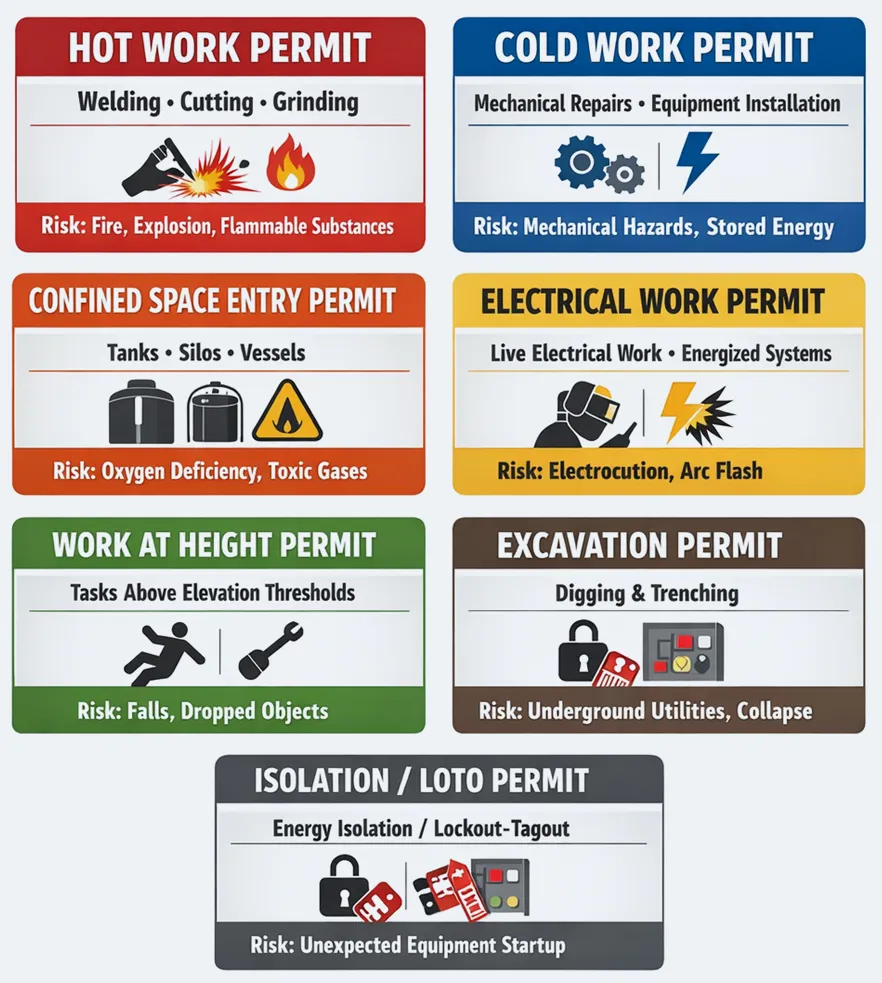
Different work activities require specialized permits. A mature organization deploys multiple PTW types aligned with risk categories. Every safety officer needs to understand the different types of permits required for different activities. And it is not the knowledge of these permits that is crucial, but the entire PTW process is important for safe work execution.

1. Hot Work Permit

For activities involving:

  • Welding
  • Cutting
  • Grinding

Risk: Fire, explosion, ignition of flammable substances

2. Cold Work Permit

For non-heat generating tasks such as:

  • Mechanical repairs
  • Equipment installation

Risk: Mechanical hazards, stored energy

3. Confined Space Entry Permit

For work inside:

  • Tanks
  • Silos
  • Vessels

Risk: Oxygen deficiency, toxic gases

4. Electrical Work Permit

For:

  • Live electrical work
  • Maintenance of energized systems

Risk: Electrocution, arc flash

5. Work at Height Permit

For tasks above defined elevation thresholds

Risk: Falls, dropped objects

6. Excavation Permit

For digging and trenching operations

Risk: Damage to underground utilities, collapse

7. Isolation / LOTO Permit

For energy isolation activities

Risk: Unexpected equipment startup
Types of Permit to Work Systems

The PTW Process

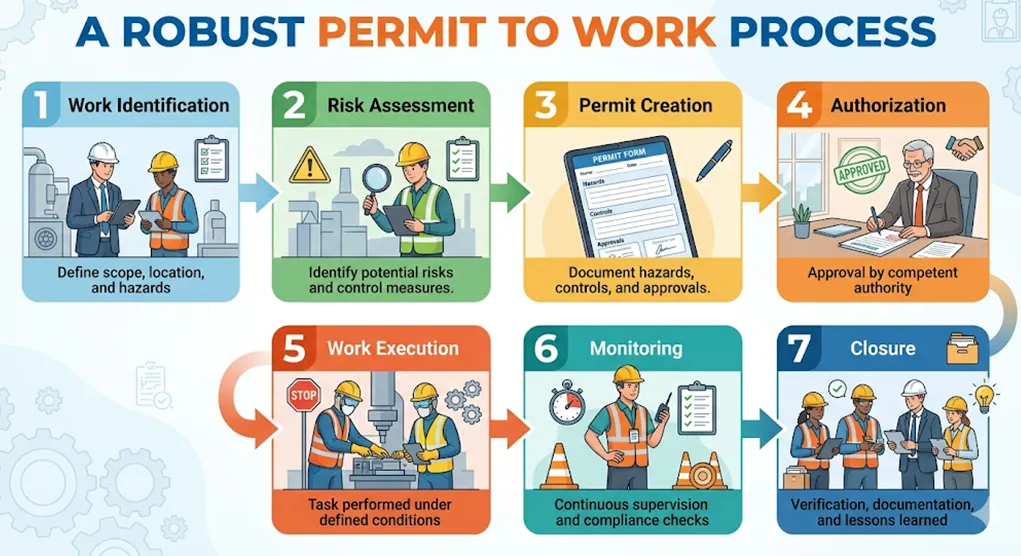
Permit to work process

A robust permit-to-work (PTW) process follows a clear sequence of steps to ensure that high-risk work is carried out safely and under control. It begins with job identification, where the job scope, exact location, and associated hazards are clearly defined. For example, if maintenance is required on a chemical pipeline in a confined space, this step would specify the pipeline section, the confined-space entry point, and potential hazards, such as toxic vapors or flammable substances.

Next is risk assessment, which might include assessing the risks of gas leaks, oxygen deficiency, or fire, and deciding on controls such as gas testing, ventilation, and explosion-proof equipment.

Once risks and controls are understood, permits are created. This involves documenting the identified hazards, the required control measures, and the necessary approvals on a formal permit. For instance, a Hot Work Permit for welding on a storage tank would list controls like fire watch, fire extinguishers, removal of flammable materials, and gas-free certification.

After the permit is prepared, authorization is required from a competent authority—usually a supervisor or safety officer—who reviews the information and formally approves the work. For example, before electrical maintenance on a live panel, the electrical supervisor may need to verify that lockout/tagout has been applied and then sign off on the Electrical Work Permit.

With authorization granted, work execution can begin, but only under the defined conditions and controls stated on the permit. A typical example would be technicians performing maintenance on a pressurized system only after confirming isolation, depressurization, and lockout as per the permit. During this phase, monitoring is critical. There should be continuous supervision and compliance checks to ensure the controls remain effective and conditions have not changed. For instance, during confined space entry, a standby person may continuously monitor gas readings and communication with the workers inside. Finally, the process ends with closure, where the work area is inspected, all isolations and lockouts are properly removed, housekeeping is verified, and the permit is formally closed.

As part of closure, lessons learned are documented—for example, discovering that an additional gas detector or clearer labeling of isolation points would improve safety for similar jobs in the future. This end-to-end process ensures that the PTW system is not just a formality but a practical tool for preventing incidents and managing risk.

The Rise of Digital Permit to Work Software

Modern permit-to-work software transforms PTW from a static process into a dynamic safety control system.

Traditional PTW systems rely heavily on paper-based workflows. While familiar, they introduce critical inefficiencies, like
  • Lack of real-time visibility
  • Delayed approvals
  • Manual errors and duplication
  • Poor audit traceability
  • Limited integration with safety systems

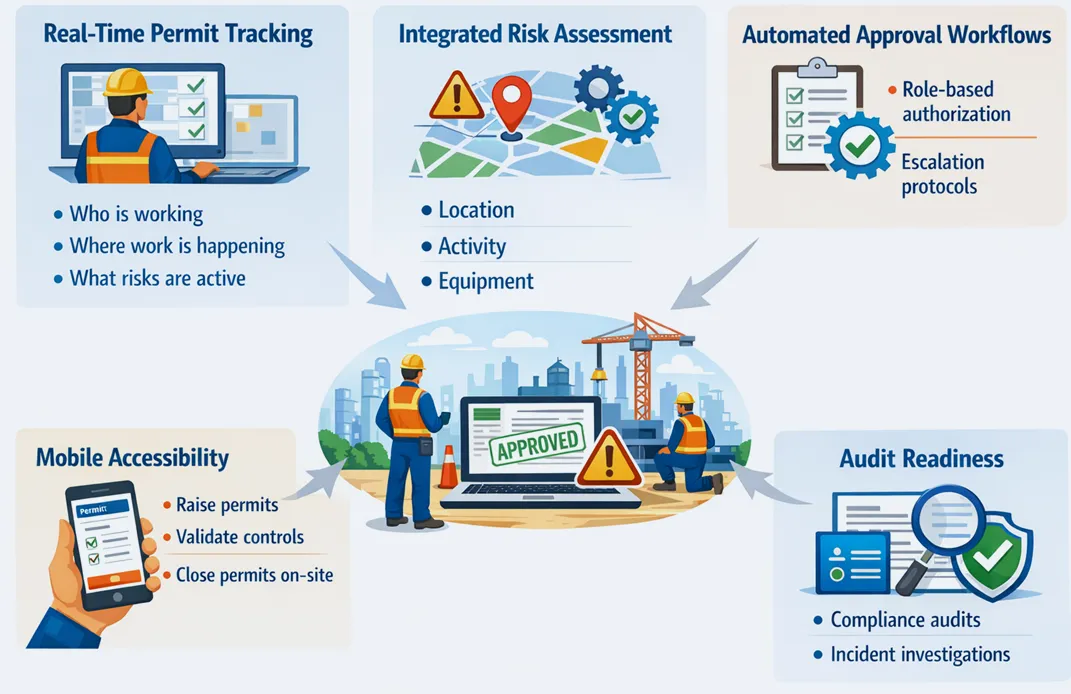
1. Real-Time Permit Tracking

Know:

  • Who is working
  • Where work is happening
  • What risks are active

2. Integrated Risk Assessment

Dynamic hazard identification linked to:

  • Location
  • Activity
  • Equipment

3. Automated Approval Workflows

Eliminate delays and ensure:

  • Role-based authorization
  • Escalation protocols

4. Mobile Accessibility

Field teams can:

  • Raise permits
  • Validate controls
  • Close permits on-site

5. Audit Readiness

Complete digital trail for:

  • Compliance audits
  • Incident investigations
Digital PTW system

Modern permit-to-work software transforms PTW from a static process into a dynamic safety control system.

Traditional PTW systems rely heavily on paper-based workflows. While familiar, they introduce critical inefficiencies, like

Strategic Shift: PTW as a Risk Intelligence System

Forward-looking organizations are reimagining PTW systems as risk intelligence platforms.

Instead of asking:

  • “Was a permit issued?”

They are asking:

  • “What patterns are emerging across permits?”
  • “Where are recurring risks?”
  • “Which controls are failing?”

This shift aligns PTW with:

  • Operational excellence
  • ESG reporting frameworks
  • Enterprise risk management

PTW and ESG: The Missing Link

Environmental, Social, and Governance (ESG) frameworks increasingly demand measurable safety performance.

A mature permit-to-work system contributes directly to ESG metrics. Some examples include

Environmental:

  • Controlled handling of hazardous materials

Social:

  • Worker safety and well-being

Governance:

  • Documented compliance and accountability

Organizations integrating PTW data into ESG reporting gain:

  • Better transparency
  • Stronger stakeholder trust
  • Improved investor confidence

An example:

In a large pharmaceutical plant, the environment is always live: multiple contractors work in parallel on utilities, HVAC systems, and sterile areas, while critical services such as clean steam, purified water, and HVAC for cleanrooms must run continuously to protect product quality and patient safety.

At the same time, regulatory expectations are extremely stringent—every action, from a minor valve replacement to a major shutdown, must be documented, justified, and traceable for audits by agencies like the FDA or EMA. In this context, a digital permit-to-work system becomes a quiet yet powerful backbone of operations.

Imagine a planned shutdown of a sterile filling line: production, maintenance, and quality teams all log into the same platform.

  • Maintenance raises permits for hot work on a utility line
  • Electrical isolation for a filling machine
  • Confined space entry for a CIP tank.

Production can immediately see which areas will be affected and adjust batch planning, while Quality checks that contamination risks and cleaning validations are built into the permit controls.

As work progresses, supervisors track in real time which contractors are working where, which utilities are temporarily isolated, and when each permit is ready for closure. Instead of phone calls and paper folders, coordination happens seamlessly through the system—downtime is reduced because approvals are quicker and conflicts are identified early.

Later, when a regulatory inspection asks, “How did you manage safety and continuity during this shutdown?”, the plant can pull a complete digital trail of permits, approvals, risk assessments, and timestamps. This strong audit trail not only satisfies compliance requirements but also demonstrates that safety and operational control are embedded into the way the plant works every day, not treated as a box-ticking exercise.

Read similar client examples here:

https://techehs.com/case-study/how-princeton-dg-improved-data-center-safety-with-digital-permit-to-work-and-ehs-enablement

https://techehs.com/case-study/building-a-dynamic-ptw-system-for-imdaad-group

Digital Transformation in PTW: What Leaders Should Focus On

For CXOs, EHS Heads, and Plant Leaders, the transformation roadmap is clear:

  • Standardization Across Sites
  • Integration with EHS Systems
  • Data-Driven Decision Making
  • Contractor Safety Integration

  • Mobility & Field Enablement

The Role of Integrated EHS Platforms

Organizations are moving toward unified platforms where PTW is no longer a standalone system but part of a larger ecosystem.

This includes:

  • Near miss reporting
  • Risk assessments
  • Compliance tracking

Such integration enables:

  • Holistic risk visibility
  • Faster decision-making
  • Stronger compliance posture

Conclusion

The most successful PTW systems are not the most sophisticated—they are the most embedded. When a permit-to-work process is truly operationalized, it is understood by workers, enforced by supervisors, and supported by leadership.

Digital tools can accelerate this journey by providing visibility, traceability, and integration, but they are only enablers. The real strength of a PTW system lies in how deeply it is woven into daily decisions and behaviors on the shop floor.

Ultimately, a mature PTW is not just about preventing incidents or passing audits; it reflects a culture where risk is actively managed, accountability is shared, and safety is treated as a core value of the organization—not a checkbox. In this way, PTW evolves from a compliance formality into a quiet yet powerful backbone of safe, reliable operations.

FAQs

A permit-to-work system is a formal process to control hazardous work by ensuring risks are identified, mitigated, and authorized before execution.

It prevents incidents by enforcing structured risk control, especially in industries like oil & gas, pharmaceuticals, and construction.

Common types include:

● Hot work permit

● Confined space permit

● Electrical permit

● Work at height permit

● Excavation permit

PTW is a broader system for managing hazardous work, while LOTO (Lockout Tagout) specifically focuses on energy isolation.

Digital PTW systems provide:

● Real-time visibility

● Automated workflows

● Better compliance tracking

● Data-driven insights

Yes. PTW systems enhance safety, governance, and compliance—key components of ESG performance.

EHS Software

Our web-based and mobile-ready HSE software solutions are a comprehensive platform for small, mid-size, and large enterprises to streamline EHS processes and standardize information management.

Solve your EHS challenges and streamline safety operations with our help.

9.3 min read Views: 8 Categories: Safety Software

Leave A Comment